
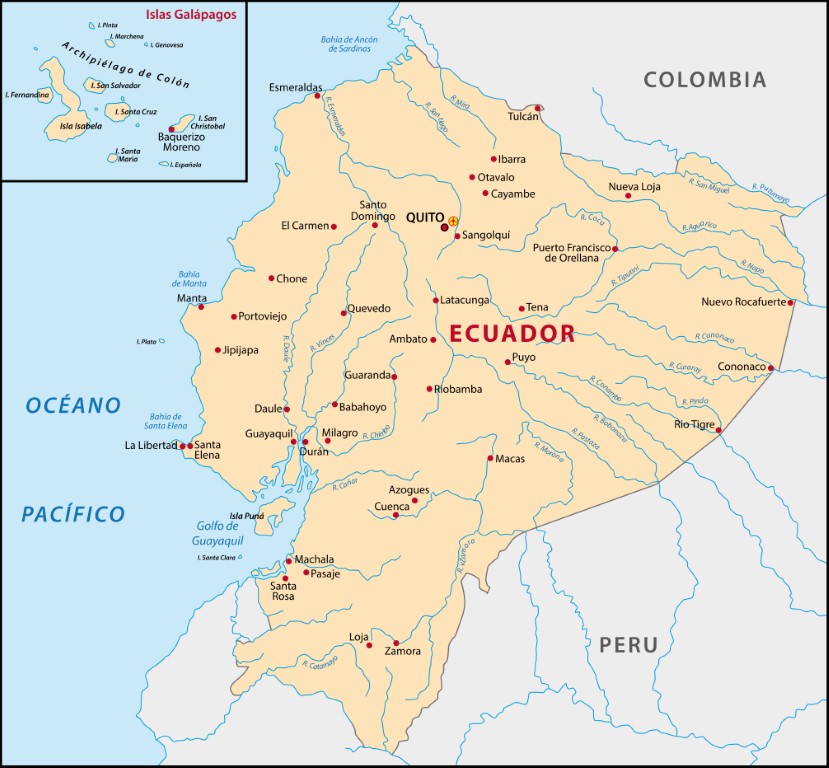
What you need to know about Ecuador ?
The Republic of Ecuador is a Latin American country with a territory covering 283,561 km². It is divided into three major geographical regions: the Pacific coast, the Andean region, and the Amazonian Ecuador. In addition, there is a fourth insular portion: the Galápagos Islands, located about 1,000 km off the coast in the Pacific Ocean.
The capital of the country is Quito, while its largest city and main economic center is Guayaquil.
In 2025, the Ecuadorian population is estimated at about 18 million inhabitants.
The international telephone code for Ecuador is +593.
Additional points on the map of Ecuador
- Ecuador is located on the Pacific coast of South America, between Colombia and Peru.
- Its physical map shows three major regions: the coast, the Andean Sierra, and the Amazon.
- The Galápagos archipelago, located nearly 1,000 km from the continent, is also part of the country.
- Quito, the capital, is perched at 2,850 m in the Andes, while Guayaquil is the main port city.
- The country is known for its exceptional biodiversity and contrasting landscapes.
Where is Ecuador located on the world map?
On the world map, Ecuador is located in America. As its name indicates, it is a country crossed by the equator situated in the northwestern section of Latin America. Ecuador borders the Pacific Ocean to the west. Its closest neighbors are: Colombia, Peru to the east and south. There are also the Galápagos Islands or Coln archipelago to the west in the Pacific Ocean, which are now part of Ecuador.

Table – Ecuador: Geographic and demographic information
| Element | Key Information |
|---|---|
| Total Area | 283,561 km² |
| Capital | Quito |
| Largest City | Guayaquil |
| Neighboring Countries | Colombia, Peru |
| Coastline | ~2,237 km on the Pacific Ocean |
| Estimated Population | ~18.3 million inhabitants (2025) |
| Population Density | ~65 inhabitants/km² |
| Relief | Andes mountain range, coastal plains, Amazon rainforest |
| Climate | Tropical on the coast and Amazon, temperate at altitude |
| Official Language | Spanish (recognized indigenous languages, including Quechua) |
| Economic Resources | Oil, bananas, cocoa, shrimp, tourism |
| Special Feature | Country crossed by the equator line, including the Galápagos archipelago |
Population in Ecuador
The current population of Ecuador is estimated at 18.3 million inhabitants in 2025. The demographic growth rate is 1.2% per year. The fertility rate is 2.1 children per woman. The birth and death rates are respectively 17.6 ‰ and 5.1 ‰.
Life expectancy at birth is 77.1 years, including 74.2 years for men and 80.3 years for women. The median age of the Ecuadorian population is 28.1 years, indicating a relatively young population. The sex ratio is balanced with about 99 men for every 100 women.
What are the colors of the country?

The Ecuadorian flag is a rectangular flag composed of 3 horizontal bands of color: yellow, blue, and red. In the center of the flag is the symbol of the national coat of arms. The yellow band is the size of the combined red and blue bands.
Several meanings can be derived from the Ecuadorian flag: the colors represent the fields and soil of the nation. They also represent the ocean and the blue of the sky as well as the blood shed during the struggle for independence.
What are the best cities to visit in Ecuador?

Quito
The capital of Ecuador is a popular and very active city. It is often the starting point towards the Galápagos or the Andes. Listed as a UNESCO World Heritage Site, Quito captivates with its remarkably preserved colonial historic center, its colorful markets, its craft beers, and its shopping centers. The city also pulses to the rhythm of festivals such as the Fiestas de Quito and the Festival of Lights.
Guayaquil
The largest city in the country and the main commercial port in South America, Guayaquil is renowned for its fresh seafood and friendly public spaces. The historic district of Las Peñas offers a panoramic view from its colorful hills. Between restaurants, cafes, and galleries, the city is full of charm. Also worth seeing: the Guayaquil Historical Park, which traces the city’s history and its connection with cocoa.
Cuenca
Nicknamed the “retirees’ city” for its quality of life, Cuenca is another UNESCO site with remarkable colonial heritage. It is full of museums, churches with French and Hispanic influences, and charming alleys lined with rivers. Nearby, the El Cajas National Park attracts hiking and wilderness enthusiasts.
Baños de Agua Santa
A town nestled at the foot of the Tungurahua volcano, Baños is known for its thermal springs, impressive waterfalls, and extreme activities such as rafting, canyoning, and the giant swing of “La Casa del Árbol” offering a unique view of the Andes. It is a major hub for adventure tourism in Ecuador.
Montañita
A small coastal town in the province of Santa Elena, Montañita is a paradise for surfers and partygoers. With its endless beaches, lively bars, and surf schools, it attracts an international youth seeking adrenaline and conviviality.
Economy of Ecuador (2025)

General overview
- GDP (PPP): approximately 300 billion USD
- GDP per capita (PPP): approximately 16,600 USD
- Real GDP growth (forecast): +1.7%
- Inflation (June 2025): between 1.3% and 1.5%
- Estimated population (2025): approximately 18.1 million
Breakdown by sector and employment
- Official currency: US dollar (USD)
- Unemployment rate: around 4.2%
- Labor force: approximately 7 million
The Ecuadorian economy mainly relies on:
- Oil, a major source of exports (about 27% of total value)
- Bananas, for which Ecuador is the world’s leading exporter
- Shrimp, cocoa, coffee, wood, chemicals
- Remittances from Ecuadorians abroad, which strongly support the local economy
The country also invests in renewable energies (notably hydroelectric power) and encourages the development of tourism, agri-food, bioenergy, and manufacturing.
Trade
- Exports: ~ 25.5 billion USD
- Imports: ~ 26.2 billion USD
Administrative and demolinguistic data
Administrative subdivisions
The Ecuadorian territory is currently divided into 24 autonomous provinces, each governed by a governor and a council elected by direct universal suffrage.
Here are the 24 provinces
- Manabí
- Morona-Santiago
- Napo
- Orellana
- Pastaza
- Pichincha
- Santa Elena
- Santo Domingo de los Tsáchilas
- Sucumbíos
- Tungurahua
- Zamora-Chinchipe
- Azuay
- Bolívar
- Cañar
- Carchi
- Chimborazo
- Cotopaxi
- El Oro
- Esmeraldas
- Galápagos
- Guayas
- Imbabura
- Loja
- Los Ríos
Demographic data
Ecuador is a multiethnic country: there are mestizos descended from Amerindians and Spaniards who represent the majority in the country at 65%. Then there are the Amerindians (25%), Europeans and Creoles (of Spanish descent) (7%). Finally, the national minority are Afro-Ecuadorians (3%) made up of Zambos and Mulattos. There are indigenous peoples of the country who live in the Amazon rainforest and also represent 3% of the population, they are:
- Quechua
- Shuar
- Achuar
- Huaorani
- Siona
- Secoya
- Shiwiar
- Zápara
The official language used in Ecuador is Spanish, with more than 78% native speakers, but there are also two other languages considered semi-official by the country’s constitution: Quechua and Shuar. There are also other dialectal variations:
- Barbacoanes
- Cañar-puruhá
- Jivaro
- Quechuas
- Tucanana
- Zaparoanes
- Isolated
The other imported languages are: Indo-European and Sino-Tibetan
FAQ – Ecuador map
Ecuador is on the Pacific coast, between Colombia and Peru.
The capital is Quito, but the largest city is Guayaquil.
The country combines tropical coast, volcanic Andes, Amazon, and the Galápagos archipelago.
