
What you need to know about Colombia ?
The Republic of Colombia is a unitary state with a presidential system located in Latin America. Its territory covers an area of 1,141,748 km², inhabited by approximately 53,400,000 people in 2025. Colombia thus ranks 26th in the world by population and 25th by area.
Its capital and largest urban area is Bogotá, and the official language spoken by Colombians is Spanish. The national currency is the Colombian peso, and the country’s telephone code is +57 (0057).
Colombia is also one of the countries richest in cultural diversity, with a people descended from several civilizations: Amerindians, Europeans, Africans, and mixed populations.
Where is Colombia on the world map?
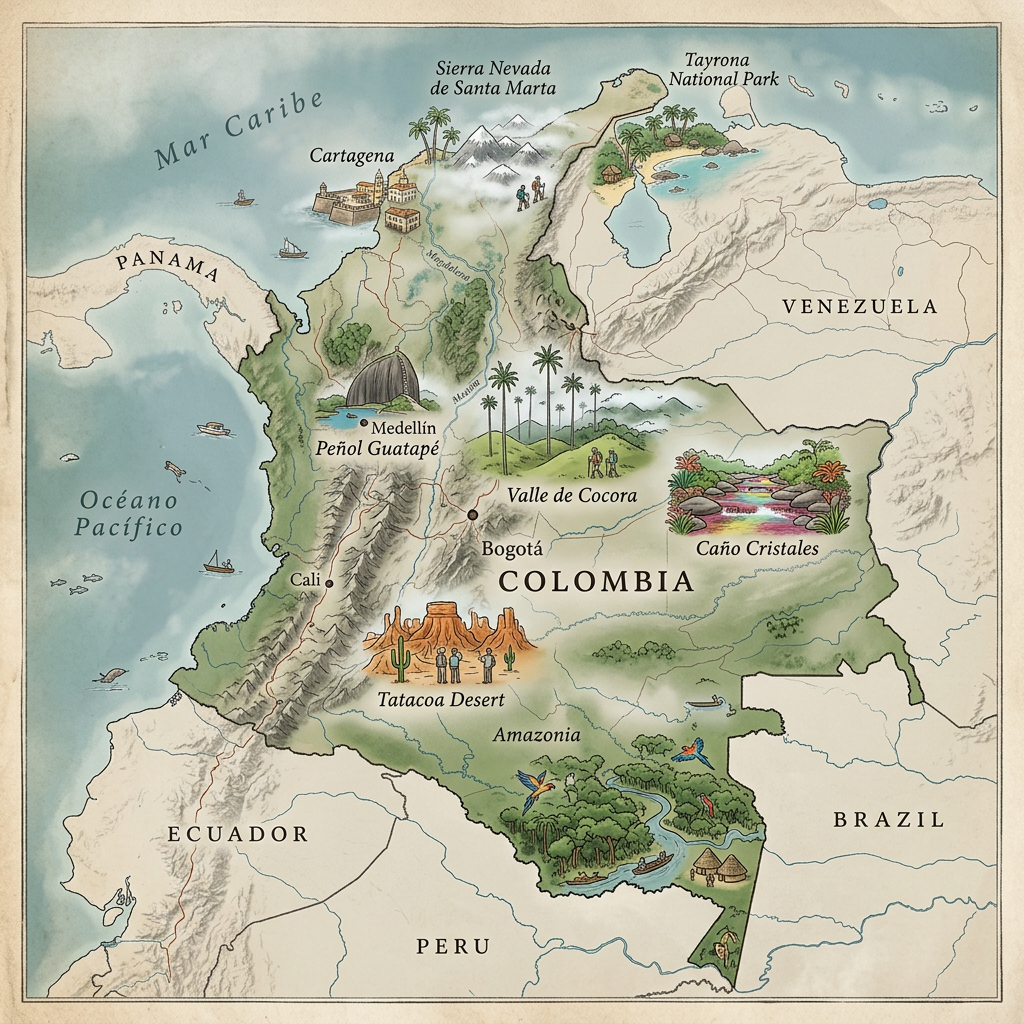
On the world map, Colombia is located on the American continent in the southern part but also has part of its territory in North America.
Its neighbors are Panama, Ecuador, Peru, Venezuela, and Brazil, which border Colombia respectively to the northwest, south, south, east, and southeast.
It benefits from a double coastline on the Pacific Ocean and the Caribbean Sea.

Table – Colombia: Geographic and demographic information
| Element | Key Information |
|---|---|
| Total Area | 1,141,748 km² |
| Capital | Bogota |
| Neighboring Countries | Venezuela, Brazil, Peru, Ecuador, Panama |
| Coastline | ~3,200 km (Pacific Ocean and Caribbean Sea) |
| Estimated Population | ~53 million inhabitants (2025) |
| Population Density | ~46 inhabitants/km² |
| Relief | Andes mountain range, Amazon plains, coastlines |
| Climate | Humid tropical, temperate at altitude |
| Official Language | Spanish |
| Economic Resources | Coffee, oil, coal, gold, emeralds, agriculture |
| Special Feature | The only South American country with a double coastline (Pacific and Caribbean) |
Additional points on the map of Colombia
- Colombia is located in the northwest of South America, at the junction with Central America via Panama.
- Its physical map shows a very contrasted country: Andean mountains, Orinoco plains, Amazon basin, and tropical coasts.
- The country shares its borders with Venezuela, Brazil, Peru, Ecuador, and Panama.
- The capital, Bogota, is located on a high Andean plateau.
- Colombia is known for its biodiversity, coffee, and mineral resources (emeralds).
Colors of Colombia
The Colombian flag is a rectangular flag composed of 3 horizontal stripes in yellow, blue, and red from top to bottom. The yellow stripe is the size of the other two stripes combined. The interpretations of the colors vary.
Generally, yellow symbolizes the soil, gold, and the country’s wealth but can also be associated with the sun, agriculture, and justice. The blue color symbolizes the blue of the sky, rivers, and the sea. Red symbolizes the blood shed for the nation’s freedom.

Population of Colombia
The Colombian population is estimated at 53,400,000 inhabitants in 2025, with an annual demographic growth rate of 1.0%. The population density is about 48 inhabitants per km² for a total area of 1,141,748 km².
The median age is 32.5 years, indicating a relatively young population. Birth and death rates are respectively 17.5 ‰ and 5.9 ‰.
The life expectancy of a Colombian at birth is about 78.3 years, with 76 years for men and 82 years for women. The sex ratio is about 97 men per 100 women.

The fertility rate of the population is 1.80 births per woman and the total population sex ratio is 1.03 men/1 woman.
What are the best cities to visit in Colombia?

Cartagena
Cartagena is a city full of colors and rich in history. The old town is magnificent and features several stone ramparts protecting old colonial buildings and narrow streets.
You will constantly see horse-drawn carriages; there are also shopping centers as well as various restaurants and bars.
It is the most sophisticated city in the country: both modern and rustic. If you want to relax, no worries, the beaches here are divine.
Bogota
Bogota is the capital of the country, located on the plateau at the foot of the Andes. The main attraction in the city is the historic center of La Candelaria, which is full of colonial buildings, old churches or convents, as well as narrow alleys.
There are also several large museums, countless restaurants and bars, as well as the magnificent Cerro de Monserrate overlooking everything. Enjoy sunsets in the city, then head to nightclubs to enjoy your evening.
Medellin
Medellin is a pleasant city to visit, where you will see several museums, various restaurants, bars, and nightclubs. There are also amusement parks scattered throughout the city. Medellin is the cradle of the country’s cultural and artistic scene and is also the second largest city in Colombia.
It is also marked by imposing skyscrapers framed by hills and mountains.
Colombia climate Map
The Colombian climate is considered to be tropical with variations for each natural region (numbering 6). The climate is also influenced by topography, temperature, humidity, wind, and precipitation.
The Colombian climate zones are categorized as: tropical forests, savannas, steppes, deserts, and mountains. The mountainous climate is typical of the Andes or other high-altitude regions. This type of climate is characterized by temperatures fluctuating above 24°C.
The rest of the country, about 82.5% of the territory, is considered a hot zone. These areas show average temperatures between 17 and 24°C during the hot season and between 12 and 17°C during the cold season.
There are also alpine and forest zones at high altitude (4000m) that display very cold temperatures with a freezing winter: ice and snow occur even in summer.
Colombia economic map

Colombia’s economy (2025)
The Republic of Colombia has one of the most robust economies in South America — the fourth by nominal GDP — and ranks among the best in terms of purchasing power parity.
Key economic indicators
- Official currency: Colombian peso (COP)
- GDP (nominal): approximately 427.8 billion USD
- GDP (PPP): approximately 1,190 billion USD
- GDP per capita (nominal): 8,050 USD (92nd worldwide)
- GDP per capita (PPP): 22,420 USD (85th worldwide)
- Projected economic growth: +2.5% in 2025, with an expected increase in investments
- Estimated inflation: 4.5%
- Unemployment rate: around 10%
- Poverty rate: approximately 31%
- HDI (2023): 0.788, placing it in the high category
Economic structure
- Main contributing sectors: services (62%), industry (31%), and agriculture (7%)
- Major export products: oil, coal, coffee, gold, bananas, flowers, emeralds
- Key trading partners: United States (~26%), China (~25%), European Union (~12%)
- Main imports: machinery, pharmaceuticals, industrial equipment
- Rapidly developing sectors: information technology, electronics, shipbuilding, fashion, audiovisual
Economic context & outlook
- Private consumption now accounts for more than 76% of GDP, which drives growth but limits economic resilience.
- Fixed investment, notably in housing and infrastructure, remains low — around 17% of GDP — delaying sustainable growth.
- Moderate current account deficit, mainly financed by foreign direct investment.
- Economic objectives: strengthen private investment, improve productivity, reduce regional inequalities, and support a transition towards a more sustainable and diversified economy.
Administrative and demo-linguistic data

Administrative subdivisions
The Colombian territory is divided into 32 departments which in turn are made up of groups of municipalities (1,122). The municipalities are then divided into towns.
Here are the 32 departments:
- Chocó
- Córdoba
- Cundinamarca
- Guainía
- Nariño
- Norte de Santander
- Putumayo
- Quindío
- Risaralda
- San Andrés y Providencia
- Santander
- Guaviare
- Amazonas
- Antioquia
- Arauca
- Atlántico
- Bolívar
- Boyacá
- Tolima
- Valle del Cauca
- Vaupés
- Vichada
- Caldas
- Caquetá
- Casanare
- Cauca
- Cesar
- Huila
- La Guajira
- Magdalena
- Meta
- Sucre
Demo-linguistic data
The official language and the one with the most speakers in Colombia (99.2%) is Spanish: specifically Castilian. The Colombian people also speak 65 Indigenous American languages, 2 creole languages, and Romani. English, on the other hand, has official language status in the archipelagos of: San Andrés, Providencia, and Santa Catalina.
According to ethnologists, there are also 101 languages counted for Colombia. Currently, those with non-zero speakers are:
- Chibchan
- Tucanoan
- Bora–Witoto
- Guajiboan
- Arawakan
- Cariban
- Barbacoan
- Saliban
The ethnic groups in Colombia are diverse but the natives come from:
- Spanish Colonists
- Africans (slave trade)
- European Immigrants
- North American Immigrants.
Whites and mestizos (mix of Europeans and Indigenous Americans) represent 87.58%, Africans represent 6.68%, Indigenous Americans represent 4.31%, Raizal represent 0.06%.
FAQ – Colombia map
Colombia is in the northwest of the continent, between Venezuela, Brazil, Peru, Ecuador, and Panama.
The capital is Bogota, perched in the Andes mountain range.
An Andean country with a double coastline, vast Amazonian plains, and exceptional biodiversity.
