
What you need to know about Peru ?
Peru is a unitary presidential republic, the third largest country in South America and the 19th largest country in the world with an area of 1,285,216 km², a territory that includes the Andean highlands, the Amazon rainforest, and a Pacific coastal frontage.
Its population today is approximately 34.9 million inhabitants, ranking it 48th worldwide. The population density remains very low, at only 27 inhabitants/km², reflecting a vast territory and challenging geography where large portions of the country, notably the Amazon rainforest, are very sparsely populated. Conversely, the population is highly urbanized: more than 80% of Peruvians live in cities, with Lima alone concentrating nearly a third of the national population. The median age is 30.6 years, making Peru a relatively young population compared to European standards.
Its capital and largest city is Lima, and the official language spoken and written in the country is Spanish. However, there are other co-official languages which are: Quechua, Aymara, and indigenous or Amazonian languages. The dominant religion in Peru is Christianity, and the country’s telephone code is 51.
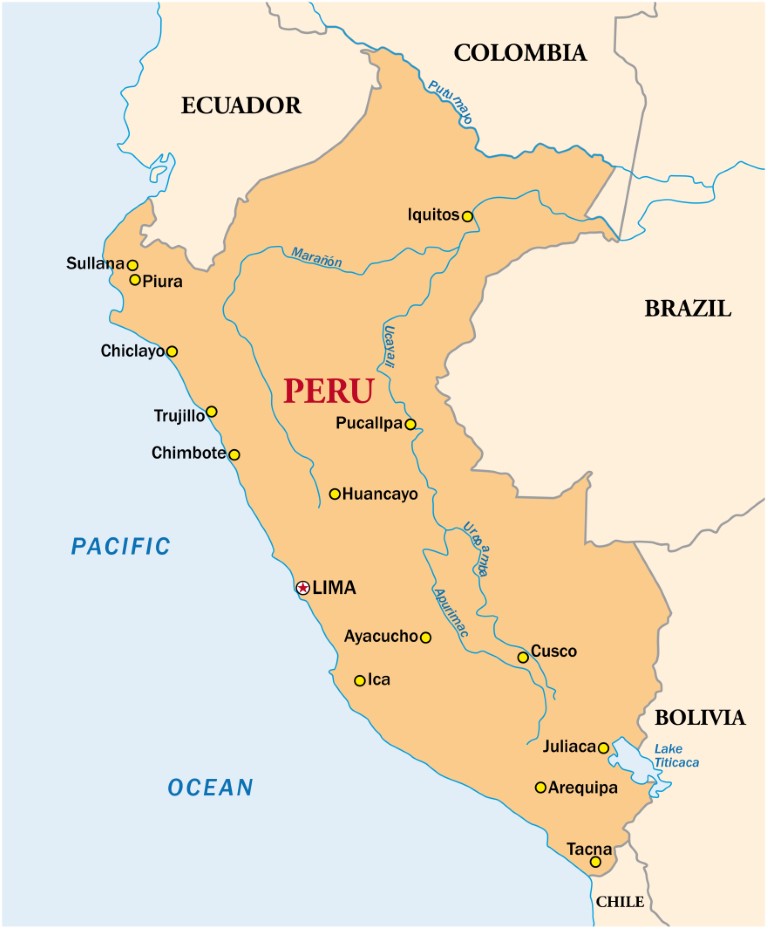
Where is Peru on the map?
On the world map, Peru is located on the American continent. Specifically, it is in the western part of South America. Its neighbors are Ecuador, Colombia, Brazil, Bolivia, and Chile. It borders the Pacific Ocean to the west and south.

Colors of Peru
The flag of Peru is a tri-band flag with two outer red bands and a central white band. In the center of the white band are the national coat of arms. The red colors symbolize the blood shed for independence, the white color represents purity and peace. The national coat of arms represents freedom, prosperity, and heroism.

What are the best cities in Peru?
Cuzco
It is the former capital of the Inca Empire. Cusco is fascinating to explore; you will see several crumbling colonial cathedrals vying for supremacy with Inca temples and recent fast-food outlets surrounding its old cobblestone streets.
Cuzco is also the archaeological capital of the continent, it is magnificent and rich in historical sites and cultural heritage. The surrounding region abounds with surprising sites just waiting to be explored. Cuzco is also the gateway to Machu Picchu.
Lima
The capital of Peru is located on the west coast of South America, facing the Pacific Ocean. The country’s capital boasts a fascinating array of architectural styles combining modern towers and slums with Spanish colonial buildings.

You will also see pre-Columbian ruins, beautiful monasteries and churches as well as captivating museums and contemporary art galleries. Lima is also full of lively bars and restaurants at night. You will see the magnificent beaches of Miraflores bordering the steep cliffs overlooking the ocean.
Arequipa
Arequipa is located at the foot of the El Misti volcano, the city offers a mountainous setting, making it magnificent. You will also see a multitude of colonial architectures in the city’s alleys.
Among them are churches, mansions, and several colonial centers. Other attractions in the country include: the Santa Catalina convent and various restaurants.
Population of Peru
Demographics
The Peruvian population today stands at about 34.9 million inhabitants, with an annual growth rate of 1.05%, one of the most dynamic in South America. The population is young, with a median age of 30.6 years, and is expected to continue growing to reach its peak around 2066.
- Fertility rate: 2.1 births per woman, at the exact replacement level
- Birth rate: 15.9 ‰
- Mortality rate: 5.5 ‰
- Life expectancy: about 74 years on average
- Male/female ratio: nearly balanced, 99 men for every 100 women
Peru is one of the most fascinating countries in South America, and for good reason: it alone concentrates a diversity of landscapes, cultures, and histories that would make many entire continents blush.
From its snow-capped Andean peaks, with Huascarán towering over 6,700 meters, to the depths of the Amazon rainforest covering more than 60% of the territory, passing through a desert coast bathed by the Pacific, each region of Peru is a world unto itself.
The Machu Picchu, an Inca city perched at 2,430 meters altitude, remains one of the most enchanting archaeological wonders on the planet. But Peru is not limited to this jewel: the Sacred Valley, the Nazca Lines, Lake Titicaca shared with Bolivia, and the ruins of Chan Chan offer as many dives into millennial civilizations.
Lima, the capital, embodies this unique blend of tradition and modernity. A sprawling city of over 10 million inhabitants, it houses pre-Columbian neighborhoods alongside ultra-modern financial centers and a gastronomic scene that has propelled Peruvian cuisine among the best in the world, with chefs like Gastón Acurio as ambassadors.
Exploring Peru means accepting to be surprised at every turn: a colorful market in the Andes, a traditional festival with dances and shimmering costumes, a ceviche meal facing the ocean. This country is a symphony of stories, landscapes, and flavors waiting to be discovered.
Economic information on Peru
The Peruvian economy is the 48th most performing in the world in terms of nominal GDP. The country is among those with the highest GDP growth rates in the world. According to the World Bank, this economy is classified as an upper-middle-income economy. Peru’s main trading partners are the USA, China, Brazil, and Chile. Here are some economic data:
- Official currency: Peruvian sol
- Nominal GDP: 228.989 billion USD
- Purchasing power parity GDP: 478.303 billion USD
- Annual GDP growth rate
- Nominal: 2.2%
- Purchasing power parity: 7.0%
- GDP per capita: 7,047 USD Nominal, 14,719 USD PPP
- HDI: 0.777
- Unemployment rate: 6.9%
- Population below poverty line: 22.1%
- Imports: 43.13 billion USD
- Exports: 44.92 billion USD
- GDP by sector
- Services sector: 53%
- Manufacturing: 22.3%
- Mining extraction: 15%
- Taxes: 9.7%
Climate information about Peru
The overall situation under the tropics, a high-altitude topography, and variations in ocean currents (Humboldt and El Nino) influence Peru’s tropical climate.

Peru exhibits very diverse climates. Coastal areas have moderate temperatures, low rainfall, and a high degree of humidity. In contrast, they are warmer and more humid compared to other northern zones.
In mountainous areas, rains are frequent in summer and temperatures and humidity decrease with altitude, such as on the peaks of the Andes. The Peruvian Amazon shows moderate rainfall and high temperatures except for its southern section which experiences cold winters and occasional rains.
Administrative subdivisions of Peru
The Peruvian territory is divided into 26 units or regions, including 25 regions and the province of Lima. The regions are further divided into provinces which are themselves divided into districts.
Here are the 25 regions
- Pasco
- Piura
- Puno
- Huancavelica
- San Martín
- Tacna
- Tumbes
- Ucayali
- Huánuco
- Ica
- Junín
- La Libertad
- Lambayeque
- Lima
- Ancash
- Apurímac
- Amazonas
- Cuzco
- Moquegua
- Arequipa
- Ayacucho
- Cajamarca
- Callao
- Loreto
- Madre de Dios
Linguistic demo data of Peru
The official language of Peru is Spanish, it is considered a governmental, administrative, and educational language.
On the other hand, the Amerindians living in the highlands of the Andes speak Quechua and Aymara and are distinct ethnic groups compared to other indigenous groups living in the eastern sections of the Andes and in the Amazon basin. Here is the linguistic subdivision of Peru:
- Spanish 82.6%
- Quechua 13.9%
- Aymara 1.7%
- Amazonian languages 0.9%
- Undefined 0.2%
Peru is a multiethnic nation and the ethnic compositions of Peru are as follows:
- Mestizos (60.2%)
- Quechua (22.3%)
- Whites (5.9%)
- Afro-Peruvians (3.6%)
- Aymara (2.4%)
- Others (2.3%)
- Undefined (3.3%)
There are also Hispanics and Africans who are immigrants to the country.
Peru map FAQ
Peru is located on the western coast of South America. It shares borders with Ecuador, Colombia, Brazil, Bolivia, and Chile, and is bordered by the Pacific Ocean.
A map of Peru helps locate the country’s major cities, administrative regions, the Andes mountain range, and the Amazon Basin. It also highlights the diversity of its landscapes, including the coast, mountains, and tropical rainforest.
A map is useful for understanding Peru’s geography and territorial organization. It also helps when planning a trip or studying the country’s geographical and demographic characteristics.
