
What you need to know about Brazil ?
The Federative Republic of Brazil is a country in South America occupying nearly half of the southern hemisphere of the continent. With an area of 8,515,767 km², it is the 5th largest country in the world.
Its population is estimated at about 214 million inhabitants (2025), making it the 6th most populous country on the planet. The capital is Brasília, while the largest city and economic heart of the country is São Paulo. The official language is Portuguese, which distinguishes Brazil from its Spanish-speaking neighbors.
The country is marked by great ethnic and cultural diversity, stemming from its Indigenous, African, and European heritages.
Brazil is a member of several major international organizations, including the UN, the G20, the BRICS, and the Mercosur.
The country’s telephone code is 55 (0055 or +55).
Where is Brazil on the world map?
On the world map, Brazil is located on the American continent. Indeed, it is located in South America and borders the Atlantic Ocean to the east with 7,000 km of coastline. 10 countries share borders with Brazil:
The map of Brazil shows the largest country in South America, bordered by Argentina, Paraguay, Bolivia, Peru, Colombia, Venezuela, Guyana, Suriname, and French Guiana. With its vast Atlantic coastline and Amazon basin, it holds a strategic position in Latin America.

Table – Brazil: Geographical and Demographic Information

| Item | Key Information |
|---|---|
| Total Area | 8,515,770 km² (5th largest country in the world) |
| Capital | Brasília |
| Largest City | São Paulo |
| Neighboring Countries | Uruguay, Argentina, Paraguay, Bolivia, Peru, Colombia, Venezuela, Guyana, Suriname, French Guiana |
| Coastline | ~7,491 km on the Atlantic Ocean |
| Estimated Population | ~214 million inhabitants (2025) |
| Population Density | ~25 inhabitants/km² |
| Relief | Amazon basin, high plateaus, coastal mountains |
| Climate | Tropical, equatorial in the north, temperate in the south |
| Official Language | Portuguese |
| Economic Resources | Coffee, soybeans, sugarcane, oil, minerals, industry, tourism |
| Special Feature | Largest country in Latin America, occupying nearly half of the South American continent |
Additional points on the map of Brazil
- Brazil is the only country in South America that speaks Portuguese, a legacy of colonization.
- Its physical map highlights the Amazon, the largest tropical rainforest in the world, and the Amazon River basin.
- The country is bordered by almost all South American countries, except Chile and Ecuador.
- The capital is Brasília, but São Paulo and Rio de Janeiro are the main metropolises.
- Its Atlantic coastline is famous for its beaches, including those of Copacabana and Ipanema.
Colors of Brazil
The Brazilian flag is a rectangular flag of green color. In its center, there is a yellow diamond with a blue sphere inside. The blue sphere symbolizes a starry sky crossed by a white band with the motto “ordem e progresso” meaning order and progress.
The yellow color symbolizes the country’s wealth and its gold reserves, the green color represents the natural colors (fauna and flora) including the Amazon rainforest. Another meaning is that the green color represents the House of Braganza and the yellow color the House of Habsburg.

What are the best cities to visit in Brazil?


Sao Paulo
The capital Sao Paulo is a huge city in Brazil but this size explains the number of places to visit here. You will see several high-end restaurants and experience a rather lively nightlife cheerfully.
There are also several cultural sites, counting only the museums (numbering 70). Sao Paulo also offers several natural sites including mountains and tropical forest that provide tourists with opportunities for camping or hiking.
The city of Sao Paulo is a cosmopolitan city with a very diverse cultural scene.
Florianopolis
Florianopolis is the capital of Santa Catarina, it is divided into two because one part is located on an island and the other on the American continent. It is there that the most beautiful beaches of Brazil are found. Popular with tourists, the city of Florianopolis has a relaxed atmosphere and several attractions.
Currently, it is the territory of recent development projects but it has still preserved some parts of its cultural heritage such as the old market and the cathedral which are both remarkable. There are 42 beaches in this city with a range of activities including water sports, paragliding, and hiking.
Salvador
The city of Salvador has a magnificent old town featuring several remnants from the colonial era dating from the 17th and 18th centuries. It is a city rich in Afro-Brazilian culture and also the birthplace of several artistic scenes especially during the carnival.
Salvador offers several beautiful tourist spots such as the Bay of All Saints, the cobbled streets of the city that will lead you to breathtaking museums. It is a unique place in the world that allows understanding of Brazilian society.
Rio de Janeiro
Rio de Janeiro is ranked as one of the most beautiful cities in the world. Here, there is Copacabana beach which runs along Guanabara Bay. There is also the sunny Ipanema beach ideal for sunbathing. You can also enjoy mountain hikes by taking trails that cross tropical forests.
The city is very lively and offers a diverse artistic and cultural scene especially during the famous Rio carnival when the city becomes a world capital of festivities. Here, there are also several monuments to visit, notably the Maracanã stadium where football matches are constantly held.
Population of Brazil

The population of Brazil is estimated at 214,326,223 inhabitants in 2025, with an annual demographic growth rate of 0.6%. The fertility rate is 1.7 births per woman, confirming the country’s demographic transition.
Birth and death rates are respectively 13.4 ‰ and 6.3 ‰.
The average life expectancy is 76.6 years, including 73.1 years for men and 80.1 years for women.
The median age of the population is 34.2 years, reflecting a still relatively young but progressively aging population.
The sex ratio is 97 men for every 100 women.


Climate map of Brazil
Brazil has an area of more than 8.5 million km², which explains a great climatic diversity depending on the regions. About 60% of the territory is located under the tropics, giving the country an overall tropical climate, with temperatures rarely below 20°C.
In the interior, the climate alternates between hot and dry, while forested areas, notably the Amazon, experience a humid equatorial climate with heavy rainfall.
São Paulo
Located in the southeast of the country, São Paulo benefits from a humid subtropical climate marked by four seasons that are not very distinct.
- The hottest month is January, with temperatures close to 25°C and heavy rains.
- The coldest month is June, with an average of about 19°C.
Rio de Janeiro
Only 440 km east of São Paulo, Rio de Janeiro experiences a tropical climate marked by very hot summers.
- Summer temperatures can reach 40°C, accompanied by abundant rainfall.
- In winter, the climate remains pleasant with averages of 21°C, making it an ideal time to visit.
Curitiba
Capital of the State of Paraná, Curitiba is located 478 km south of São Paulo. The city enjoys a highland subtropical climate, cooler than in the rest of the country.
The annual average is 15°C, with February as the hottest month (22°C).
In summer (December to February), temperatures are mild with episodes of coolness.
In winter (June to August), temperatures frequently drop below 10°C.
Brazil economic map


Brazil has a developed mixed economy and is among the world powers. It is ranked as the 12th largest economy in nominal GDP and the 8th in purchasing power parity (PPP). The country has significant natural resources (gold, uranium, iron) and diversified industries, making it a major player in Latin America.
The International Monetary Fund (IMF) estimates that Brazil continues to strengthen its position thanks to its agricultural, mining, and industrial exports, even though social inequalities persist.
Brazil economic data:
- Official currency: Brazilian Real (BRL)
- Nominal GDP: 1.363 trillion USD
- GDP in purchasing power parity (PPP): 3.078 trillion USD
- Annual GDP growth rate: 1.1% (nominal); 3.6% (PPP)
- GDP per capita (nominal): 6,450 USD
- GDP per capita (PPP): 14,563 USD
- Inflation rate: 3.6%
- HDI: 0.765 (high)
- Unemployment rate: 14.7% of the active population
- Main industries: textiles, clothing, chemicals, cement manufacturing, mining and processing, aerospace, automotive, machinery and equipment.
- Exports: 217.7 billion USD
- Imports: 150.7 billion USD
Administrative and demographic linguistic data


Administrative subdivisions
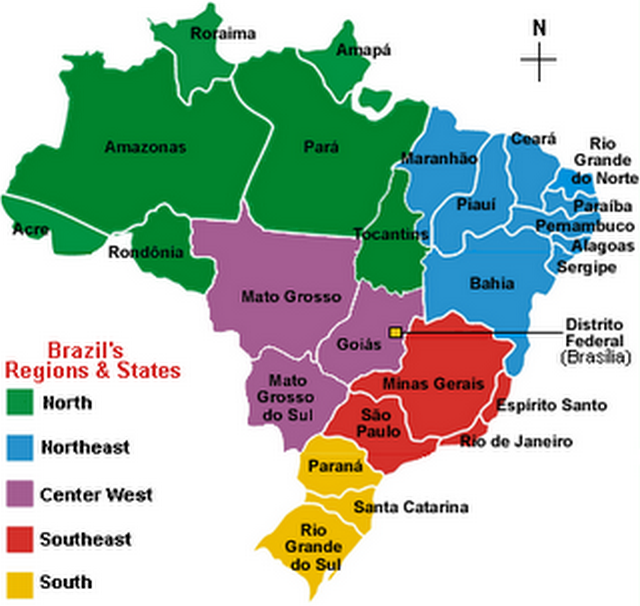
The Brazilian territory is subdivided into 5 geographic regions which are:
- The North region
- The Northeast region
- The Central-West region
- The Southeast region
- The South region
These regions are then subdivided into 25 federative units, namely 26 states and 1 federal district:
- Goiás
- Paraná
- Rio Grande do Norte
- Rio Grande do Sul
- Maranhão
- Mato Grosso
- Acre
- Alagoas
- Amapá
- Amazonas
- Bahia
- Pernambuco
- Piauí
- Rio de Janeiro
- Ceará
- Espírito Santo
- Mato Grosso do Sul
- Minas Gerais
- Pará
- Paraíba
- Rondônia
- Roraima
- Santa Catarina
- São Paulo
- Sergipe
- Tocantins
- Federal District
Demo Linguistic Data


The Portuguese language is the official language of the country but more precisely, it is a variant of Portuguese called Brazilian Portuguese or Portuguese of Brazil according to natives. It is spoken by more than 100 million speakers in the country and even by the Brazilian diaspora. The Brazilian dialect is subdivided into northern and southern, here are the different dialects:
- Caipira
- North Coast
- Baiano
- Fluminense
- Gaúcho
- Mineiro
- Nordestino
- Northern
- Paulistano
- Sertanejo
- Southern
- Florianopolitan
- Carioca
- Brasiliense
- Amazon
- Recifense
The Brazilian population is divided into 3 ethnic groups which are whites at 40%, mixed-race at 50%, blacks at 8%, and minorities (including indigenous peoples) at 2%.
FAQ – Brazil map
Brazil is located in South America, on the Atlantic coast, occupying nearly half of the continent.
The capital is Brasília, but the best-known cities are São Paulo and Rio de Janeiro.
The country combines the Amazon, high plateaus, a vast Atlantic coastline, and a great climatic diversity.
