
What you need to know about Jamaica ?
Located in the Caribbean, Jamaica is a country whose form of government is a constitutional monarchy with a parliamentary and federal political system. Jamaica is part of the Antilles as a sovereign state. The total area of the country is 11,425 km2 and the capital and largest city is Kingston.
Table – Jamaica: Geographical and demographic information
| Element | Key Information |
|---|---|
| Total Area | 10,991 km² |
| Capital | Kingston |
| Neighboring Countries | None (Caribbean island) |
| Coastline | ~1,022 km on the Caribbean Sea |
| Estimated Population | ~2.9 million inhabitants (2025) |
| Population Density | ~260 inhabitants/km² |
| Relief | Mountains (Blue Mountains), coastal plains |
| Climate | Humid tropical, influenced by trade winds and hurricane season |
| Official Language | English (Jamaican Creole widely spoken) |
| Economic Resources | Tourism, bauxite, sugar, rum, music and culture |
| Special Feature | Island of the Greater Antilles, world-renowned for reggae and Usain Bolt |
Additional points on the map of Jamaica
- Jamaica is located in the Caribbean, south of Cuba and west of Haiti.
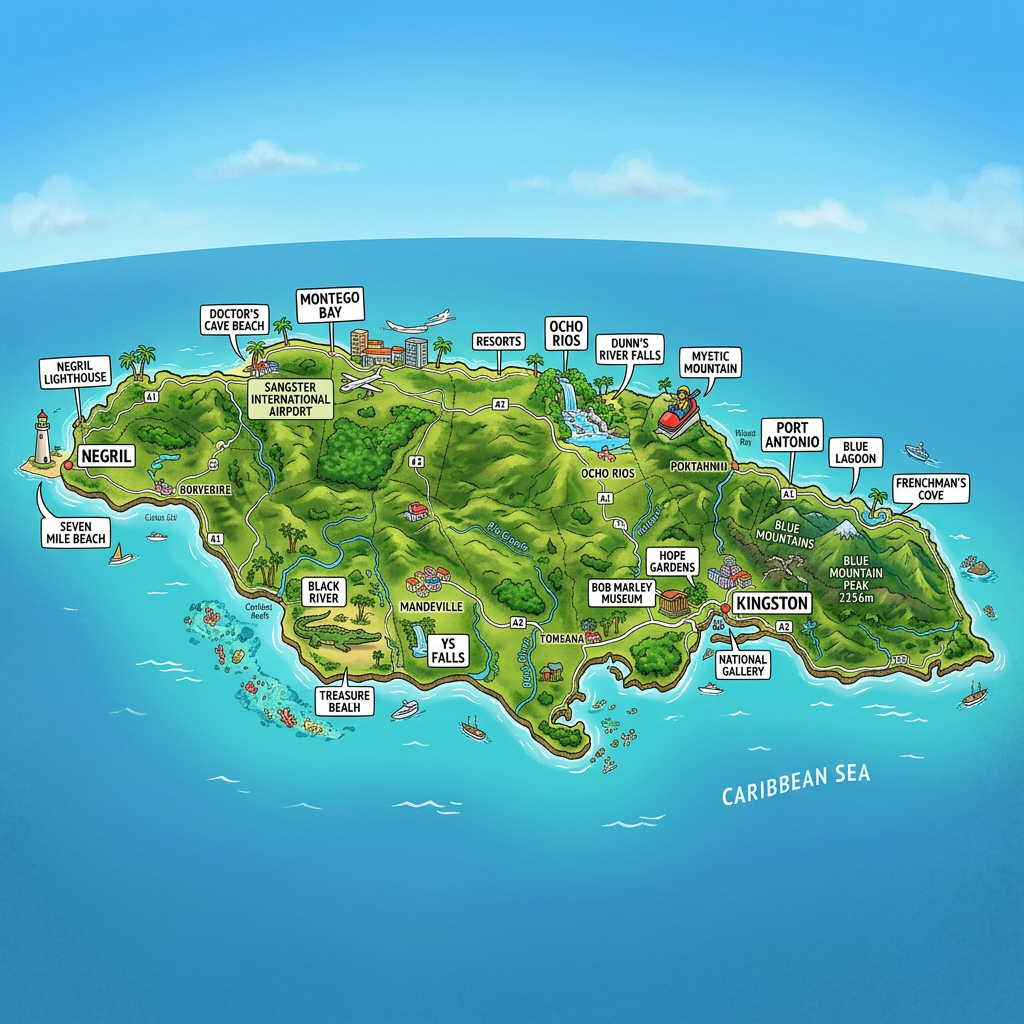
- Its physical map shows the Blue Mountains, the highest point with Blue Mountain Peak (2,256 m).
- The capital Kingston is a major port and the cultural heart of the country.
- Its coastline is famous for its paradise beaches and tourist resorts such as Montego Bay and Negril.
- The island is a major cultural center, notably thanks to reggae music and its athletics champions.
Neighboring countries of Jamaica
Jamaica is a large island in the Caribbean Sea. It is located 630 kilometers northeast of the central area of Central America. Its close neighbors are Haiti to the east and Cuba to the north. There are mountains and elevations inside and to the east of the island.
The map of Jamaica highlights a Caribbean island, located south of Cuba and west of Haiti. Its mountainous relief, renowned beaches, and capital Kingston make it a territory both tourist and culturally influential.
The Colors of Jamaica
The national flag of Jamaica was first raised on Independence Day, August 6, 1962. It symbolizes “the independence of our country.” A bipartisan board of the Jamaican House of Representatives planned the Jamaican flag which includes a diagonal cross with four triangles placed side by side.

The diagonal cross is gold; the top and base triangles are green; and the crane and fly triangles (sides) are black. “The sun shines, the earth is green, and the individuals are strong and inventive” is the imagery of the banner’s shades. The black color depicts the strength and imagination of the individuals; gold, the normal wealth and magnificence of daylight; and green, horticultural activities.
The Best cities to visit in Jamaica

Negril
Probably the most popular destination on the island, ideal for a honeymoon or a vacation with friends. Negril is famous for its white sandy beaches bordered by spectacular cliffs to the south, called the West End. The sunset there is considered one of the most beautiful in the world.
Montego Bay
Nicknamed MoBay, it is the second largest city in Jamaica. It has the main international airport after Kingston, luxury hotel complexes, splendid beaches, golf courses, and the famous Glistening Waters luminous lagoon. The city also houses the Great House Rose Hall (1770), a colonial mansion full of history.
Kingston
Capital and largest city of the country, Kingston is the cultural and economic heart of Jamaica. You can visit the Bob Marley Museum, located in his former home, the Emancipation Park for its concerts, or the National Gallery of Jamaica. Not far away, the Blue Mountains offer magnificent landscapes and produce one of the best coffees in the world.
Ocho Rios
Located on the north coast, Ocho Rios is famous for its Dunn’s River Falls, its cruises, and its resorts. It is also a popular place for diving, swimming with dolphins, and visiting local plantations.
Port Antonio
A quieter town, Port Antonio attracts travelers seeking authenticity. It features the Blue Lagoon, famous for its turquoise waters, preserved beaches like Frenchman’s Cove, and tropical landscapes perfect for ecotourism.
Financial map of Jamaica
Jamaica has a mixed economy, where the service sector (notably tourism and finance) dominates. Agriculture remains important, representing about 20% of GDP and employing nearly 10% of the workforce.
Economic data (2024):
- Official currency: Jamaican Dollar (JMD)
- Nominal GDP: 16.3 billion USD
- GDP (PPP): 34.5 billion USD
- GDP growth rate: 2.1%
- GDP per capita: 5,300 USD (nominal), 11,300 USD (PPP)
- HDI: 0.734 (medium human development)
- Unemployment rate: 8.2%
- Exports: 1.8 billion USD (aluminum, bauxite, bananas, rum, sugar)
- Imports: 6.5 billion USD (petroleum products, foodstuffs, manufactured goods)
Climate map of Jamaica
In Jamaica, the climate is tropical, warm all year round, with little difference between winter and summer (only a few degrees). Even in winter, daytime temperatures are around 27/30 °C and nighttime temperatures around 20/23 °C.
The southern coast, where Kingston is located, is slightly warmer during the winter months; in fact, the maximum temperature is about 30 °C even in January. The main difference between the seasons lies in precipitation and air humidity: the rainy season, from late April to October, is hot and humid.
Precipitation mainly occurs in the form of thunderstorms in the late afternoon. The rainfall pattern is also due to the northeast trade winds, typical of the tropics, which blow from November to March. Along the northern coast of Jamaica, precipitation varies between 1,200 and 1,800 millimeters per year.
Demographic and administrative map of Jamaica
Demographics of Jamaica
- Total population: 2,812,090 inhabitants
- Population growth: -0.05% per year
- Fertility rate: 2.09 children per woman
- Birth rate: 16.5 ‰
- Death rate: 7.6 ‰
- Life expectancy: 74.5 years
- Median age: 27.8 years
- Sex ratio: 98 men per 100 women
Ethnic and linguistic composition
- Ethnic groups:
- Majority Black
- Minorities: Indians, Whites, Chinese
- Languages spoken: English (official) and Jamaican Creole
- Dominant religion: Protestantism (with several branches, notably Baptists, Adventists, and Pentecostals)
Administrative division of Jamaica
Jamaica is subdivided into 14 parishes, grouped into 3 counties:
- Cornwall: Hanover, Saint Elizabeth, Saint James, Trelawny, Westmoreland
- Middlesex: Clarendon, Manchester, Saint Ann, Saint Catherine, Saint Mary
- Surrey: Kingston, Portland, Saint Andrew, Saint Thomas

Jamaica demolinguistic data
Population of Jamaica
About 97% of the population is of partial or total African descent. This population is made up of Blacks, Mulattoes, and Black-Indians or Black-Chinese. Other ethnic groups include East Indians (1.3%), Chinese (0.2%), Europeans (0.2%), and others (0.6%). Almost the entire population is native Jamaican.
Languages in Jamaica
Indeed, the majority of the Jamaican population, about 90%, has Jamaican Creole, known as Patois, as their mother tongue. The rest are English speakers or speak other immigrant languages. As a result, Jamaica is considered a country with a linguistically homogeneous plan. Moreover, even Jamaican Creole is a language lexically based on English.
FAQ – Jamaica map
Jamaica is located in the Greater Antilles, south of Cuba and west of Haiti.
The capital is Kingston, located on the southeast coast of the island.
A mountainous island bordered by tropical beaches, with a humid climate and known for its cultural richness.
