
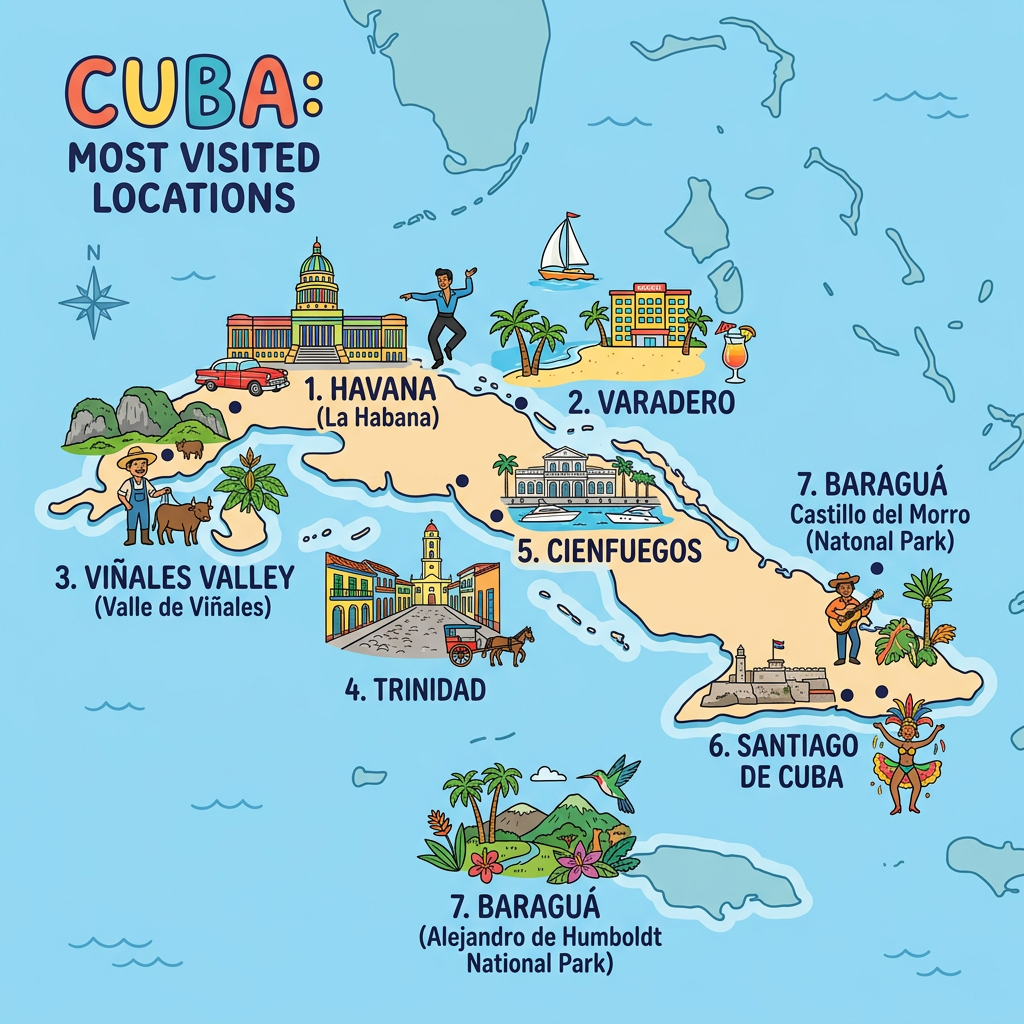
What you need to know about Cuba ?
The Republic of Cuba is an island state with a territory including the island of Cuba, the Isle of Youth, and several small archipelagos. The official area of Cuban territory is currently 109,884 km2 and that of its main island is 104,556 km2.

Cuba has a population of 11,193,470 inhabitants with a density of 101 inhabitants per Km2. It is therefore the 81st most populous country and the 104th largest in the world. The capital of Cuba and its largest city is Havana, and the official language of the country is Spanish.
The government of the country is a unitary Marxist-Leninist government with a single socialist republic party. The telephone code for Cuba is 53 (0053 or +53).
Where is Cuba located on the world map?
On the world map, Cuba is considered part of Latin America except that its territory is located in the Caribbean: precisely to the North where the Caribbean Sea, the Gulf of Mexico, and the Atlantic Ocean meet. It is then located to the East of the Yucatan Peninsula in Mexico and to the South of the states of Florida and the Bahamas in the United States.
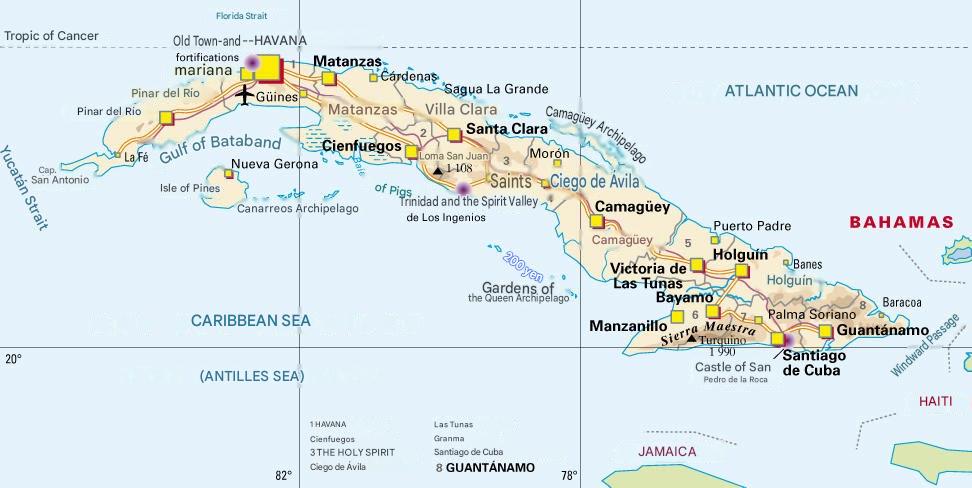
The map of Cuba highlights the largest island in the Caribbean, located south of Florida, east of Mexico, and north of Jamaica and Haiti. Its capital, Havana, is a major historical and cultural center of the Americas.

Population of Cuba
Currently, the population of Cuba is estimated at 11,193,470 inhabitants, with a density of 101.9 inhabitants per km². The demographic growth rate is slightly negative, at -0.1%. The birth rate is 9.9 ‰, while the death rate reaches 7.6 ‰.
The life expectancy of Cubans is 78 years, with 75.8 years for men and 80.4 years for women. The fertility rate is 1.45 children per woman, reflecting a low birth rate. The sex ratio is balanced, with about 99 men for every 100 women.
The inhabitants of Cuba are called Cubans, and the official language is Spanish.
Table – Cuba: Geographical and demographic information
| Element | Key Information |
|---|---|
| Total Area | 109,884 km² |
| Capital | Havana |
| Bordering Countries | None (Island state), close to the United States (Florida), Mexico, the Bahamas, Jamaica, and Haiti |
| Coastline | ~5,746 km on the Atlantic Ocean, the Caribbean Sea, and the Gulf of Mexico |
| Estimated Population | ~11.1 million inhabitants (2025) |
| Population Density | ~101 inhabitants/km² |
| Relief | Coastal plains, mountains (Sierra Maestra), plateaus |
| Climate | Tropical, rainy season and hurricanes |
| Official Language | Spanish |
| Economic Resources | Sugar cane, tobacco, nickel, tourism, medical services |
| Special Feature | Largest island in the Caribbean, famous for its cultural heritage and geopolitical role |
Additional points on the map of Cuba
- Cuba is located in the Caribbean, north of Jamaica and east of the Yucatán Peninsula (Mexico).
- The physical map shows a large elongated island with some mountain ranges, including the Sierra Maestra in the east.
- The capital Havana is a coastal metropolis on the Florida Strait.
- The country is known for its musical culture, colonial architecture, and revolutionary heritage.
- With more than 5,700 km of coastline, Cuba is surrounded by reefs and hundreds of small islands.
What Are the colors of the country?
The colors of Cuba are red, white, and blue. They have been adopted since the 19th century when anti-Spanish Cubans left New York under the leadership of Narciso Lopez. They then adopted the flag suggested by the poet Miguel Teurbe Tolon.

This is how the national flag was created with three blue stripes alternating with two white stripes. Towards the hoist side, there is a red isosceles triangle with a white five-pointed star in the center.
The three blue stripes represent the military districts that dominated Cuba, and the white stripes symbolize the purity of the cause. As for the red triangle, it signifies the country’s constancy and strength but also reflects the Masonic symbol. The white star signifies the independence of the people.
What Are the best cities to visit in Cuba?

Havana
The capital of Cuba is the main transportation hub, as most flights to the country land here. It is indeed a retro, sophisticated, and welcoming city known especially for its very lively nightlife but also for unique days.
Visit Habana Vieja to see the remains of colonial buildings as well as the vibrant mid-century structures. You can also taste hand-rolled cigars in a small local factory or sample freshly produced rum in a distillery.
Trinidad
For those who love architectural history, Trinidad is a very good destination in Cuba. The heart of the city is Plaza Mayor, which is located in the main district surrounded by neo-baroque buildings.
Near the Plaza is the colonial convent which is today the war museum “Lucha Contra Bandidos”. Then visit the Palacio Brunet Mansion which is currently a romantic museum where you will see several antique artworks dating from the 19th century.
Santiago de Cuba
Santiago de Cuba is a city located in the east of the country. It is a coastal city mainly known for its colonial past. The city was founded in the 16th century by the Hispanics and is now recognized as the second city of the country.
The city center is Parque Cespedes, which is a central area surrounded by several Spanish colonial buildings. Formerly, Parque Cespedes was the place where Fidel Castro declared the success of the revolution in 1959. There is also the Castillo de San Pedro de la Roca fort dating from the 17th century overlooking the bay.
Cuba climate map

Cuba has a tropical climate characterized by a dry, mild, and relatively cool season occurring between November and April, and a rainy and humid season between April and November. The Cuban territory has a fairly homogeneous climate, which is why the differences are barely noticeable.
Annual rainfall is approximately between 1000 and 1500 mm per year, but in the south, there are mountainous areas that are less humid than the rest of the country, with between 700 and 800 mm of precipitation per year.
The winter period in Cuba is moderately warm in the northern sector and hot in the southern part of the country with temperatures around 26°C between December and February.
Precipitation is less frequent, but it is still present especially in the northern sections of the country which are subject to warm winds from the North and cold winds from the West.
The wet seasons are quite hot with temperatures that can reach 33 or 34°C especially between July and August. Rainfall during this season is quite high which leads to afternoon thunderstorms.
Cuba economic map

The Cuban economy is a planned economy governed by state-owned enterprises. The country’s government owns and manages most industries and the employees are civil servants.
Cuba follows the Soviet model of the 1990s which allows the Cuban Communist Party to train cooperative workers and promotes self-employment. However, private properties were only accepted by the constitution in 2019.
Currently, public sector employment constitutes 76% of the total jobs in the country and the private sector represents only 23%, moreover, the government sets product prices and rations adapted to each citizen.
That is why the human development index is only 0.783 and public debts represent 35% of GDP with an inflation rate of 5.5%.
- Currency: Cuban Peso
- GDP: 100.023 billion USD (nominal) and 137 billion (PPP)
- GDP per capita: 8,222 USD (nominal) and 12,300 (PPP)
- Human Development Index: 0.778
- Unemployment rate: 2.6%
- Main industries: Oil, mining, pharmaceutical, tobacco, cement, agri-food, sugar, tourism
- Exports: 2.63 trillion USD
- Imports: 11.06 trillion USD
Administrative and demolinguistic data
Administrative subdivisions
The Cuban territory is administratively divided into 15 provinces associated with a special municipality excluded from any province. This arrangement is quite recent (2020) during which Havana was divided into two new provinces: Artemisa and Mayabeque.

Here are the provinces of Cuba:
- Pinar del Río
- Artemisa
- La Habana
- Mayabeque
- Matanzas
- Cienfuegos
- Villa Clara
- Sancti Spíritus
- Ciego de Ávila
- Camagüey
- Las Tunas
- Granma
- Holguín
- Santiago de Cuba
- Guantánamo
- Youth Island (special municipality)
Demolinguistic data
Since Cuba is a multiethnic nation, its people come from different origins, have different religions and languages.
- Here are the ethnic groups inhabiting Cuba
Whites or Europeans or Criollos. They represent 64.1% of the inhabitants considered white. They are mainly Spaniards but there are also English, French, Irish, Italians, Scots.
Blacks or Sub-Saharan Africans
They represent 9.3% of the Cuban population and come from several African ethnic groups: Akans, Yoruba, Igbo, Congo, Arara, Carabali, Mandingo, Fula, Makua. Blacks are 65% native Africans, 29% are mixed-race.
Asians
These Cubans of Asian origin represent 1.02% of the population. They are mainly immigrants.
Amerindians
The exact census is not yet defined.
- Cuban religion
The dominant religion is Roman Catholicism, which accounts for 60% of the country’s believers, followed by Protestants and other Christians at 5%, African Religions at 11%, and non-religious at 24%.
- Cuban Dialect
The main language spoken in Cuba is Cuban Spanish, a variation of the Hispanic language also called Cubano or “Linga Franca de Cuba.” It is a language derived from Castilian Spanish brought by immigrants from the Canary Islands. Now, the main spoken languages are Cuban Spanish and Haitian Creole.
FAQ – Cuba map
Cuba is located in the Greater Antilles, between the Gulf of Mexico, the Atlantic Ocean, and the Caribbean Sea.
The capital is Havana, located on the northwest coast.
A large tropical island, with agricultural plains, some mountain ranges, and a very extensive coastline.
