
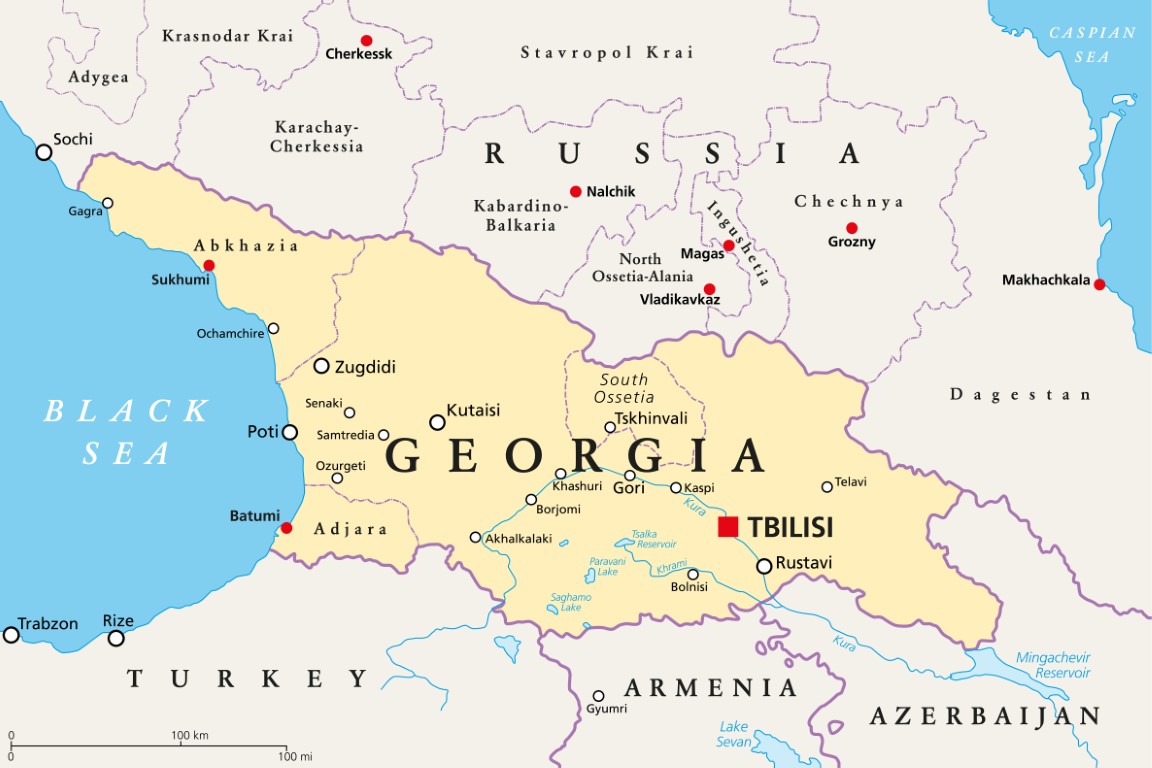
Georgia is a country located halfway between Asia and Europe, making it a Euro-Asian country situated in the Caucasian region of Eurasia. The official name of the country is the Republic of Georgia due to its parliamentary status.
Georgia covers an area of 69,700 km² and has an estimated population of about 3.8 million people in 2025. The population is predominantly made up of ethnic Georgians, who account for approximately 86% of the country’s inhabitants. Other significant ethnic groups include Azerbaijanis, Armenians, Russians, as well as Ossetians, Yezidis, Greeks, and several other minority communities.
The largest urban area of the country as well as its capital is Tbilisi, and the official language of the country is Georgian. The religion of the majority of the people (88%) is Christianity. The country’s telephone code is 995, i.e., 0995 or +995.
Which countries border it?
The neighboring countries of Georgia are Russia, Azerbaijan, Armenia, and Turkey. The country is also bordered to the west by the Black Sea.
Population of Georgia
The population of Georgia is estimated at around 3.8 million people in 2025. With a land area of 69,700 km², the population density is approximately 54 inhabitants per km². The country is experiencing very low or slightly negative population growth, with an annual growth rate close to 0% to -0.3% according to recent estimates.
The birth and death rates in Georgia are estimated at approximately 12 births per 1,000 inhabitants and 13 deaths per 1,000 inhabitants (around 1.2% and 1.3%, respectively).
Life expectancy at birth is about 74 years, reflecting gradual improvements in healthcare and living conditions.
The sex ratio is generally skewed in favor of females, with around 90–92 males per 100 females overall. At birth, the ratio is approximately 105 boys per 100 girls, remains similar among those under 15, and gradually declines with age to about 95–96 males per 100 females in the adult and elderly population.
What are the colors of the country?

The flag of Georgia is a flag called the five-cross flag. It consists of a white background with a large red cross in the middle and 4 smaller crosses in the 4 sections formed by the large one. Information about the flag indicates that the colors signify many things.
White represents purity, abstinence, brightness, and discernment. The color red represents valor, courage, righteousness, and affection. Literally, the Georgian flag is a Christian flag that represents the people’s love for their God.
Main things to visit in Georgia

Tbilisi
The capital is a magnificent city representing both old Europe combined with some oriental relics. The city is located on the banks of the Kura River surrounded by mountain ranges. You will see several buildings dating from the Soviet era as well as modernized buildings such as the new theater or the Bridge of Peace.
Situated on a height, the capital is a wonderful place for walking; you can stroll along the paved alleys around which several churches are built. The old town also includes the Narikala fortress, which offers a panoramic view of the region’s expanse.
One of its famous monuments is the Cathedral of the Holy Trinity erected high on Mount Saint Elias, next to which stands a botanical park ideal for outdoor walks. The city is also a famous seaside resort where thermal springs are found at its heart. It will therefore be a magnificent place to recharge and relax. Do not forget to visit the Clock Tower, which is a puppet theater and represents the culture of the city. It is also where musical performances often take place, where both adults and children can enjoy themselves.
Kutaisi
Kutaisi is the second largest urban area in the country; it is a small quiet village with a countryside charm. Lined by the Rioni River, the city displays a magnificent design with charming little houses. In this city, the walk is pleasant and you can even admire the old neighborhoods as well as the original houses with foliage scattered all around.
If you prefer to discover the country’s crafts and taste the city’s specialties, visit the covered market. It is there that you can taste a drink called chacha or tchurtchkhela, a dried fruit delicacy. The upper part of the city is accessible via a cable car that ends its route at the Bagrat Cathedral, a remnant of Georgian architecture. Also visit the Gelati Monastery located near the city just a few kilometers away. It is also part of the UNESCO World Heritage.
Tusheti
The town is located in the northeastern section of the country, access to which is only possible via dangerous roads. It is a very remote town that is difficult to reach even during the summer periods. The town is located right in the center of the Caucasus and is bordered by mountain ranges; access is via small streets that cross panoramas and original villages scattered among vast wild emptiness.
This region is one of the least populated in the Caucasus but it is also the territory of several ancient architectures and protected monuments. Here, you will find some fortified boroughs and defense keeps that once preserved the town’s security against invasion. The inhabitants once lived off shepherding and farming.
Rent a 4×4 and head to Omalo, which abounds with parks left in a wild state that you can discover along with the abundant wildlife.
Where the cities are located on the map of Georgia ?

Tbilisi
The city of Tbilisi is located in the eastern part of the country inland. It is crossed by the Kura or Mt’kvari River. Geographic coordinates: 41° 43′ 01″ north, 44° 46′ 59″ east.
Kutaisi
The city of Kutaisi is located in the central section of Georgia, the Rioni River passes through the city center. Geographic coordinates: 42° 15′ north, 42° 42′ east.
Tusheti
The town of Tusheti is located in the northeastern section of Georgia, it is an area that is part of the world heritage, its geographic location is: 42°30’N, 45°30’E.
Economic map of Georgia
Georgia’s economy remains relatively fragile and import-dependent, with a trade deficit, according to the IMF. The country mainly serves as an energy transit corridor, especially for oil and gas flows between Asia and Europe.
Foreign investment supported GDP growth, with strong expansion before the 2008 crisis, followed by a gradual slowdown. Growth fell from about 9% annually before 2008 to around 2% in 2016. Industry remains limited, accounting for about one-quarter of GDP, while key sectors include services, real estate, and trade.
Foreign trade represents around 12% of GDP, while agriculture accounts for about 8%. The labor force is estimated at around 2 million people, with an unemployment rate between 12% and 16% depending on the year. Below are some key economic indicators of the country.
- Currency: Lari
- IInternational organizations: WTO, Council of Europe, EU Eastern Partnership
- Nominal GDP: around US$30 billion
- GDP growth: about 7% (2025)
- GDP per capita (PPP): around US$21,000
- Inflation: about 2–3%
- Poverty rate: around 15–20% of the population
- Labor force: about 2.0 million people
- Unemployment rate: around 14%
- Exports: about US$6–7 billion
- Imports: about US$12–14 billion
Climate map of Georgia
Although the Georgian territory is small, the climate is diverse. In the western coastal regions as well as the surrounding plains, the climate is tropical rainy. The central regions experience an arid climate. In contrast, the mountainous areas have an alpine climate.
Climate in coastal areas
The coastline bordering the Black Sea shows abundant rainfall exceeding 1500mm annually. These precipitations are evenly distributed throughout the year but are more abundant during the winter and autumn periods. In this part of the Georgian territory, the winter is milder with temperatures around 7°C.
This climate is influenced by the sea as well as the North Caucasus which prevents winds coming from the north from prevailing. Snow cover in the area is short, about 10 days per year. The summer in this part of the territory is hot but temperatures are lower than in the rest of the country, averaging 23°C. It is also the rainy season with rains often occurring in the afternoon in the form of thunderstorms.
Climate inland
In the center of the Georgian territory, the topography is dominated by mountain ranges as well as plateaus and valleys elevated over 400m altitude. As a result, the climate in this area is of the dry tropical type. Spring temperatures are around 25°C. However, summer is hotter with maximum sunshine and thunderstorms occurring in the early afternoon. Temperatures range between 35 and 38°C.
In the capital, the mountain ranges that make up the territory exhibit an alpine climate characterized by a cold winter with frequent snowfall and glaciers spread over a large area. In the highest part of the city, which is Mount Chkhara, rainfall is frequent. The capital area is highly subject to strong winds that bring frequent summer rains amounting to about 4500 mm annually. Along the capital’s coast, the winds hit hard and blow into the mountains.
Administrative and Demolinguistic Data
Administrative Subdivisions
Georgia is subdivided into autonomous republics, regions, and municipalities.
Currently
- There are 76 municipalities
- There are 12 autonomous cities
- There are 64 communities
Just like the autonomous republics, there are nine regions also called Mkhare. These are: Lechkhumi and Kvemo Svaneti, Samegrelo-Zemo Svaneti, Samtskhe-Javakheti, and Shida Kartli. The capital is also called an autonomous territory which is subdivided into 10 districts.
Here are the 12 administrative regions of Georgia:
- Abkhazia
- Mingrelia and Upper Svaneti
- Guria
- Adjara
- Racha-Lechkhumi and Lower Svaneti
- Imereti
- Samtskhe-Javakheti
- Upper Kartli (or Kartalinie)
- Meskheti (and Mtianeti)
- Lower Kartli (or Kartalinie)
- Kakheti
- Tbilisi
Demolinguistic data
Currently, there are more than 50 Georgian ethnic groups. The most important are
- Georgians who represent 70.50% of the population; the language of this ethnicity is Georgian
- Mingrelians who represent 7.70% of the population and speak Mingrelian
- North Azerbaijanis or Azeris who represent 6.00% of the population and speak North Azeri
- Armenians who represent 5.40% of the population and speak Armenian
- Abkhazians who represent 2.90% of the population and speak Abkhaz
- Greeks or Turkified people from Mariupol or Ourums who represent 2.00% of the population and speak Ourum.
- There are also Russians, Ossetians, and Kurds.
FAQ – Georgia map: What you need to know about Georgia
Georgia is located at the border of Eastern Europe and Western Asia, bordered by the Black Sea to the west, Russia to the north, Turkey and Armenia to the west, and Azerbaijan to the east.
Georgia is bordered by Russia, Turkey, Armenia, and Azerbaijan.
Georgia is situated at the crossroads of Europe and Asia but is generally considered part of Europe.
