
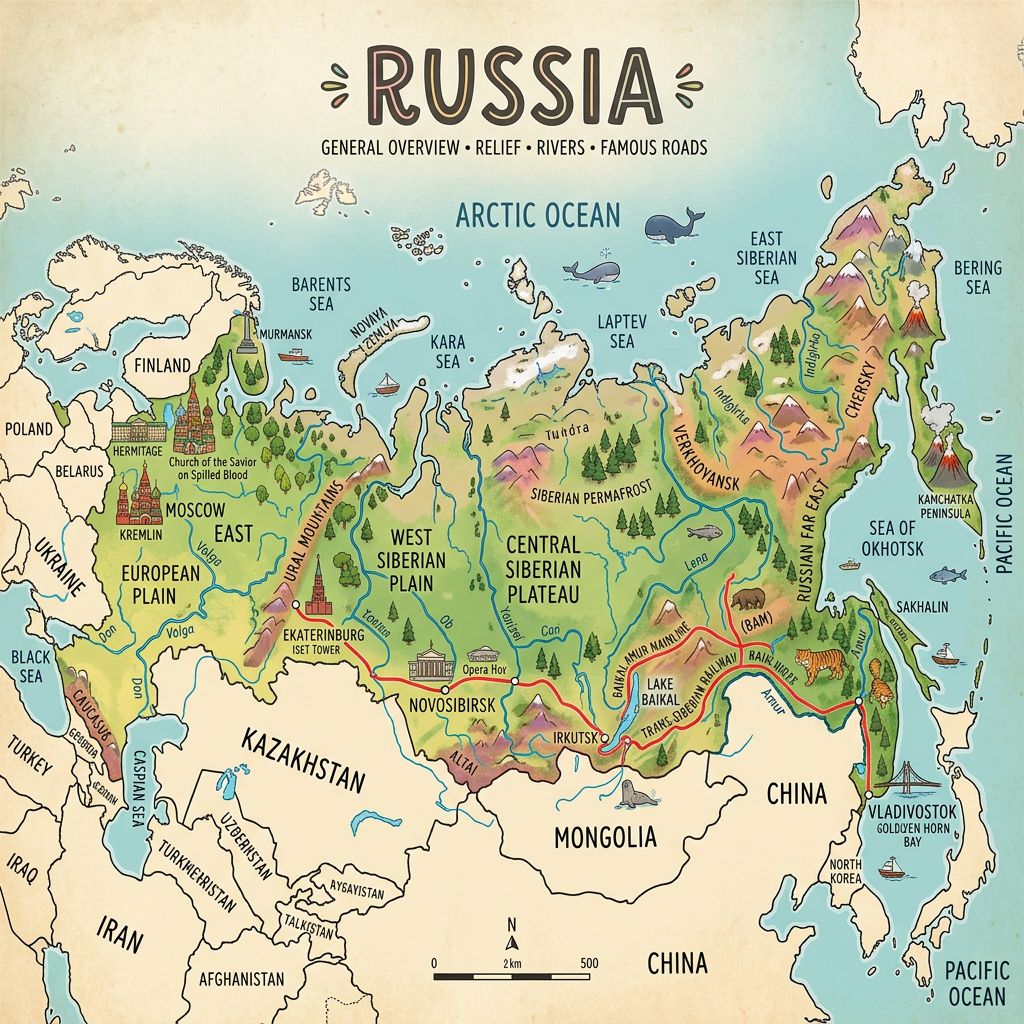
Russia is an Eastern European country that is considered the largest country in the world by area. It is a country divided into 21 republics forming the Commonwealth of Independent States and altogether constituting the Russian Federation.
The area of Russia is 17,098,242 km2 and it shares 14 borders with 14 countries: Kazakhstan, China, Mongolia, Ukraine, Belarus, Finland, Georgia, Azerbaijan, Latvia, Estonia, Lithuania, Poland, Norway, and North Korea. The telephone code in Russia is 7, either 007 or +7
The best cities in Russia
Main tourist attractions and places of interest
- Moscow: The capital, famous for Red Square, the Kremlin, and Saint Basil’s Cathedral.
- Saint Petersburg: Imperial city founded by Peter the Great, known for the Hermitage Museum and its sumptuous palaces.
- Trans-Siberian Railway: Legendary train journey connecting Moscow to Vladivostok, crossing Siberia.
- Lake Baikal: The largest freshwater reservoir in the world, known for its natural beauty and biodiversity.
- Ural Mountains: Mountain range separating Europe from Asia, rich in natural resources.
- Kamchatka: Volcanic peninsula, famous for its geysers, brown bears, and wild landscapes.
- Vladivostok: Strategic port city near the Chinese and Japanese borders, terminus of the Trans-Siberian Railway.

Moscow
Moscow is the capital of Russia and offers important sites such as the Kremlin or Red Square. You can also visit the old fortress and Saint Basil’s Cathedral.
Moscow is also popular for various shows such as ballet, circus performances, or theaters. Lastly, Moscow is also an attractive city thanks to its diverse restaurants and bars.
Saint Petersburg
Saint Petersburg is the former capital of Russia with important palaces and cathedrals to visit. Tourists enjoy the green parks or the rivers and canals. It is a calm city that hosts various restaurants and shops. Finally, don’t forget to visit the Hermitage Museum.
Kazan
Kazan is a very interesting place as it reflects several cultures. The city has numerous churches and mosques. You can also visit it to enjoy countless cultural attractions such as the Kazan Kremlin.
Yekaterinburg
Yekaterinburg is a very old city popular especially for its numerous historical and cultural sites. It has an international airport, many bars and cafes. Yekaterinburg is primarily a nightlife city; tourists also visit to see the Ural Mountains.
Vladivostok
Vladivostok is a city located in the East of Russia. Its coasts are adorned with small islands and bays interesting for seaside walks. The city includes cultural attractions made up of theaters and restaurants, added to cocktail bars for unique taste pleasures.
Where the cities are located on the map ?

Moscow
On the map, Moscow is located southeast of Helsinki. It is 1,151 km away from Warsaw in the east-northeast direction. And 1,569 km away from Budapest in the northeast direction. It is 1,649 km away from Tbilisi and 2,273 km away from Nur-Sultan in the west-northwest direction, and finally, 4,635 km away from Ulaanbaatar in the northwest. Geographic coordinates: 55° 45′ 09″ N, 37° 37′ 23.11″ E
Saint Petersburg
Saint Petersburg is located northwest in the Gulf of Finland in the Baltic Sea. It is 635 km away from Moscow in the northwest direction. 317 km away from Tallinn in the east-northeast, and 300 km away from Helsinki. Geographic location: 59° 56′ 02″ N, 30° 18′ 22″ E
Kazan
The city of Kazan is located in the west of the map. It is also the capital of Tatarstan. It is 720 km east of Moscow. Geographic location: 55° 47′ N, 49° 10′ E
Yekaterinburg
Yekaterinburg is a city located in western Siberia. On the map, the city is on the Trans-Siberian line, next to the Ural Massif on the eastern slope. Geographic location: 56° 50′ N, 60° 35′ E
Vladivostok
It is a city located in the southwest and the capital of the Far Eastern Federal District. On the map, Vladivostok is located on the peninsula in the southwest section. Geographic location 43° 07′ N, 131° 54′ E
Financial map of Russia
Russia has low public debt and budgetary leeway allowing for gradual consolidation. This year, the Russian economy has decreased its economic growth by 4%. Here are some figures:
- Population : around 144 million inhabitants.
- GDP per capita : around USD 15,000.
- GDP : around USD 2.2 trillion.
- Investment: around 1.7% annual growth.
- Industrial production : around 4% annual growth.
- Unemployment rate: around 2.5%.
- Budget balance : around 1.7% of GDP.
- Public debt : around 20% of GDP.
- Trade balance: around USD 140 billion.
- External debt: 16 % of GDP
Climatic map of Russia
Russia is a very vast country, so it will be difficult to determine a general climate. However, it is known that almost all regions of Russia have hot summers and very cold winters. This reflects a continental climate generally defined by very cold winters with temperatures that can reach -30°C.
The summer will be hot and dry with precipitation averaging 750 mm in the western regions. The south and southeast, on the other hand, have drier summers with rainfall below 200 mm.
Northern Russia: characteristic climate with a dry and very sunny summer with afternoon thunderstorms. Winter is cold with heavy snow and frost. Spring and autumn are characterized by frequent rain and strong winds.
Siberia : This region of Russia experiences harsh and dry winters with frost and snow from late October to mid-March. Summers, on the other hand, are very hot and short.
Southern Russia: This region of Russia experiences dry and very sunny summers followed by harsh winters. Rainfall occurs almost all year round due to the influence of the Mediterranean.
Murmansk : Winter is rather harsh with a total absence of sunshine and short days. In spring, however, the temperature is around 17°C which results in regular sunshine.
Saint Petersburg : The city of Saint Petersburg experiences a mild and rainy summer associated with low precipitation in winter which sometimes turns into snowfall.
Moscow : The capital of Russia experiences a fairly warm summer with a temperature of around 19°C which can increase. However, thunderstorms are more frequent and mainly occur in the afternoon. In winter, there may be snowfall and sometimes frost.
Southern Russia : Temperatures between Ukraine and Kazakhstan are characterized by very cold winters and hotter summers than in other regions. Precipitation is low, amounting to 350 millimeters per year.
Demographic and administrative map of Russia

Table on the main geographical characteristics of Russia
| Characteristic | Detail |
|---|---|
| Area | 17,098,242 km² |
| Capital | Moscow |
| Population | About 144 million inhabitants |
| Official language | Russian |
| Highest point | Mount Elbrus, 5,642 meters |
| Main rivers | Volga, Ob, Yenisei, Lena |
| Geographical region | Eastern Europe and Northern Asia |
Demography of Russia
Russia’s population is currently estimated at around 144 million inhabitants according to the latest estimates. This represents nearly 1.8% of the world’s population.
Russia ranks among the 10 most populous countries in the world. With an area of about 17.1 million km², its population density is around 8 inhabitants per km², one of the lowest among large countries.
Most of the population lives in urban areas, accounting for about 75% of all inhabitants. Finally, Russia’s median age is around 40 years, reflecting an aging population.
Russia Administration
Russia is subdivided into 89 divisions called federations. These federations each belong to the following categories:
- Republic 21
- Territory 6
- Region 49
- Autonomous district 2
- Autonomous region 1
- Federal city 2
These subdivisions are called first-order divisions. The second-order divisions are of two types:
- county
- city with status: county
Each city can be subject to a republic, a region, a territory, a district (autonomous or not). These are the third-order divisions which are:
- district
- city
Here are the Federal Districts:
- North-West.
- Center
- North Caucasus
- Volga
- Ural
- Siberia
- Far East
Here are the cities of Russia
- Moscow
- Saint Petersburg
- Novosibirsk
- Yekaterinburg
- Nizhny Novgorod
- Kazan
- Samara
- Chelyabinsk
- Omsk
- Rostov-on-Don
- Ufa
- Krasnoyarsk
- Perm
- Volgograd
- Voronezh
- Saratov
- Krasnodar
- Togliatti
- Izhevsk
- Ulyanovsk
- Barnaul
- Vladivostok
- Yaroslavl
- Irkutsk
- Tyumen
- Makhachkala
- Khabarovsk
- Novokuznetsk
- Orenburg
- Kemerovo
- Ryazan
- Tomsk
- Astrakhan
- Penza
- Naberezhnye Chelny
- Lipetsk
- Tula
- Kirov
- Cheboksary
- Ivanovo
- Bryansk
- Kaliningrad
- Magnitogorsk
- Kursk
- Tver
- Nizhny Tagil
- Ulan-Ude
- Arkhangelsk
- Stavropol
- Kurgan
- Belgorod
- Murmansk
- Kaluga
- Orel
- Sochi
- Smolensk
- Chita
- Vladimir
- Vladikavkaz
- Volzhsky
- Cherepovets
- Saransk
- Tambov
- Vologda
- Surgut
- Taganrog
- Komsomolsk-on-Amur
- Kostroma
- Nalchik
- Petrozavodsk
- Sterlitamak
- Dzerzhinsk
- Bratsk
- Yoshkar-Ola
- Orsk
- Angarsk
- Nizhnevartovsk
- Novorossiysk
- Syktyvkar
- Nizhnekamsk
- Prokopyevsk
- Rybinsk
- Shakhty
- Blagoveshchensk
- Biysk
- Novgorod
- Stary Oskol
- Grozny
- Yakutsk
- Pskov
- Severodvinsk
- Balakovo
- Petropavlovsk-Kamchatsky
- Zlatoust
- Engels
- Armavir
- Syzran
- Kamensk-Uralsky
- Podolsk
- Yuzhno-Sakhalinsk
- Berezniki
- Novocherkassk
- Volgodonsk
- Abakan
- Rubtsovsk
- Mytishchi
- Salavat
- Miass
- Ussuriysk
- Maykop
- Lyubertsy
- Kovrov
- Kolomna
- Nakhodka
- Balashikha
- Elektrostal
- Korolyov
- Khimki
- Pyatigorsk
- Almetyevsk
- Odintsovo
- Norilsk
- Novomoskovsk
- Pervouralsk
- Nevinnomyssk
- Serpukhov
- Dimitrovgrad
- Kislovodsk
- Kamychin
- Murom
- Novocheboksarsk
- Nazran
- Neftekamsk
- Orekhovo-Zuyevo
- Khasavyurt
- Achinsk
- Noginsk
- Yelets
- Cherkessk
- Sergiyev Posad
- Novokuybyshevsk
- Schelkovo
- Leninsk-Kuznetsky
- Arzamas
- Seversk
- Oktyabrsky
- Nefteyugansk
- Bataisk
- Kiselevsk
- Novotroitsk
- Obninsk
- Velikiye Luki
- Elista
- Kyzyl
- Zheleznodorozhny
- Ukhta
- Sarapul
- Kansk
- Solikamsk
- Mezhdurechensk
- Zhukovsky
- Novokhantyinsk
- Derbent
- Glazov
- Ust-Ilimsk
- Zelenodolsk
Demolinguistic map of Russia
The Russian language was originally divided into three dialects: north, south, and center
- Gekanie: Southern dialect
- Okanie: typical northern dialect
- Akanie: typical southern Russian dialect
FAQ-Russia map: Geographic and demographic information
Russia extends across Eastern Europe and Northern Asia, making it the largest country in the world. It shares borders with 14 countries and has coastlines along several seas and oceans.
Moscow is the capital of Russia and also its largest city. The country has a population of approximately 146 million people, making it one of the ten most populous countries in the world.
A map of Russia helps identify its major cities, regions, and international borders. It is also useful for understanding the country’s immense size and the diversity of its landscapes.
