
What you need to know about Indonesia ?
Indonesia is an island country and at the same time the archipelago that has the most islands in the world, with 13,466 islands, of which only 922 are inhabited. It is officially called the Republic of Indonesia due to its administrative status as a unitary republic with a presidential system.
Indonesia has an estimated population of about 278 million people in 2025, making it the fourth most populous country in the world.
This population is mainly Muslim, and its largest city and capital is Jakarta. The official currency of the country is the Indonesian rupiah, and the telephone code is 62, that is 0062 or +62. The country is part of several international organizations including AIIB, INBAR, CIR, G20, GGGI, the Cairns Group, G33, and G15.
Which countries border Indonesia?
Indonesia’s neighbors are Malaysia, the Philippines, the island states of Singapore and Brunei, Papua New Guinea, and Australia.

Population of Indonesia
Indonesia has an estimated population of about 278 million people (2025), with a population growth rate of around 0.7% per year. The country is experiencing a gradual decline in fertility, at about 2.1 children per woman, close to the replacement level.
The birth rate remains higher than the death rate, at approximately 16 births per 1,000 people versus 6 deaths per 1,000 people. Life expectancy is around 73 years, with higher averages for women than men. The population is relatively young, with a median age close to 30 years.
The sex ratio is broadly balanced at around 101 males per 100 females, though it varies by age group. Indonesia is highly diverse, with major ethnic groups including the Javanese, Sundanese, Madurese, Minangkabau, Bugis, and others. The dominant religion is Islam, practiced by about 87% of the population.
What are the colors of the country?

The flag of Indonesia is a rectangular flag consisting of two horizontal bands of equal size. From top to bottom, the bands are red and white. The red symbolizes courage, fervor, and the struggle for freedom. The white represents the purity and fairness of the people.
Main things to visit in Indonesia

Jakarta
The capital is both a dynamic and wonderful city; you might feel a bit hesitant when you find yourself in the city center because the streets of the capital seem a bit disorderly. However, even though the capital is densely populated with more than 30 million inhabitants, it is a welcoming city. You will see several skyscrapers and towers that adorn the skyline.
You will also see a Chinatown enriched with old colonial buildings. There are several friendly restaurants, cafes, and bars where tourists can have a good time or recharge after a long day. The capital truly represents the entire country in terms of cuisine, culture, and craftsmanship.
Yogyakarta
Called Jogia in the Indonesian language, the city of Yogyakarta is a magnificent city but represents the culture of the country. Walk along the narrow streets of the city and admire the street artists and small mobile shops that will serve you snacks or trinkets as souvenirs.
You will also see several beautiful and well-preserved temples there. Among them are Prambanan and Borobudur; once you see these two monuments, you will immerse yourself in Indonesian history as well as the story of the Buddhist and Hindu kingdoms that were once rivals.
Bandung
The city of Bandung is located in the western section of the island of Java. It is one of Indonesia’s best tourist attractions, also called the Paris of the island. You can enjoy natural landscapes and lush parks.
There are also several restaurants serving dishes as diverse as they are delicious. You can also enjoy fashion boutiques found throughout the city. Finally, enjoy Angklung performances and art galleries that you will find everywhere.
Padang
The city of Padang is a real hive of restaurants. Their architecture is somewhat unique as they feature curved roofs caricaturing the horns of yaks. The city of Padang was once Dutch territory during the colonial occupation.
This domination left architectural remains that tourists can visit. There is also an old Chinese quarter called Chinatown.
Where the cities are located on the map of Indonesia ?

Jakarta
On the map of Indonesia, the city of Jakarta is located on the island of Java, in its northern section. There is also the Ciliwung River that crosses the city center and flows through the capital’s bay. Geographic coordinates: 6° 12′ 53″ south, 106° 50′ 42″ east
Yogyakarta
The city of Yogyakarta is located right in the center of the island of Java, within the special territory bearing its name. Geographic coordinates: 7° 47′ 00″ south, 110° 22′ 00″ east
Bandung
On the map of Indonesia, the city of Bandung, also called Bandoung, is located in the city center of the western province of the island of Java. Geographic coordinates: 6° 54′ 53″ south, 107° 36′ 36″ east
Padang
On the map of Indonesia, the city of Padang is located in the western section of the island of Sumatra. Geographic coordinates: 0° 27′ 52″ south, 100° 24′ 03″ east
Economic map of Indonesia
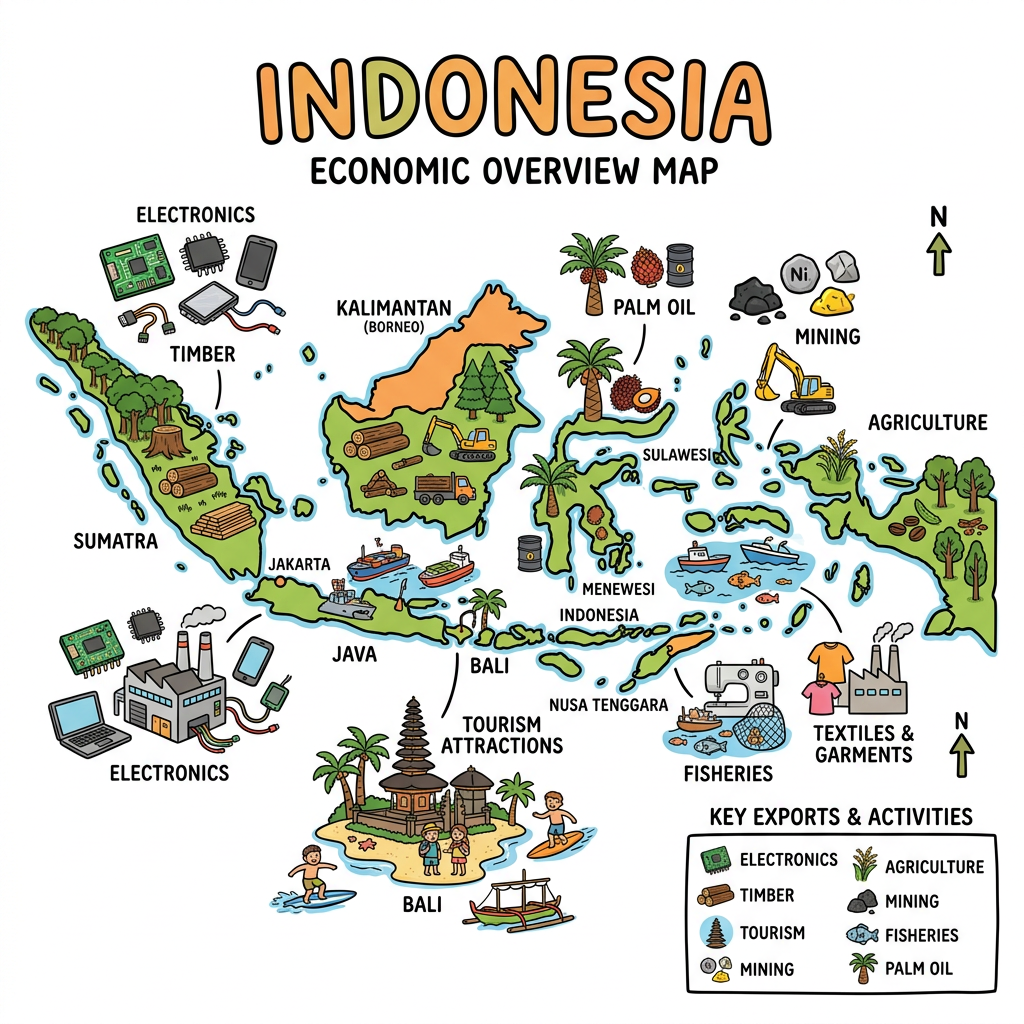
Indonesia has a developing market economy, where the state still plays a significant role in strategic sectors through state-owned enterprises. The economy is mainly driven by agriculture, natural resources, fishing, and manufacturing industries, particularly textiles and electronics.
Indonesia is an important global trade player but faces strong competition, especially from China, which affects the competitiveness of some exports. The country has developed major trade partnerships with economies such as Japan, the United States, and several Southeast Asian nations.
Tourism also plays an important role, although infrastructure limitations remain in some regions. The country is gradually expanding its transport network (roads, ports, airports, and railways), which is essential for sustaining economic growth.
However, significant challenges remain regarding access to basic services, with inequalities in access to clean water, electricity, and sanitation systems in certain rural areas.
- Currency: Indonesian Rupiah
- Nominal GDP: approximately US$1.4 trillion
- GDP growth: around 5%
- CPI: about 2–3%
- Poverty rate: around 9% of the population
- HDI: around 0.71 (medium to high human development)
- Unemployment rate: about 5% of the labor force
Indonesia climate map
The territory of Indonesia is composed of several islands, some of which are located on either side of the equator. As a result, the climate of the country can be characterized as equatorial.
The characteristics of this climate are hot and humid summers but rainfall spread throughout the year. Some parts of the Indonesian territory experience long dry seasons in addition to wet and stormy seasons.
In the highland areas composed of mountain ranges, winters in these regions are colder.
The majority of the Indonesian territory experiences more than 12 hours of daylight. Summer temperatures are around 22°C and can reach 32°C in areas very close to the equator.
These zones, including the southern part of Sumatra and the western part of Java, are subject to rainy summers with annual precipitation of 4,000 mm. The rainiest areas are those near the western coast, such as Padang and the Mentawai Islands. The rains generally occur between October and December.
The areas near the equator are those located in the southern section of Sumatra and the western section of Java.
The climate in these parts of the country is characterized as equatorial. The equatorial coast is therefore rainy with precipitation of more than 400mm during the rainy season. The summer is very hot and dry, but the coastal areas have a climate softened by sea breezes.
Climate in the capital Jakarta
The capital is primarily a less rainy area than the rest of the country. The annual rainfall amounts to about 1800mm; however, the dry season is short. Moreover, temperatures in the city center and the coasts are very high during the summer, but along the coast, the heat is tempered by the sea breeze.
Rainy periods occur mainly between December and March, but stormy rains occur between January and February, with about 300mm of rain observed during these two months.
Administrative and demolinguistic data
Administrative subdivisions
Indonesia is made up of 30 provinces, two of which are considered special territories: the capital Jakarta and Yogyakarta. Here are the provinces of Indonesia:
- Bali
- Bangka-Belitung
- Banten
- Bengkulu
- Gorontalo
- Riau Islands
- Jambi
- Central Java
- West Java
- East Java
- Central Kalimantan
- West Kalimantan
- East Kalimantan
- South Kalimantan
- Lampung
- Maluku
- North Maluku
- West Nusa Tenggara
- Nusa
- East Nusa Tenggara
- West Papua
- Riau
- Central Sulawesi
- North Sulawesi
- West Sulawesi
- South Sulawesi
- Southeast Sulawesi
- North Sumatra
- South Sumatra
- West Sumatra
Demolinguistic data
Currently, Indonesia has more than 583 variants of Indonesian, but overall there are just under 800 in the country. Here we consider dialects with around 100,000 speakers. Here are the most important languages in the country:
- Javanese 34.8%
- Sundanese 13.9%
- Pesisir 8.4%
- Madurese 6.1%
- Malay 5.2%
- Minangkabau 3.6%
- Peranakan 1.7%
- Bugis 1.7%
- Bali 1.6%

FAQ – Indonesia map: Practical information and country overview
Indonesia is a vast archipelago located in Southeast Asia, between the Indian Ocean and the Pacific Ocean. It is made up of thousands of islands, including the well-known Java, Sumatra, Borneo, and Sulawesi.
The capital of Indonesia is Jakarta, located on the island of Java. It serves as the country’s main political, economic, and cultural center.
A map of Indonesia helps identify the main islands, major cities, and volcanic regions. It also provides a better understanding of the geographical distribution of this vast archipelago.
