
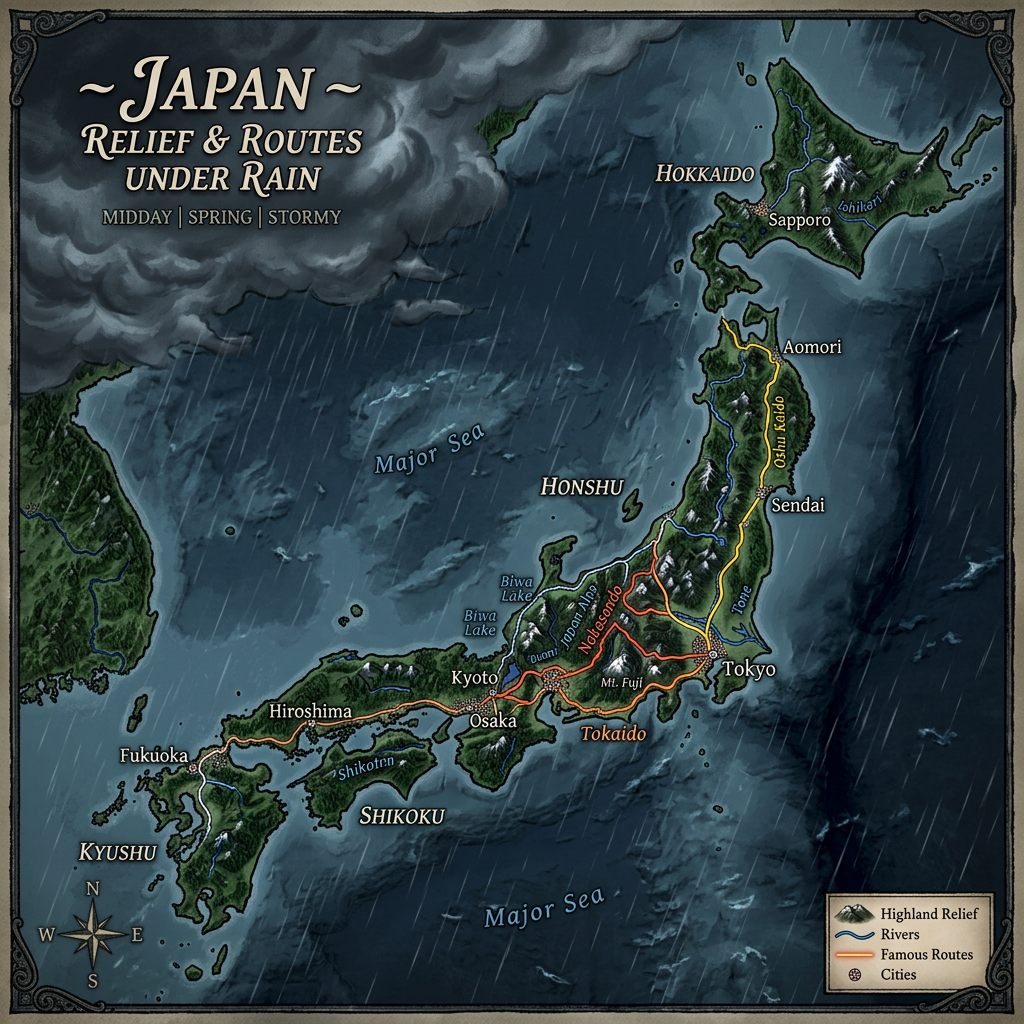
Japan, known in Japanese as Nihon, is an island located in Asia in the northwestern sector of the Pacific. The Japanese territory comprises exactly 6,852 islands over an area of 377,975 km2. The most important islands in terms of area are Hokkaido, Honshu, Shikoku, Kyushu, and Okinawa. The capital and largest urban area of the country is Tokyo, and other major urban areas include Yokohama, Osaka, Nagoya, Sapporo, Fukuoka, Kobe, and Kyoto.
The Japanese population is exclusively concentrated on coastal areas because inland, a quarter of the country is dominated by mountain ranges. The official language used in the country is Japanese, the total area of the territory is 377,975 km2, and the total population is 125,710,000 inhabitants. The official currency used is the Japanese Yen, and the telephone code is 81, either 0081 or +81.
Which countries border Japan?

Japan’s closest neighbors across the sea are China and Taiwan, respectively to the north and south. Japan’s maritime borders are also bordered by the Sea of Japan and the Sea of Okhotsk, respectively to the west and north.
Population of Japan (2026)
Japan’s population today stands at approximately 122.4 million inhabitants, or 1.47% of the world population, ranking it 12th worldwide. This is a significant decrease from 126 million a few years ago: Japan has been experiencing continuous demographic decline since 2010, losing about 700 inhabitants per day. This marks the 16th consecutive year of population decline in Japan.
The population density is 336 inhabitants/km², mainly concentrated in large coastal urban areas. Indeed, 93% of the population lives in urban areas, with Tokyo alone housing more than 13 million inhabitants in the city proper, and nearly 38 million in its metropolitan region, the largest in the world.
The most striking indicator remains the median age: 50.2 years, the highest in the world alongside Italy, reflecting a rapidly aging society. More than one-third of the population is over 60 years old. This demographic poses considerable challenges for financing pensions and the healthcare system, with no simple solution in the absence of a mass immigration policy, which is culturally sensitive in Japan.
Natural balance: negative since 2009, with nearly 919,000 more deaths than births in 2024
Life expectancy: 82.3 years on average, among the highest in the world
Birth rate: one of the lowest in the world, with a fertility rate around 1.2 children per woman in 2024 — historically low level
What are the colors of the country?

The colors of the Japanese flag are white and red. The flag is rectangular with a white background, and a red disc is placed in the middle of the flag. Here are the meanings of the colors
- Red: symbolizes the sun or light and thus confirms sincerity and fervor.
- White : symbolizes uprightness and purity
What are the best cities to visit in Japan?

Tokyo
Tokyo is a city that swallows you up as soon as you leave the airport, and we love that! The capital and megacity with 38 million inhabitants in its metropolitan area, it is both ultra-modern and deeply rooted in Japanese tradition. I spent an entire morning at the Senso-ji Buddhist shrine in Asakusa, the oldest temple in Tokyo, before diving into the hustle and bustle of Akihabara, the electronics and manga culture district. The Imperial Palace and its gardens, the modern art museum, the animation museum… Tokyo is a city-universe where each district has its own identity. A fun fact: I spent two hours in a museum dedicated to parasites—strange, certainly, but unforgettable!
Kyoto
Kyoto, the former imperial capital for over a thousand years, is the cultural soul of Japan. It has more than 1,600 temples and shrines, some of which are UNESCO World Heritage sites: the Byodo-in temple, Nijo Castle with its famous “singing” floors that warn of intruders, and the sumptuous Kinkaku-ji, the Golden Pavilion, whose reflection in the lake water is unforgettable. The bamboo forests of Arashiyama and the thousands of orange torii gates at the Fushimi Inari shrine are among the most iconic images of Japan. In the evening, stroll through the Gion district: if you’re lucky, you might spot a geisha heading to a tea house (ochaya) for a kaiseki gourmet evening.
Osaka
Osaka is the most gourmet city in Japan; the Japanese themselves have a word for it: kuidaore, “to ruin oneself by eating.” The third largest city in the country, it was rebuilt after the war but overflows with unique energy and human warmth. Osaka Castle, a 16th-century fortress rebuilt, dominates the city with its five golden floors. The Dotonbori district, with its neon signs and the smells of takoyaki, is a sensory festival in itself. Don’t forget the Bunraku theaters, the traditional Japanese puppet theater, and the onsen (hot springs) to relax after a day of sightseeing.
Hiroshima
Hiroshima is a must-visit, deeply moving. The Peace Memorial and its Genbaku Dome, the only building left standing after the atomic bombing in August 1945, command respectful silence. The Peace Memorial Museum recounts the history of this tragedy with precision and humanity. But Hiroshima is also a lively city resolutely looking to the future: the reconstructed feudal castle, now transformed into a museum dedicated to samurai history with live demonstrations outside the walls, is definitely worth a visit. For car enthusiasts, the Mazda Museum—whose global headquarters is in Hiroshima—is a top attraction.
Where are the cities located on the Japan map?

Tokyo
The city of Tokyo is literally called the capital of the East and is located on the east of the Japanese island. Geographic coordinates: 35° 40′ 15″ N, 139° 46′ 19″ E
Kyoto
The city of Kyoto is located in the Honshu archipelago and is surrounded by mountains. Geographic coordinates: 35° 01′ north, 135° 46′ east.
Osaka
On the map of Japan, the city of Osaka is also located on the island of Honshu at the edge of the Pacific. Geographic coordinates: 34° 41′ 37″ north, 135° 30′ 07″ east
Hiroshima
This historic city is located inside the Seto Inland Sea on the large Japanese island. Geographic coordinates: 34° 23′ 13″ north, 132° 26′ 43″ east
Japan climate map
In Japan, the climate varies by region but is generally called a temperate climate. Despite the length of the country of more than 3000 km, the Japanese climate can be subdivided according to regions:
The Hokkaido region experiences harsh winters with frequent snowfall. This winter is strongly influenced by cold winds from Siberia which bring ambient humidity and a drop in temperature. Inland, the windy cold is limited by mountain ranges which lead to more snowfall.
The Southern climate is, on the other hand, subtropical. In this region, such as the city of Okinawa for example, winter temperatures are less harsh. They hover around 10°C; however, sunshine is low and rains are frequent but not stormy. Summer in this southern section often experiences typhoons originating from the Pacific. Consequently, the country can suffer up to 4 typhoons in the same year.
Since the Japanese territory is dominated by mountain ranges, the climate between the coast facing the Sea of Japan and that of the Pacific Ocean coast are different. Winter in this area is dry and sunshine is moderate. Summer, on the other hand, shows high rainfall and is subject to frequent typhoons on the coasts.
Economic map of Japan
Japan has long been the 3rd largest economic power in the world, a position it held for decades. But in 2025, India surpassed Japan, relegating the latter to 4th place, a historic change reflecting both Indian dynamism and the structural slowdown of the Japanese economy, weighed down by demographic aging and sluggish growth.
Its nominal GDP of about 5,050 billion USD remains considerable, far ahead of France and the United Kingdom. The Japanese economy rests on two pillars: the service sector (nearly 70% of GDP, 71% of the workforce) and a manufacturing industry globally recognized in automobiles, electronics, and robotics. The primary sector now represents only 3% of the workforce, reflecting a fully tertiary economy.
Japan also remains one of the major global exporters, although its market share has been eroded by China and South Korea in recent decades.
- Currency: Yen (JPY)
- Nominal GDP: about 5,050 billion USD (2025)
- GDP per capita in PPP: about 56,400 USD (IMF, 2026 projection)
- GDP growth: about +1.1% in 2025
- Unemployment rate: about 2.5%, one of the lowest among OECD countries
- Population below poverty line: about 16%
- HDI: 0.920, 24th worldwide rank
Administrative and demolinguistic data
Administrative subdivisions
Japan has three territorial subdivisions:
- The first is the prefecture, there are about 47 of them, of which 6 are divided into sub-prefectures.
- The second division is the municipality: this division includes cities, towns, and villages. Cities can be subdivided into neighborhoods (for designated cities) or districts
- The last division is then the subdivision into neighborhoods, but only for larger cities
Here are the prefectures of Japan:
- Hokkaidō
- Aomori
- Iwate
- Miyagi
- Akita
- Yamagata
- Fukushima
- Ibaraki
- Tochigi
- Gunma
- Saitama
- Chiba
- Tōkyō
- Kanagawa
- Niigata
- Toyama
- Ishikawa
- Fukui
- Yamanashi
- Nagano
- Gifu
- Shizuoka
- Aichi
- Mie
- Shiga
- Kyōto
- Ōsaka
- Hyōgo
- Nara
- Wakayama
- Tottori
- Shimane
- Okayama
- Hiroshima
- Yamaguchi
- Tokushima
- Kagawa
- Ehime
- Kōchi
- Fukuoka
- Saga
- Nagasaki
- Kumamoto
- Ōita
- Miyazaki
- Kagoshima
- Okinawa
Demolinguistic Data
The language spoken in Japan is Japanese; however, there are several dialectal varieties depending on the regions. International languages are also spoken in Japan: these are European languages.
Ryukyuan Languages
These languages originate from the introduction of Chinese characters which were related to the hiragana used in mainland Japan.
Ainu Languages
These languages are exclusively spoken by the speakers of Tohoku and the inhabitants of: Hokkaido, Karafuto, and the Kuril Islands. Ainu is also spoken by eastern speakers.
Orok Language
A very ancient language used in: Hokkaido, Karafuto, Kuril Islands but is no longer widely used currently.
Nivkh Language
Somewhat similar to Orok and spoken in: Hokkaido, Karafuto, and the Kuril Islands. Users of this dialect are rarely found.
European Languages
These are languages also used in places related to foreign culture, notably airports, restaurants, banks, etc. These languages are exclusively English and French.
