
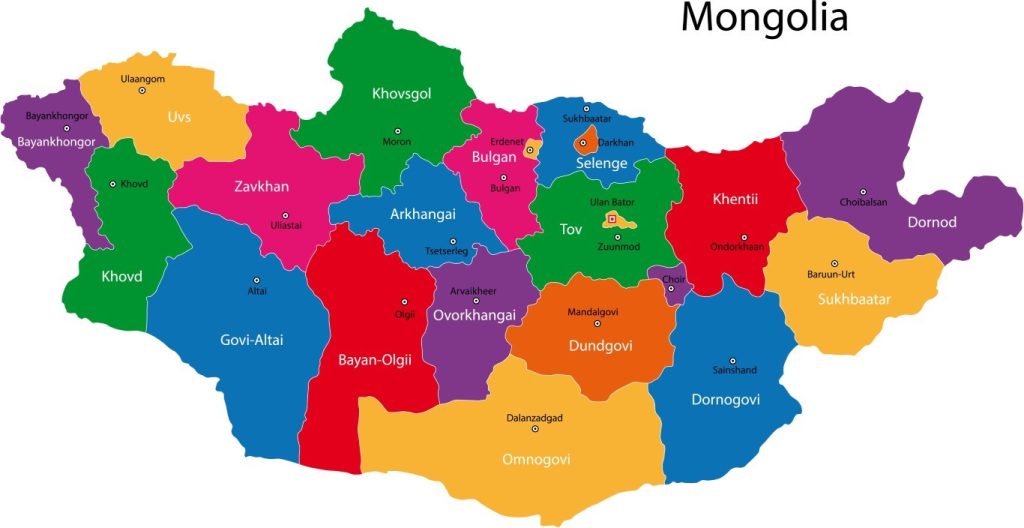
What you need to know about Mongolia ?
Mongolia is a landlocked country in East Asia and Central Asia, officially called the Republic of Mongolia. It is a semi-presidential multiparty republic.
With an area of 1,564,116 km², Mongolia is the 19th largest country in the world. Its population is estimated at about 3.2 million inhabitants in 2025, making it the least densely populated country in the world, with barely 2 inhabitants per km².
The capital and largest city is Ulaanbaatar, the political, economic, and cultural center of the country. The official language is Mongolian and the national currency is the tugrik (MNT).
Mongolia is a member of several international organizations, including the AIIB, APSCO, GGGI, G33, and CD. The international telephone code is +976.
Table – Mongolia: Geographical and demographic information
| Item | Key Information |
|---|---|
| Total area | 1,564,116 km² |
| Capital | Ulaanbaatar |
| Neighboring countries | Russia, China |
| Coastline | None (landlocked country) |
| Estimated population | ~3.5 million inhabitants (2025) |
| Population density | ~2.3 inhabitants/km² (one of the lowest in the world) |
| Relief | Steppe, mountains (Altai), Gobi Desert |
| Climate | Extreme continental: very cold winters, hot and dry summers |
| Official language | Mongolian |
| Economic resources | Coal, copper, gold, livestock (horses, sheep) |
| Special feature | Least densely populated country in the world |

Additional points on the map of Mongolia
- Mongolia is a landlocked country, wedged between Russia to the north and China to the south.
- Its physical map is dominated by vast steppes and the Gobi Desert.
- The western part of the country is home to the Altai Mountains.
- The capital Ulaanbaatar concentrates nearly half of the population.
- The country is known for its historical heritage linked to Genghis Khan and the Mongol Empire.
Which countries border Mongolia?
The map of Mongolia illustrates a vast country in Central Asia, landlocked between Russia to the north and China to the south. Its territory, made up of endless steppes, the Gobi Desert, and mountain ranges, makes it one of the wildest and least densely populated countries in the world.

Population of Mongolia
The population of Mongolia is estimated at around 3.3 million inhabitants, making it the least densely populated country in the world, with only 1.7 inhabitants per km².
- Population growth: ~1.5% per year
- Birth rate: about 20.7 ‰
- Death rate: about 6 ‰
- Life expectancy: ~68 years (66 years for men and 70 years for women)
- Sex ratio: close to balance (100 men for 100 women)
- Dominant ethnicity: Mongols (majority), with Kazakh minorities and other Turkic groups.
The colors of the Mongolian flag
The flag of Mongolia is composed of three vertical stripes: red, blue, and red. On the red stripe near the hoist is the national symbol Soyombo in yellow.
- Red: progress, strength, and prosperity of the country
- Blue: traditional Mongolian color, representing the eternal sky
- Yellow (Soyombo): sun, victory, wisdom, and independence of the Mongolian people
The Soyombo is the national emblem, symbolizing the freedom and sovereignty of Mongolia.
The best places to visit in Mongolia

Karakorum
Former capital of the Mongol Empire, Karakorum is nestled in the Orkhon valley. The city bears witness to the past grandeur of the Mongols with its historical ruins, Buddhist temples, and monuments dedicated to Genghis Khan. It is also home to the Erdene Zuu monastery, the oldest Buddhist monastery in the country.
Terelj National Park
Located near Ulaanbaatar, the Gorkhi-Terelj National Park is famous for its steep mountains, pine forests, and spectacular rock formations such as the Turtle Rock. Visitors can hike, discover nomadic camps, or enjoy the hot springs.
Ulaanbaatar
The capital, Ulaanbaatar, blends Soviet heritage and modernity. You can visit:
- the Bogd Khan Winter Palace (19th century),
- the National Museum of Mongolia,
- Sükhbaatar Square with its statue of Genghis Khan,
- and many craft markets.
It is a dynamic city that concentrates most of the country’s political, economic, and cultural life.
Gobi Gurvansaikhan National Park
In the south of the country lies the famous Gobi Desert and the Gobi Gurvansaikhan National Park. Here you can discover:
rare wildlife (gazelles, snow leopards).
This extreme environment remains inhabited by nomads, preserving an ancestral way of life.
the singing dunes of Khongoryn Els,
the frozen gorges of Yolyn Am,
Where the cities are located on the map of Mongolia ?
Karakorum
On the map of Mongolia, Karakorum is a city located right in the center of the country, situated in the northern section of the country in the Övörkhangai province. Geographic coordinates: 47° 11′ 53″ N, 102° 49′ 16″ E
Terelj National Park
On the map of Mongolia, Gorkhi-Terelj National Park is located in the central section of the country, just a few kilometers from the capital. Geographic coordinates: 48° 09′ 01″ N, 107° 34′ 34″ E
Ulaanbaatar
Ulaanbaatar, the capital of Mongolia, is located in the east-central part of the country; the city is crossed by the Tuul River in its center. Geographic coordinates: 47° 55′ 00″ N, 106° 55′ 00″ E
Gobi Gurvansaikhan National Park
The Gobi National Park is located in the southern section of Mongolia. Geographic coordinates: 43° 48′ 10″ N, 101° 35′ 23″ E
Mongolia climate map
Mongolia’s landlocked position influences its climate, which is therefore a moderate continental climate. This results in a long-lasting cold winter and a short, very hot summer. Winter temperatures are extremely cold, and in summer, they can reach 45°C during the hottest periods. Rainfall is very low in the country, so the climate tends to be desert-like and dry in summer. The territory is also influenced by the Asian monsoon.
In the northern section of the country, precipitation is frequent and reaches 3000 mm annually. In the southern section of the country, annual rainfall is low, around 200 mm. Winter is heavily snowed but not long enough. Snow cover can occur even with sunshine.
The Mongolian territory is topographically made up of a plateau between 1000 and 1500 m altitude. This makes the high summer temperatures less effective in several areas of the territory. Sometimes, these areas can experience gusty winds coming from the south and north. These winds can occur even in spring.
Sometimes during summer, strong winds can bring sand or dust storms. This is more frequent in the southeastern section of the country and lasts for almost a month per year. It is also the same in the central section, but in the north, it is less windy.
Winter in Mongolia is freezing with intense cold reaching -20°C, this cold is worsened by fast winds that can reach 72 km/h, causing an ambient cold of more than -35°C. This can cause instant freezing of living beings not sufficiently covered.
Climate in the capital Ulaanbaatar
The capital is located in the northern part of the country at an altitude of 1300 meters. It is a relatively rainy area and its topography is dominated by mountain ranges. The annual rainfall amounts to 270mm and temperatures hover around -24.5°C in winter and reach 25.5°C in summer, sometimes 38°C during hotter periods.
Economic map of Mongolia
The economy of Mongolia remains dominated by the primary sector, particularly agriculture and livestock farming. The country also has significant mineral resources: copper, coal, molybdenum, tin, tungsten, and gold, which represent the main driver of its growth.

Historically, the Mongolian economy was heavily supported by Russia, whose aid once accounted for up to 30% of GDP. Since joining the WTO, Mongolia has diversified its trade partnerships, notably with China, its main economic partner, and other neighboring countries.
Growth remains volatile and dependent on the global economic situation and Chinese demand for minerals. Foreign investments, particularly in the mining sector, have enabled a strong inflow of foreign currency and a temporary increase in GDP. However, dependence on its neighbors makes the economy vulnerable to external slowdowns.
Key economic characteristics (2025)
- Official currency: Tögrög (MNT)
- Economic status: middle-income country, developing
- International memberships: WTO, IMF, World Bank, Asian Development Bank (ADB), Shanghai Cooperation Organization (SCO)
- Nominal GDP: ~ 13.6 billion USD
- GDP (PPP): ~ 46.7 billion USD
- GDP growth (nominal): +6.9%
- GDP growth (PPP): –0.5%
- GDP per capita (nominal): ~ 4,130 USD
- GDP per capita (PPP): ~ 14,300 USD
- Inflation (CPI): ~ 5.6%
- Population below poverty line: ~ 28%
- Human Development Index (HDI): 0.735
- Unemployment rate: ~ 6.3%
Administrative and demolinguistic data
Administrative subdivisions
The Mongolian territory is divided into 22 provinces also called aimags, in addition to which there are 4 special municipalities.
List of provinces:
- Arhangaj
- Bayan-Hongor
- Bayan-Ölgij
- Bulgan
- Darhan
- Dornod
- Dornogovi
- Dundgovi
- Dzavhan
- Erdenet
- Govi-Altaj
- Khovd
- Hovd
- Hövsgöl
- Ömnögovi
- Övörkhangai
- Selenge
- Sükhbaatar
- Töv
- Ulaanbaatar
- Uvs
These provinces are in turn subdivided into soums (315), which are equivalent to federal districts.
Demolinguistic data
The population of Mongolia is mainly (85%) composed of Khalkha Mongols. The ethnic minorities are Kazakhs or Turks, Tungus, as well as Russians and Chinese. Their respective percentages are 7%, 4.6%, and 3.4%.
The Mongols speak Mongolian, with a majority of about 90% of speakers. This language, also called Khalkha, is part of the Altaic languages of the Mongolic group. Here are the subdivisions of the dialects:
Turkic
- Turkish
- Turkmen
- Uzbek
- Uyghur
- Azerbaijani
- Kazakh
- Kyrgyz
- Tatar
- Gagauz
- Karakalpak
- Bashkir
- Yakut
- Chuvash
- Tuvan or Tuvinian
Mongolic
- Khalkha (proper Mongolian)
- Oirat
- Buryat
- Kalmyk
- Shor
- Evenki
- Darkhat, etc.
Tungusic
- Manchu
- Lamut
- Even
- Nanai
- Negidal
- Oroch
- Orok
- Udege
- Ulch
FAQ – Mongolia map: 3 questions
Mongolia is located in Central Asia, landlocked between Russia and China.
The capital is Ulaanbaatar, located in the northern part of the country.
The country is characterized by its steppes, the Gobi Desert, its mountains, and its extreme continental climate.
