
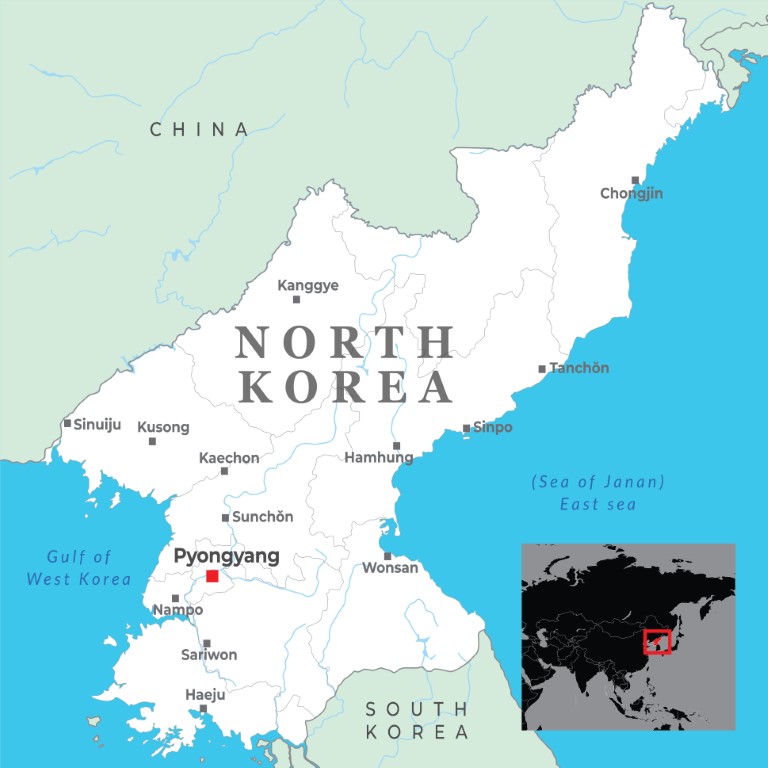
North Korea, officially the Democratic People’s Republic of Korea, occupies the northern part of the Korean Peninsula in East Asia. Bordered by China and Russia to the north and separated from South Korea by the demilitarized zone (DMZ), it opens to the east onto the Sea of Japan and to the west onto the Yellow Sea. Its capital is Pyongyang, the political, economic, and cultural center of the country. A map of North Korea allows visualization of its mountainous terrain, extensive coastline, as well as the distribution of its main cities and strategic infrastructures.
What you need to know about North Korea ?
North Korea (Democratic People’s Republic of Korea)
Telephone code: +850.
Location: situated in the northern part of the Korean Peninsula, in East Asia.
Capital: Pyongyang, the largest urban area in the country.
Official language: Korean (Munhwaŏ).
Area: 120,538 km².
Population (2025): approximately 26.3 million inhabitants.
Population density: approximately 214 inhabitants/km².
Ethnicity: population almost exclusively Korean.
Table – North Korea: Geographic and demographic information
| Element | Key Information |
|---|---|
| Total area | 120,538 km² |
| Capital | Pyongyang |
| Neighboring countries | China, South Korea, Russia |
| Coastline | Approximately 2,495 km on the Yellow Sea and the Sea of Japan (East Sea) |
| Estimated population | ~25.8 million inhabitants (2025) |
| Population density | ~210 inhabitants/km² |
| Relief | Mountainous, volcanoes (Paektu, 2,744 m), river valleys |
| Climate | Continental: cold, dry winters; hot, humid summers |
| Official language | Korean |
| Economic resources | Coal, iron, rare metals, limited agriculture |
| Particularity | Isolated country, authoritarian regime, demilitarized zone (DMZ) with South Korea |
Which countries border North Korea?
North Korea’s neighbors are: obviously South Korea, China, and Russia. These countries border it respectively to the south, to the north, and along the Yalu River also called the Amnok River.
Its territory also opens onto two maritime fronts: the Yellow Sea and the Sea of Japan (East Sea).
Additional points on the map of North Korea
- North Korea is located at the northeastern tip of Asia, on the Korean Peninsula.
- It shares a long border with China and a short border with Russia.
- To the south, the border with South Korea is marked by the DMZ (demilitarized zone).
- The physical map shows a mountainous territory, not very suitable for agriculture.
- The capital Pyongyang is located on the banks of the Taedong River.

Population of North Korea
Currently, the population of North Korea is estimated at 25.8 million inhabitants, or about 0.33% of the world population. With an area of 120,410 km², this corresponds to an average density of 214 inhabitants per km². The country ranks 54th worldwide by population.
More than 62.5% of North Koreans (about 16.1 million people) live in large urban areas. The median age of the population is 35.3 years, indicating a relatively young but aging population.
The colors of the North Korean flag
The flag of North Korea, called Ramhongsaek Konghwagukgi (“red flag”), is rectangular and composed of several elements:
- A central red band bearing a five-pointed red star inside a white circle, on the hoist side.
- Two thin white stripes framing the red band.
- Two blue bands at the top and bottom of the flag.
Meaning of the colors and symbols
- Red: communism and patriotism.
- Red star: the spirit and unity of the people.
- Blue: serenity and prosperity.
- White: purity, vigor, and elegance.
What are the best cities to visit in North Korea ?

Pyongyang
Capital of North Korea, Pyongyang is generally the first stop for visitors. Founded as early as the Neolithic according to some sources, it retains traces of the various eras that have marked it. The city is dominated by imposing monuments dedicated to Kim Il-Sung, as well as vast and symbolic squares.
You can admire the Ryugyong Hotel, a skyscraper over 300 meters tall, as well as the Pyongyang Metro, famous for its richly decorated stations in a Soviet style. The city also houses major public facilities such as the Pyongyang Theatre, the Paektusan Architectural Research Institute, and the Korea Computer Research Center.
Kaesŏng
Located in the south, near the border with South Korea, Kaesŏng is a former capital of the Koryŏ dynasty. It preserves major historical remains, such as the tomb of King Kongmin, the traditional Korean houses, and the medieval university of Songgyungwan.
Visitors also appreciate the surrounding natural sites: Mount Songak, the Taeung Pavilion, and the Kwanum Temple. Traditional hotels like the Janamsan Hotel and the Kaesŏng Hotel allow visitors to extend the experience in an authentic setting.
Nampo (Nampho)
55 km west of Pyongyang, Nampo is a port city overlooking the Yellow Sea. Once a simple fishing village, it became an important commercial port as early as 1897, then modernized after 1945. Today, it is an industrial center with large complexes such as the Nampo Glass Corporation and the Nampo Shipbuilding Complex.
The city is also known for its universities and institutes, including the Nampo Medical University and the Nampo Agricultural University.
Wonsan
Located on the east coast, Wonsan is a seaside town known for its beaches and resorts frequented by North Koreans. It also hosts the navy’s military port. Nearby, visitors can explore the Masikryong tourist area, famous for its modern ski resort, as well as the Kumgang Mountains, renowned for their natural beauty.
Chongjin
In the northeast of the country, Chongjin is a large industrial and port city. Although less open to tourism, it offers a glimpse of everyday North Korean life outside the capital. It houses several educational and cultural sites as well as an active port, essential for maritime trade.
Where are the cities located on the map of North Korea?

Pyongyang
The city of Pyongyang is located in the center of North Korea, slightly close to the Yellow Sea, it is crossed by the Taedong River. Geographic coordinates: Latitude: 39.032, Longitude: 125.75 39° 1′ 55″ North, 125° 45′ 0″ East
Kaesŏng
On the map of North Korea, the city of Kaesŏng is located inside the territory of North Korea, it is also a city very close to the border with South Korea. Geographic coordinates: 37° 58′ 01″ north, 126° 33′ 00″ east
Nampo or Nampho
Nampo is a port city overlooking the Yellow Sea or the West Sea, it is located on the tributary of the Taegeuk. Geographic coordinates: 38° 44′ N, 125° 24′ E
Climate map of North Korea
The climate of North Korea is influenced by the sea, which is why there are two types of climate in the country, namely the oceanic climate and the continental climate. There are then 4 seasons in the country including a cold winter and a hot and dry summer, there are also periods of rain between the seasons, which are also called Changma.
Winter lasts a little longer than the other seasons and is marked by frequent snowfalls coupled with violent cold winds from Siberia. Temperatures range between -3 and -13°C during this season, and more than a month of snow cover is observed.
Summer, on the other hand, is brief and strongly influenced by the two Korean monsoons coming from the South and Southeast. The relative humidity of the air is also influenced by winds from the Pacific Ocean. Thus, temperatures in North Korea during summer range between 20 and 29°C. Temperatures in the capital are similarly comparable. The rainy season often occurs between June and September. It is also the typhoon season, which arrives at the end of spring and brings significant flooding.
Economic map of North Korea
The economy of North Korea is highly centralized and entirely controlled by the government, following the model of a centrally planned economy. Since 2012, under the regime of Kim Jong Un, some economic liberalization measures have been introduced, but they remain limited and regulated by the state.

Historically, the North Korean economy has been largely supported by the Soviet Union and China. After the collapse of the Soviet bloc, the country had to strengthen its external economic relations, notably with China (and not truly with South Korea, except through occasional projects like Kaesong). Industrialization remains dominated by state industries and agricultural cooperatives. Some foreign investments exist, but they remain marginal due to international sanctions.
Key figures of the North Korean economy
- Official currency: North Korean Won (KPW)
- Nominal GDP: ~ 28.5 billion USD
- GDP (PPP): ~ 40 billion USD
- GDP growth rate: –4.1% (2018, last reliable estimate)
- GDP per capita (nominal): ~ 1,300 USD
- GDP per capita (PPP): ~ 1,700 USD
- Unemployment rate: ~ 6% of the active population
- Foreign direct investment (FDI): ~ 1.9 billion USD
- Annual revenues: ~ 3.2 billion USD
- Annual expenditures: ~ 3.3 billion USD
Administrative and demolinguistic data
Administrative subdivisions
Provinces, special administrative regions, and cities with their own administrative status make up the primary level subdivision of North Korea’s territory. There are 9 provinces in total:
- Chagang
- North Hamgyong
- South Hamgyong
- North Hwanghae
- South Hwanghae
- Kangwon
- North Pyongan
- South Pyongan
The second-level divisions are counties, cities, directly governed cities, or districts.
Here are the cities of North Korea:
- Pyongyang
- Hamhŭngb
- Ch’ŏngjin
- Nampho
- Wŏnsan
- Sinŭiju
- Tanch’ŏn
- Kaech’ŏn
- Kaesŏng
- Sariwŏn
- Sunchon
- Pyongsong
- Haeju
- Kanggye
- Anju
- Tŏkch’ŏn
- Kimch’aek
- Rasŏn
- Kusong
- Hyesan
- Jŏngju
- Hŭich’ŏn
- Hoeryŏng
- Sinpho
- Songrim
- Munch’ŏn
- Manpho
Demolinguistic data
The majority of the North Korean population (90%) speaks Korean, which is the only language understood within the Korean language family. However, there are some dialectal variations depending on territorial areas. The North Korean dialects are:
- Hamgyŏng (Northeast)
- Pyŏngan (Northwest)
- Hwanghae (Southwest)
- Gangwon (Southwest)
FAQ – North Korea map: 3 questions
It is located in the northern part of the Korean Peninsula, between China, Russia, and South Korea.
The capital is Pyongyang, located in the central-west part of the country.
The country is mountainous, with a pronounced continental climate and a coastline on two seas: the Yellow Sea and the Sea of Japan.
