
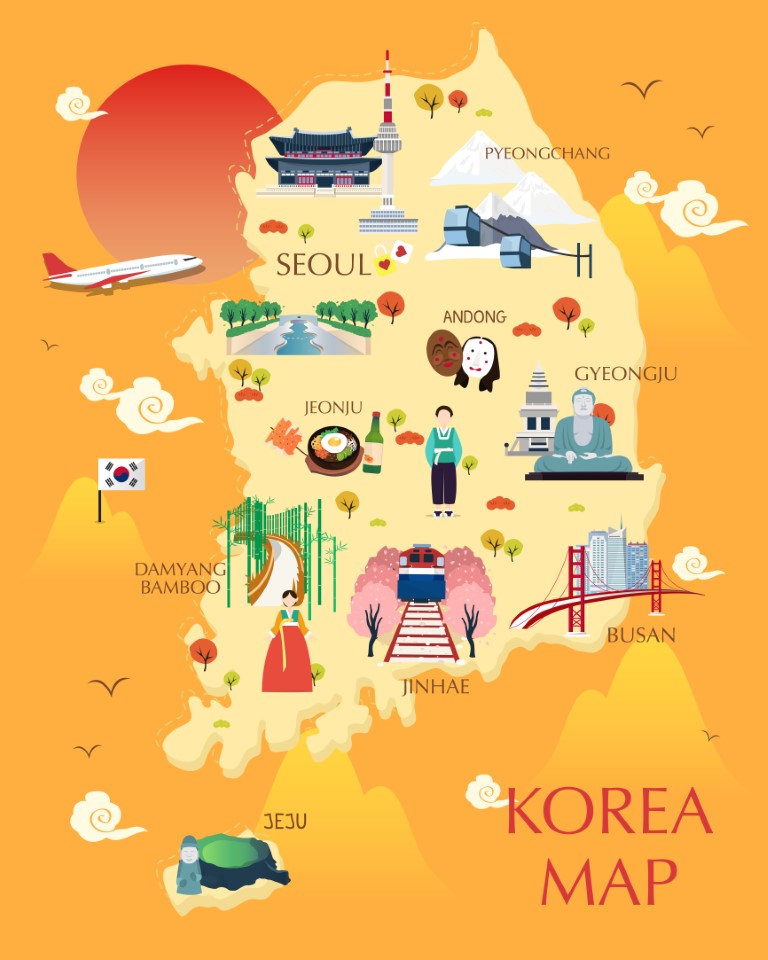
What you need to know about South Korea ?
South Korea, as its name indicates, is located in the southern part of the Korean Peninsula, in East Asia. Its official name is the Republic of Korea and it shares a land border with North Korea.
About 50% of the South Korean population lives in the metropolitan area of Seoul, making it one of the largest urban concentrations in the world.
- International dialing code: +82
- Capital and largest city: Seoul
- Official language: Korean (Pyojun-eo)
- Area: 97,230 km²
- Population (2026): approximately 51.6 million inhabitants
- Average density: 531 inhabitants/km², one of the highest in Asia
- Official currency: South Korean Won (KRW)
- Median age: 46.2 years
- Urban population: 82.8%
- Fertility rate: 0.80 children per woman (2025), the lowest in the world
- Metropolitan concentration: about 50% of the population in the Seoul area
South Korea: Geographical and demographic information
| Item | Key Information |
|---|---|
| Total area | 100,210 km² |
| Capital | Seoul |
| Neighboring countries | North Korea (to the north, via the DMZ) |
| Coastline | About 2,413 km on the Yellow Sea and the Sea of Japan (East Sea) |
| Estimated population | About 51.6 million inhabitants |
| Population density | ~520 inhabitants/km² |
| Relief | Mountainous (70% of the territory), narrow coastal plains |
| Climate | Temperate: cold and dry winters, hot and humid summers |
| Official language | Korean |
| Economic resources | Technology, automotive, steel industry, shipbuilding |
| Special feature | 10th largest economy in the world, highly urbanized and connected |
Additional points on the map of South Korea
- South Korea occupies the southern part of the Korean Peninsula.
- It is separated from North Korea by the Demilitarized Zone (DMZ).
- Its physical map shows a very mountainous country with densely populated coastal plains.
- Seoul, the capital, is located near the northern border.
- The country is bordered by the Yellow Sea to the west and the Sea of Japan (East Sea) to the east.

What are the neighboring countries?
The direct neighbor of South Korea is North Korea. It is also close to Japan across the sea. The border with North Korea is 238 km long and is located on a demilitarized zone and a 4 km buffer strip.
Population of South Korea
The population of the Republic of Korea is estimated at about 51.3 million inhabitants in 2025, or about 0.65% of the world population. The country ranks 28th worldwide by population.
With an area of 97,239 km², the average density is about 527 inhabitants/km². The population is highly urbanized, with nearly 82% of South Koreans living in cities. The median age is 43.7 years, reflecting an aging population.
The colors of the South Korean flag
The South Korean flag, called the Taegeukgi, is composed of:
- a white background, symbolizing peace and purity,
- a red and blue Taegeuk in the center, representing balance and unity in diversity,
- four black trigrams placed in each corner, symbolizing the fundamental elements of the universe (sky, earth, fire, water).
The best cities to visit in South Korea
Seoul
The South Korean capital has more than 25 million inhabitants in its metropolitan area. It is a dynamic city that blends tradition and modernity:
- the Changdeokgung Palace, dating from the 15th century,
- numerous Buddhist temples and museums,
- trendy shopping districts (Myeongdong, Gangnam),
- parks and hiking trails on the surrounding hills.
Seoul is also a global center of technology, fashion, and pop culture (K-pop, dramas).
Busan
The country’s second largest city, Busan is a port metropolis surrounded by mountains, forests, and beaches. Visitors can see:
- the Beomeosa Temple,
- natural hot springs,
- famous beaches like Haeundae and Gwangalli,
- fish markets and restaurants specializing in seafood.
Busan captivates with its varied landscapes and its atmosphere blending modernity and traditions.
Jeju
Capital of Jeju Island, this city is the gateway to a destination highly popular with Korean and foreign tourists. The island is known for:
- its Hallasan volcano,
- its beaches and waterfalls,
- its theme parks such as Jeju Loveland,
- its hotel resorts, casinos, and seaside activities.
Thanks to its mild climate, Jeju is a favored place for relaxing stays.
Incheon
Located 40 km from Seoul, Incheon is a modern and historic port city. It is known for:
- its Chinatown district,
- the Jeondeungsa temple, one of the oldest in the country,
- its port which was a strategic point during the Korean War,
- its current role as an international economic and logistics center, with one of the largest airports in Asia.
Where the cities are located on the map of South Korea ?

Seoul
The capital of South Korea, Seoul, is located in the northwest of the country, on the banks of the Han River.
- Geographical coordinates: 37° 33′ 57″ N, 126° 58′ 41″ E
- Distance:
- Seoul → Busan: about 325 km (1 hour flight / 4 h 30 by car or 2 h 30 by KTX high-speed train).
- Seoul → Jeju: about 450 km (1 h 10 flight / + ferry about 5 h 30).
- Seoul → Incheon: about 30 km (40 minutes by car).
Busan
Busan, the country’s second city, is a large port metropolis located in the south of the Korean peninsula, on the edge of the East Sea.
- Geographical coordinates: 35° 06′ N, 129° 02′ E
- Distance:
- Busan → Seoul: about 325 km (1 h / 4 h 30 / 2 h 30 by KTX high-speed train).
- Busan → Jeju: about 300 km (1 h / ferry 3 h 30 to 4 h).
Jeju
The city of Jeju is located on the volcanic island of the same name, about 85 km south of the Korean peninsula.
- Geographical coordinates: 33° 22′ N, 126° 32′ E
- Distance:
- Jeju → Seoul: about 450 km (1 h 10 / ferry + road about 5 h 30).
- Jeju → Busan: approximately 300 km (1 h / ferry 3 h 30 to 4 h).
Incheon
Incheon is located in the northwest of South Korea, very close to Seoul, and hosts one of the largest airports in Asia.
Incheon → Jeju: approximately 480 km (1 h 10).
Geographical coordinates: 37° 27′ 50″ N, 126° 38′ 55″ E
Distance:
Incheon → Seoul: approximately 30 km (40 min).
Incheon → Busan: approximately 340 km (1 h / 4 h 30).
South Korea climate map
The Republic of Korea experiences a rather cold climate in winter with noticeable heat in summer but significant rainfall. The other two seasons are brief but bearable. Winter is also strongly influenced by the Asian monsoon and cold air. Summer, on the other hand, is influenced by tropical waves of warm air. However, the winds bring a lot of rain, amounting to about 1500 mm per year.
Autumn and summer can be influenced by typhoons which also bring heavy precipitation except on the southern coast. Across all areas of the country, winter is very cold in the northern regions and inland. In the southern coastal areas, however, there is significant sunshine even in winter.

Throughout the territory of South Korea, snowfall is present but almost rare, winds often blow and bring debris and dust. Summer temperatures range between 30 and 32 °C while in winter temperatures range between -2.5°C and -4°C during the harshest seasons. Southern region: it is characterized by milder temperatures during winter, around 3°C. Sometimes, cold winds can drop temperatures down to -10° or even -20°C.
Northern region: this is mainly a mountainous area which is generally snowy in winter but in summer it is hot and humid with precipitation of 45 to 60 mm per month. In the capital, however, rainfall amounts are lower, about 20 to 25 mm per month. Throughout the entire territory, summer is marked by fairly warm temperatures but humidity makes the heat bearable. Moreover, sunny days alternate with cloudy days.
South Korea Economic Map
South Korea is a developed country with a mixed economy and industrialization strongly dominated by large family conglomerates called chaebols (Samsung, Hyundai, LG, etc.). Often cited as a success model, it has gone in a few decades from being one of the poorest countries in the world to a newly industrialized country, then a major economic power.
Today, South Korea is part of the G20, the OECD, and the Next Eleven. It is recognized as the 10th largest economy in the world by nominal GDP and one of the most innovative in the fields of technology, automotive, telecommunications, and robotics.
GDP growth remains positive, supported by exports and technological innovation, although it tends to slow down with the aging population.
Key economic features (2025)
- Official currency: South Korean Won (KRW)
- Nominal GDP: ~ 1.6 trillion USD
- GDP (PPP): ~ 2.3 trillion USD
- Global GDP ranking: 10th nominal, 14th PPP
- Annual GDP growth: ~ 2.9%
- GDP per capita (nominal): ~ 30,600 USD
- GDP per capita (PPP): ~ 44,300 USD
- Inflation rate: ~ 0.5%
Administrative and demolinguistic data

Administrative subdivisions
17 administrative divisions make up the first level of subdivision (provincial division) of South Korea: 6 metropolitan cities, 1 special city, 9 provinces, and one special autonomous province.
The second level of subdivision consists of smaller units (municipal division) which are counties, districts, cities, and townships.
Here are the municipal subdivisions:
- Seoul
- Busan
- Daegu
- Incheon
- Gwangju
- Daejeon
- Ulsan
- Sejong autonomous city
- Gyeonggi-do
- Gangwon-do
- Chungcheongbuk-do
- Chungcheongnam-do
- Jeollabuk-do
- Jeollanam-do
- Gyeongsangbuk-do
- Gyeongsangnam-do
- Jeju special autonomous province
List of South Korean cities (sub-municipal division)
- Andong
- Ansan
- Anseong
- Anyang
- Asan
- Boryeong
- Bucheon
- Busan
- Changwon
- Cheonan
- Cheongju
- Chuncheon
- Chungju
- Daegu
- Daejeon
- Dangjin
- Dongducheon
- Donghae
- Gangneung
- Geoje
- Gimcheon
- Gimhae
- Gimje
- Gimpo
- Gongju
- Goyang
- Gumi
- Gunpo
- Gunsan
- Guri
- Gwacheon
- Gwangju
- Gwangju
- Gwangmyeong
- Gwangyang
- Gyeongju
- Gyeongsan
- Gyeryong
- Hanam
- Hwaseong
- Icheon
- Iksan
- Incheon
- Jecheon
- Jeongeup
- Jeonju
- Jeju
- Jinju
- Naju
- Namyangju
- Namwon
- Nonsan
- Miryang
- Mokpo
- Mungyeong
- Osan
- Paju
- Pocheon
- Pohang
- Pyeongtaek
- Sacheon
- Sangju
- Samcheok
- Sejong
- Seogwipo
- Seongnam
- Seosan
- Seoul
- Siheung
- Sokcho
- Suncheon
- Suwon
- Taebaek
- Tongyeong
- Uijeongbu
- Uiwang
- Ulsan
- Wonju
- Yangju
- Yangsan
- Yeoju
- Yeongcheon
- Yeongju
- Yeosu
- Yongin
Demolinguistic data
The majority of the South Korean population (96.9%) speaks Korean, which is the only language understood within the Korean language family. However, there are some dialectal variations depending on territorial areas. The South Korean dialects are:
- Gangwon or gyeong-gi or Seoul dialect
- Chungcheong (Central-West)
- Jeolla (South-West)
- Gyeongsang (South-West.)
FAQ – South Korea map: 3 questions
<!– wp:yoast/faq-block {"questions":[{"id":"faq-question-1755869958386","question":"u003cstrongu003eWhere is South Korea located on the world map?u003c/strongu003e","answer":"South Korea is located in East Asia, south of the Korean Peninsula, between the Yellow Sea and the Sea of Japan.","images":[],"jsonQuestion":"u003cstrongu003eWhere is South Korea located on the world map?u003c/strongu003e","jsonAnswer":"South Korea is located in East Asia, south of the Korean Peninsula, between the Yellow Sea and the Sea of Japan.","jsonImageSrc":""},{"id":"faq-question-1755869963188","question":"u003cstrongu003eWhat is the capital of South Korea visible on the map?u003c/strongu003e","answer":"The capital is Seoul, a modern megacity near the North Korean border.”,”images”:[],”jsonQuestion”:”u003cstrongu003eWhat is the capital of South Korea visible on the map?u003c/strongu003e”,”jsonAnswer”:”The capital is Seoul, a modern megacity near the North Korean border.”,”jsonImageSrc”:””},{“id”:”faq-question-1755869968157″,”question”:”u003cstrongu003eWhat are the main geographical features of South Korea?u003c/strongu003e”,”answer”:”The country is mostly mountainous, with densely populated coastal plains and a highly developed coastline.”,”images”:[],”jsonQuestion”:”u003cstrongu003eWhat are the main geographical features of South Korea?u003c/strongu003e”,”jsonAnswer”:”The country is mostly mountainous, with densely populated coastal plains and a highly developed coastline.”,”jsonImageSrc”:””}]} –>
South Korea is located in East Asia, south of the Korean Peninsula, between the Yellow Sea and the Sea of Japan.
The capital is Seoul, a modern megacity near the North Korean border.
The country is mostly mountainous, with densely populated coastal plains and a highly developed coastline.
