
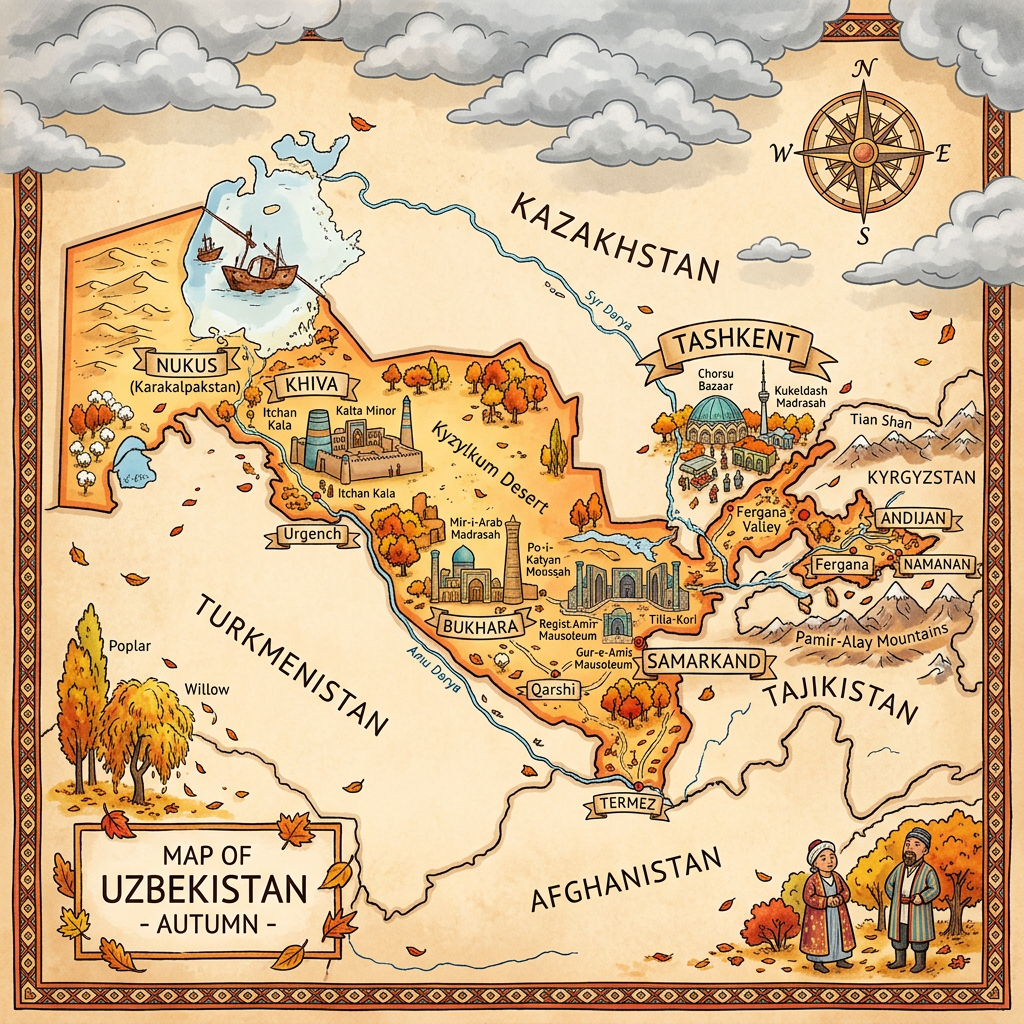
What you need to know about Uzbekistan ?
Uzbekistan is a semi-presidential republic in Central Asia.
- The area of its territory is 447,400 km², making it the 55th largest country in the world.
- Its population is estimated to be around 36.7 million inhabitants in 2025, with an average density of about 82 inhabitants/km².
- Uzbekistan is the 37th most populous country in the world.
Its capital and largest city is Tashkent, the political, economic, and cultural center of the country. The official language is Uzbek.
The country is a member of several international organizations, including the AIIB, the Turkic Council, and the ECO.
The international dialing code is +998.
Table – Uzbekistan: Geographic and demographic information
| Item | Key Information |
|---|---|
| Total Area | 447,400 km² |
| Capital | Tashkent |
| Neighboring Countries | Kazakhstan, Turkmenistan, Afghanistan, Tajikistan, Kyrgyzstan |
| Estimated Population | ~36 million inhabitants (2025) |
| Population Density | ~80 inh./km² |
| Relief | Steppes, deserts (Kyzylkum), mountains in the east |
| Climate | Dry continental: very hot summers, cold winters |
| Official Language | Uzbek |
| Economic Resources | Cotton, gas, gold, uranium, agriculture |
| Special Feature | One of only two doubly landlocked countries in the world (with Liechtenstein) |
Additional points on the map of Uzbekistan

- Located in Central Asia, Uzbekistan is a landlocked country with no access to the sea.
- Its physical map shows the Kyzylkum Desert occupying a large part of the territory.
- The east is more mountainous, especially towards the Fergana Valley.
- Tashkent is the capital and largest city, but Samarkand and Bukhara are famous for their historical heritage.
- The country was part of the Silk Road, connecting Asia to Europe.
Colors of Uzbekistan
The Uzbek flag is a rectangular flag with a 1:2 ratio, composed of 3 colors arranged in horizontal stripes: Blue, White, and Green, separated by two thin red stripes. In the top left corner, near the hoist, there is a crescent moon and 12 white five-pointed stars.

Best places to visit in Uzbekistan

Bukhara
Former capital of Uzbekistan and listed as a UNESCO World Heritage Site, Bukhara is a true open-air museum. You can discover there:
- the Ark Fortress, former residence of the emirs,
- the Ulugbek madrasa, one of the oldest in the country,
- the Kalon minaret and mosque, symbols of the city,
- as well as numerous historic caravanserais and bazaars.
Samarkand
Renowned for its splendor, Samarkand was one of the jewels of the Silk Road and remains a must-visit city. Its UNESCO-listed monuments include:
- the famous Registan Square, surrounded by three madrasas with blue domes,
- the Gur-Emir mausoleum, tomb of Tamerlane,
- the Bibi-Khanum mosque, one of the largest in the medieval Islamic world,
- the Shah-i-Zinda necropolis, a complex of richly decorated mausoleums.
Tashkent
Modern capital and largest city of the country, Tashkent combines tradition and modernity. Must-see:
- the Chorsu market, a huge covered bazaar,
- the Khast Imam mosque, religious center of the city,
- the public gardens and parks such as Alisher Navoi Park,
- the Tashkent metro, famous for its richly decorated stations.
Khiva
Museum city listed by UNESCO, Khiva is another essential stop. Its historic center, Itchan Kala, is surrounded by perfectly preserved walls. You can find there:
- the Islam Khodja minaret,
- the Tash Khauli palace,
- the Mohammed Amin Khan madrasa,
- as well as numerous mosques and former merchant residences.
Ferghana Valley
Less known on classic tours, the Ferghana Valley is famous for its lush landscapes and craftsmanship. It is particularly known for:
- Margilan silk,
- Rishan ceramics,
- and its lively traditional markets.
Kyzylkum desert
For nature lovers, the Kyzylkum Desert offers a unique immersion into Uzbek steppes and dunes. You can visit:
- and enjoy excursions to Aydar Lake.
- traditional yurts,
- archaeological sites such as Ayaz-Kala,
Where is Uzbekistan located on the world map?
On the world map, Uzbekistan is located in Central Asia, at the heart of the Asian continent. It is a landlocked country, without access to the sea, bordered by five neighbors: Kazakhstan to the north and west, Kyrgyzstan to the northeast, Tajikistan to the southeast, Afghanistan to the south, and Turkmenistan to the southwest.

The map of Uzbekistan highlights a landlocked country in Central Asia. It shares its borders with Kazakhstan to the north and west, Turkmenistan to the southwest, Afghanistan to the south, Tajikistan to the southeast, and Kyrgyzstan to the east. Its history and cities like Samarkand testify to its central role on the ancient Silk Road.
Climate of Uzbekistan
The Uzbek climate is characterized as continental. This translates into hot summers and mild winters. During the summer season, temperatures can exceed 40°C, and during the winter period, temperatures range between -2°C and -40°C. Almost the entire Uzbek territory is semi-arid because annual rainfall ranges around 100 to 200 mm and mainly occurs during the winter period or early in the year. Conversely, the periods between July and September show low precipitation.
Administrative division of Uzbekistan
Here are the main subdivisions of Uzbekistan:
First level: Republic of Karakalpakstan, City of Tashkent, Region
Second level: City of regional subordination, Districts, County, City of regional subordination
Third level: Urban-type settlement, City, Village citizens’ assembly, Urban-type settlement
Last level: Village citizens’ assembly, urban-type settlement, subordination of the district city.
First level of subdivision:
- City of Tashkent
- Andijan
- Bukhara
- Fergana
- Jizzakh
- Namangan
- Navoiy
- Kashkadarya
- Samarkand
- Syr-Darya
- Surkhandarya
- Tashkent
- Khorezm
- The Republic of Karakalpakstan
Second level of subdivision:
- Amudarya
- Beruniy
- Chimboy
- Ellikqala
- Kegeyli
- Mo‘ynoq
- Nukus
- Qonliko‘l
- Qo‘ng‘irot
- Qorao‘zak
- Shumanay
- Taxtako‘pir
- To‘rtko‘l
- Xoʻjayli
Economy of Uzbekistan

The Uzbek economy remains marked by its Soviet heritage, with a strong presence of agriculture (notably cotton, cereals, vineyards, and cattle and sheep farming) and a growing industrialization (textiles, chemicals, energy, mining). Since the economic reforms undertaken in recent years, the country has been opening up more to foreign investments and diversifying its exports.
- Official currency: Uzbek som (UZS)
- Nominal GDP: ~111 billion USD (2024)
- GDP (PPP): ~397 billion USD (2024)
- Annual GDP growth: ~5.5% (2024)
- GDP per capita (nominal): ~3,000 USD
- GDP per capita (PPP): ~10,700 USD
- Inflation: ~10% (high rate but gradually decreasing)
- Population below poverty line: ~14–15% (significantly down from 33% before 2015)
- Exports: ~25 billion USD (mainly gas, gold, cotton, fruits, and vegetables)
- Imports: ~30 billion USD (machinery, chemicals, metals, consumer goods)
- Public debt: ~35% of GDP
- Public revenues: ~15 billion USD
- Public expenditures: ~20 billion USD
Population and linguistic data of Uzbekistan
In 2025, the population of Uzbekistan is estimated at about 36.7 million inhabitants, with a growth rate of about 1.2% per year.
- Birth rate: ~22 ‰
- Death rate: ~5 ‰
- Life expectancy: ~72 years (70 years for men, 74 years for women)
- Median age: ~29 years
- Sex ratio: about 99 men per 100 women
Linguistic composition
- Uzbek (official, ~74%)
- Russian (~12–14%, mainly urban and administrative)
- Tajik (~4–5%, mainly in the Fergana Valley and Samarkand)
- Others: Kazakh, Karakalpak, Tatar, Turkmen, etc. (~7%)
Ethnic Composition
- Uzbeks: ~80%
- Russians: ~5%
- Tajiks: ~5%
- Kazakhs: ~3%
- Karakalpaks: ~2.5%
- Tatars: ~1.5%
- Other minorities: Koreans, Turkmens, etc.
Religion
The majority of the population is Sunni Muslim (about 90%), with a minority of Shiites and small Russian Orthodox and Christian communities.
FAQ – Uzbekistan map: 3 questions
It is located in Central Asia, between Kazakhstan, Turkmenistan, Afghanistan, Tajikistan, and Kyrgyzstan.
The capital is Tashkent, a major metropolis of Central Asia.
The country is dominated by steppes and the Kyzylkum desert, with mountains to the east and fertile valleys like the Fergana Valley.
