
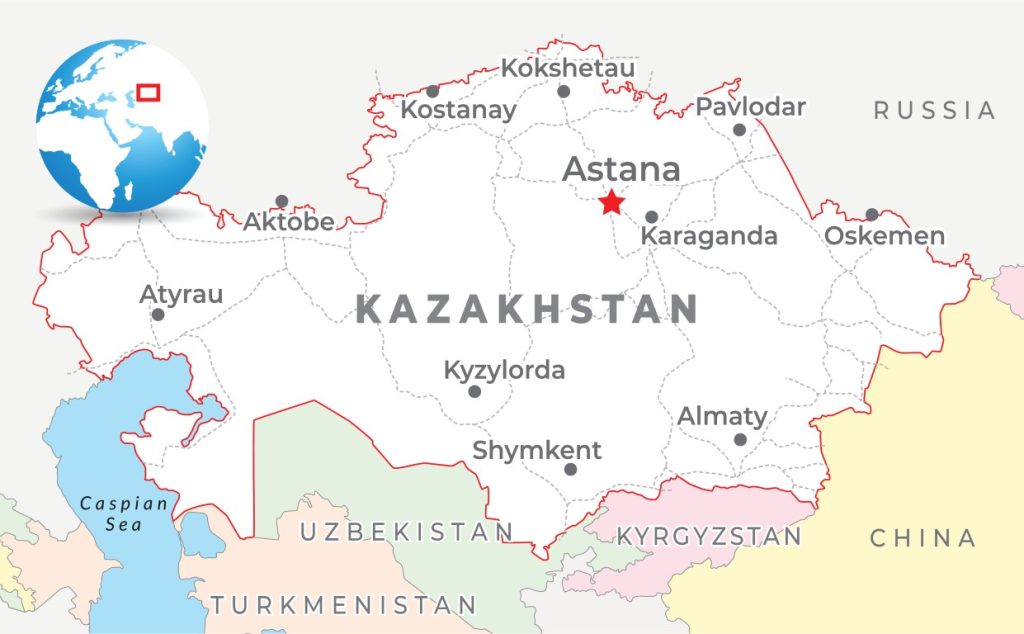
Discovering Kazakhstan through a geographical map offers an incredible panorama of one of the largest countries in the world. In Central Asia, Kazakhstan fascinates with its vast spaces, the natural and cultural diversity of its territory, as well as the richness of its history. Whether you are a geography enthusiast, a travel lover, or simply curious to learn more about this unique region, consulting a map provides many valuable insights.
General presentation of Kazakhstan
Located in the heart of Central Asia, Kazakhstan stands as the ninth largest country on the planet. Its area is approximately 2.7 million square kilometers, making it a territory comparable in size to many European countries combined.
On a geographical map, this vastness immediately stands out: endless steppes to the north, mountain ranges to the east, arid deserts to the south, and winding rivers to the west compose a spectacular landscape.
Over time, the Kazakh population has adapted to this varied environment, creating a culture deeply rooted in the wild nature and mobility. This gigantic, often little-known territory reveals on a simple map the complexity of its reliefs, the extent of its uninhabited lands, and the importance of its major metropolitan areas.
Table – Kazakhstan: Geographical and demographic information
| Element | Key Information |
|---|---|
| Total Area | 2,724,900 km² (9th largest country in the world) |
| Capital | Astana (formerly Nur-Sultan) |
| Neighboring Countries | Russia, China, Kyrgyzstan, Uzbekistan, Turkmenistan |
| Estimated Population | ~20 million inhabitants (2025) |
| Population Density | ~7 inhabitants/km² |
| Relief | Steppes, deserts, mountains in the southeast (Tien Shan, Altai) |
| Climate | Continental: cold winters, hot and dry summers |
| Official Languages | Kazakh, Russian |
| Economic Resources | Oil, gas, uranium, wheat |
| Particularity | Largest landlocked country in the world, between Europe and Asia |
Additional points on the map of Kazakhstan
- Kazakhstan is located straddling Central Asia and Europe (Ural border).
- Its map reveals immense steppes and semi-desert areas.
- The country borders the Caspian Sea, but has no access to a global ocean.
- Astana (formerly Nur-Sultan) is a modern capital built in the north of the country.
- The demographic map shows a population concentrated in the south and east, notably around Almaty.
The map of Kazakhstan highlights a vast country in Central Asia, bordered by Russia to the north, China to the east, Kyrgyzstan and Uzbekistan to the south, as well as Turkmenistan to the southwest. Its territory, dominated by steppes and deserts, makes it a pivotal area between Europe and Asia.
Understanding the borders and neighboring countries of Kazakhstan
By consulting a detailed map of Kazakhstan, one quickly becomes aware of the uniqueness of its borders. Sharing boundaries with five states, it occupies a strategic position between Europe and Asia, weaving connections with each of its neighbors. These exchanges have shaped its identity and contributed to forging a cultural mosaic, visible throughout the territory.

The total length of its land borders exceeds 12,000 kilometers, reminding us how Kazakhstan’s geopolitical and economic integration is part of the region’s complex history.
Which countries border Kazakhstan?
Kazakhstan shares its borders with Russia, China, Kyrgyzstan, Uzbekistan, and Turkmenistan. This border situation creates a true crossroads between different civilizations and contributes to the linguistic richness as well as the variety of landscapes visible from a precise geographical map.
The relationships established with these neighboring countries influence both daily life and main trade routes, linking ancient roads, such as the Silk Road, to modern routes essential for the movement of goods and people.
What are the characteristics of Kazakhstan’s borders?
Long and sometimes changing, Kazakhstan’s borders reflect its past or current alliances and define areas crossed by important watercourses or marked by impressive mountain ranges. The border line with Russia is the longest uninterrupted land border in the world, while the eastern edge, near China, is distinguished by its inhospitable high plateaus.
These specificities further strengthen Kazakhstan’s role as a passage and exchange point, benefiting not only within Central Asia but also with neighboring powers.
Anatomy of a map of Kazakhstan
A geographical map of Kazakhstan reveals in detail the contrasts of the relief and the distribution of strategic or remarkable natural sites. Between desert areas, large plains, mountain ranges, and vast protected expanses, each mapped element reflects the country’s extraordinary diversity.

Careful analysis of these elements provides a global view of how the territory is structured around major cities, main road axes, and essential ecological sites.
How to identify the main cities?
On a map of Kazakhstan, certain cities stand out due to their demographic, economic, or historical importance. Nur-Sultan (formerly Astana) serves as the political and administrative center, while Almaty remains a key cultural and financial hub. Other municipalities, such as Karaganda, Shymkent, or Aktau, appear as important landmarks in territorial organization and regional development.
Identifying these urban centers on a map helps to better understand the urban dynamics that traverse the country and influence both internal migration movements and international flows.
Where are the main road axes located?
The roads and road axes appear very clearly on the majority of official maps of Kazakhstan. The network connects the major urban areas with each other while ensuring linkage with rural regions. Several major axes follow the ancient Silk Road, reflecting a millennia-old tradition of exchange.
Exploring how these infrastructures are organized sheds light on the level of connectivity of Kazakh territory, essential to support economic growth and promote population mobility.
Nature, natural reserves, and biodiversity on the map of Kazakhstan
Any nature enthusiast will be captivated by the abundance of national parks and the raw beauty of the landscapes offered by Kazakhstan. A careful observation of a geographical map reveals the ecological richness, reflecting a balanced territorial management between modernity and preservation of natural resources.

The reliefs and climatic diversity favor the establishment of vast protected ecosystems, true sanctuaries for the fauna and flora characteristic of Central Asia.
- The Altyn-Emel National Park, renowned for its singing dunes.
- The Kolsai Nature Park, famous for its sparkling lakes surrounded by wooded mountains.
- The Charyn Park and its spectacular canyons, witnesses of geological time.
- Remarkable ornithological zones, notably around Lake Tengiz.
These national parks represent on the map a clear intention to reconcile sustainable tourism and the preservation of rare species present in the region. Observing where they are located in relation to the main cities provides information on the accessibility of these biodiversity havens.
Hydrography: rivers, streams, and lakes on the map of Kazakhstan
The hydrological map of Kazakhstan is marked by large river basins that irrigate the country and supply a significant portion of the population. Even though a good part of the territory remains arid, the presence of certain rivers and streams remains an essential factor to understand agricultural and urban structuring.
The Aras, Irtysh, Ural, and Syr Darya are among the major navigable waterways highlighted on most topographic maps. Their vital role in local economic development is well established, as is the special place once occupied by the Aral Sea, now reduced to modest stretches following large-scale Soviet irrigation projects.
Population, density, and urbanization across the map of Kazakhstan
Analyzing a thematic map highlighting the Kazakh population clearly demonstrates the contrasts in settlement. The population density remains low across much of the territory, especially outside the major cities, a direct consequence of the vast area covered by the country.
Nearly 20 million inhabitants currently populate Kazakhstan, but most residents are concentrated in a few main urban centers and along strategic routes. This distribution reflects both the influence of natural resources, easier access to water, and economic infrastructures that allow the maintenance of stable communities despite sometimes harsh climates.
- Astana (Nour-Soultan), administrative capital
- Almaty, former capital and commercial center
- Shymkent, industrial locomotive of the south
- Aktobe, western gateway
Comparing the location of these cities to the position of major roadways and agricultural zones sheds light on the land use strategy and the progressive development of the national urban fabric.
Why does the map of Kazakhstan attract so much curiosity?
Kazakhstan, often cited as a bridge between East and West, intrigues with the variety of its landscapes and the monumental size of its area. Exploring a geographical map of the country is like virtually traveling between desert, steppe, modern city, and mountain range. Using the map is therefore an excellent way to plan trips or better understand local issues in terms of population, nature, roads, and borders.
Each glance reveals a new facet of this Central Asian country, unveiling human, heritage, and natural wealth. Thanks to careful reading of the Kazakh map, understanding the contemporary realities of the country becomes more precise, opening the way to genuine discoveries on the ground.
FAQ – Kazakhstan map: 3 questions
Kazakhstan is located in Central Asia, between Russia, China, and the Central Asian countries.
The capital is Astana (formerly Nur-Sultan), while Almaty remains the largest city.
The country is dominated by vast steppes and deserts, bordered by the Caspian Sea and mountains to the southeast.
