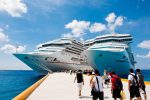
Every year, thousands of travelers board to discover Norway by sea. And we understand them. A cruise in these waters is probably the only way to see these landscapes as they were carved: from the water, very small, with walls rising on each side over a thousand meters. No road, no train offers that viewpoint.
📋 The essentials at a glance: Personally, I consider that a cruise in the Norwegian fjords is mainly prepared around 3 key choices: the season, the itinerary, and the type of boat. Between mid-April and September, the landscapes are greener, the days longer, and the stops easier to organize.
Why the boat changes everything
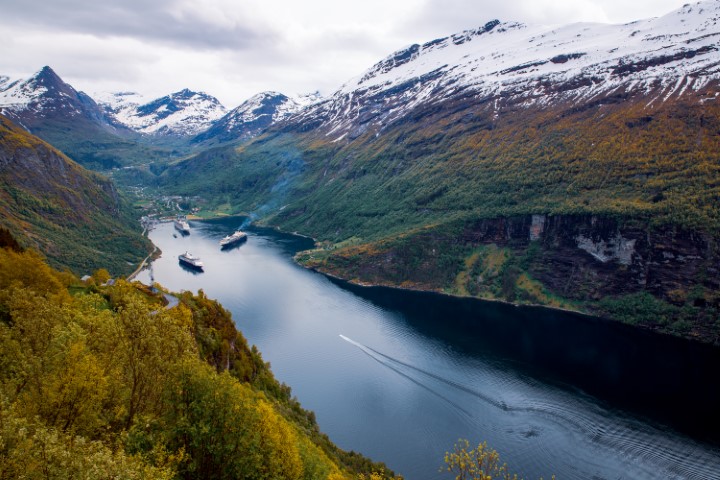
You can admire a fjord from a viewpoint. It’s beautiful, yes. But it’s not the same story as a cruise in the Norwegian fjords. From a road, you see the summit. From the deck of a ship, you grasp the whole: the height of the cliffs, the narrowing width, the waterfalls rushing down the rock just above you.
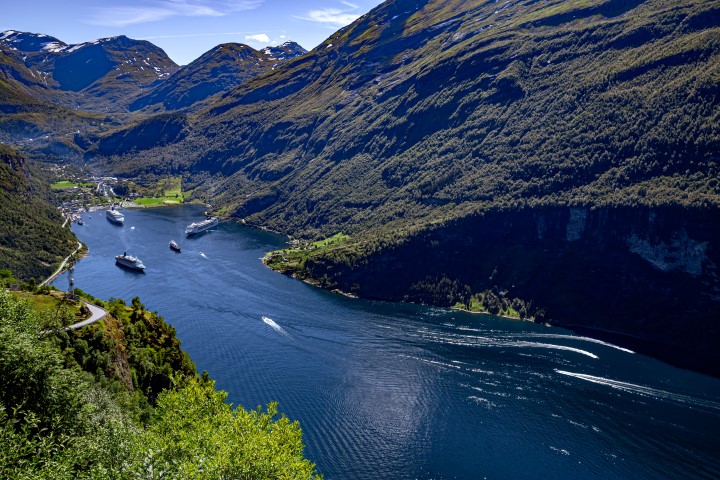
The Sognefjord really gives the scale. It is the longest and deepest in Norway: 204 kilometers inland, and in places more than 1,300 meters deep. Crossing it by boat makes you feel tiny, in a good way. Add to that the comfort onboard, full board, the stops that follow one another without having to drive, and the appeal becomes obvious.
Stops worth the detour
Itineraries vary from one company to another, but some stops almost always come up. Rightly so.
Bergen, the starting point
Most cruises set off from Bergen. An old Hanseatic city wedged between sea and mountains, the city has character. Its colorful wooden houses on the Bryggen quay have been UNESCO-listed since 1979. Before boarding, take the funicular up to Mount Fløyen for the view, and take a walk at the fish market. Half a day is enough to get into the mood.
Geiranger, the highlight of the show
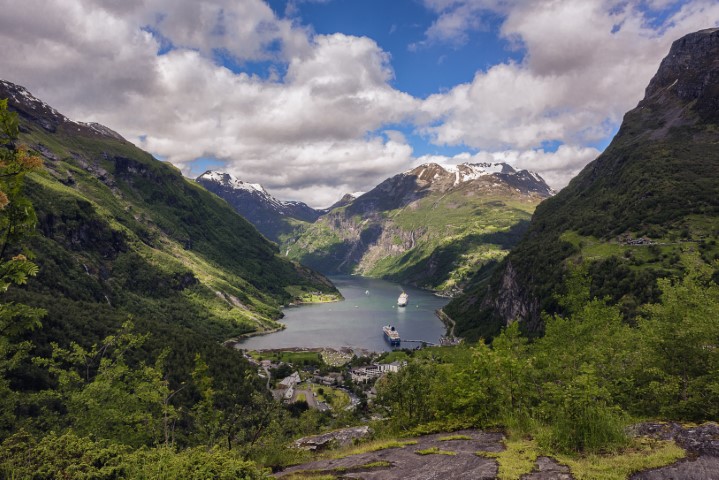
The Geirangerfjord is often the highlight of the trip. Listed as a UNESCO World Heritage Site since 2005 along with the Nærøyfjord, it features steep walls and famous waterfalls, such as the Seven Sisters or the Bridal Veil. At the end of the fjord, the small village of Geiranger serves as a base for hikes and panoramic viewpoints. Climb up to Dalsnibba if the stop allows: the panorama there is hard to forget.
Ålesund, Flåm, and the others
The other stops each have their own identity. Ålesund stands out for its Art Nouveau architecture, rebuilt after a great fire at the beginning of the 20th century. Flåm, nestled at the end of the Aurlandsfjord, is the departure point of a spectacular mountain train that climbs in an hour through valleys and waterfalls. Further north, Olden opens access to the Briksdal glacier, and Trondheim deserves a stop for its cathedral and student atmosphere. The Nærøyfjord itself is only 250 meters wide at its narrowest point. A unique sensation.
Summer or winter: two different journeys
| Period | Atmosphere | Highlights | What to expect |
|---|---|---|---|
| April to May | Cool spring | Powerful waterfalls, snow at altitude | Warm clothes, changing weather |
| June to August | High season | Long days, green landscapes, more excursions | Higher prices, busier ports |
| September | End of season | Softer colors, calmer atmosphere | Possible rain, dropping temperatures |
| October to March | Winter experience | Northern lights, snow, wilder atmosphere | Cold, different routes, short days |
The choice of season changes everything, much more than the itinerary.
From May to September, the climate remains mild, the days lengthen, and the waterfalls are swollen by the melting snow. It is also the window for the midnight sun. North of the polar circle, the sun no longer dips below the horizon for several weeks: at midnight, the fjord still shines with a golden, low light. Seen from the deck, it is a suspended moment.
Winter, on the other hand, plays a completely different tune. The fjords are covered with snow, the cold bites, and the sky sometimes comes alive with northern lights. These green and purple veils above the mountains alone are worth the trip. Some cruises even adjust their course northward to maximize the chances of seeing them. Nothing is guaranteed, the weather decides. But when it happens, it is unforgettable.
Duration, budget, and life on board
Regarding formats, there is something for every pace. Count 3 to 5 days for a first approach around Bergen, 7 to 10 days for a classic itinerary with several stops, and 12 days or more to push up to the far north and brush the Arctic. My advice: if you can, opt for the longer duration. The fjords are best savored slowly, and rushing from one stop to another spoils the experience a bit.
Prices vary greatly. Several factors play a role: the season, the ship’s rating, the view from the cabin, the number of included excursions. Many packages include full board, sometimes guided tours. Be attentive to what the displayed price really covers, as shore excursions can quickly add up.
Life on board oscillates between relaxation and discovery. Panoramic lounges to watch the shores go by, wellness areas with sauna, restaurants highlighting Nordic products. Families often find a kids’ club, and lectures on geography or local culture punctuate the sailing days. When evening comes, the good reflex is to go up to the upper deck. For a last golden ray in summer. To watch for the auroras in winter.
Some tips before booking
Book early, especially for summer: the best cabins go fast. Plan warm clothes even in July, as the wind on the fjords remains cool. And choose a cabin with a balcony or porthole if the budget allows, because here, the landscape is part of the journey at every moment.
An experience that leaves a mark
Ultimately, a fjord is contemplated from above, but felt from below. The cruise has this rare power to place the traveler at the heart of the scenery, rocked by the water, without any organizational effort. If Norway is on your list, put the cruise at the top of yours. It’s the kind of memory that withstands time.
To complete the preparation, I recommend how much a cruise costs, useful for setting the budget before booking. If you want to compare itinerary styles, choosing your itinerary also provides good guidelines. And to expand the trip towards the North, visiting Scandinavia nicely complements this guide.