
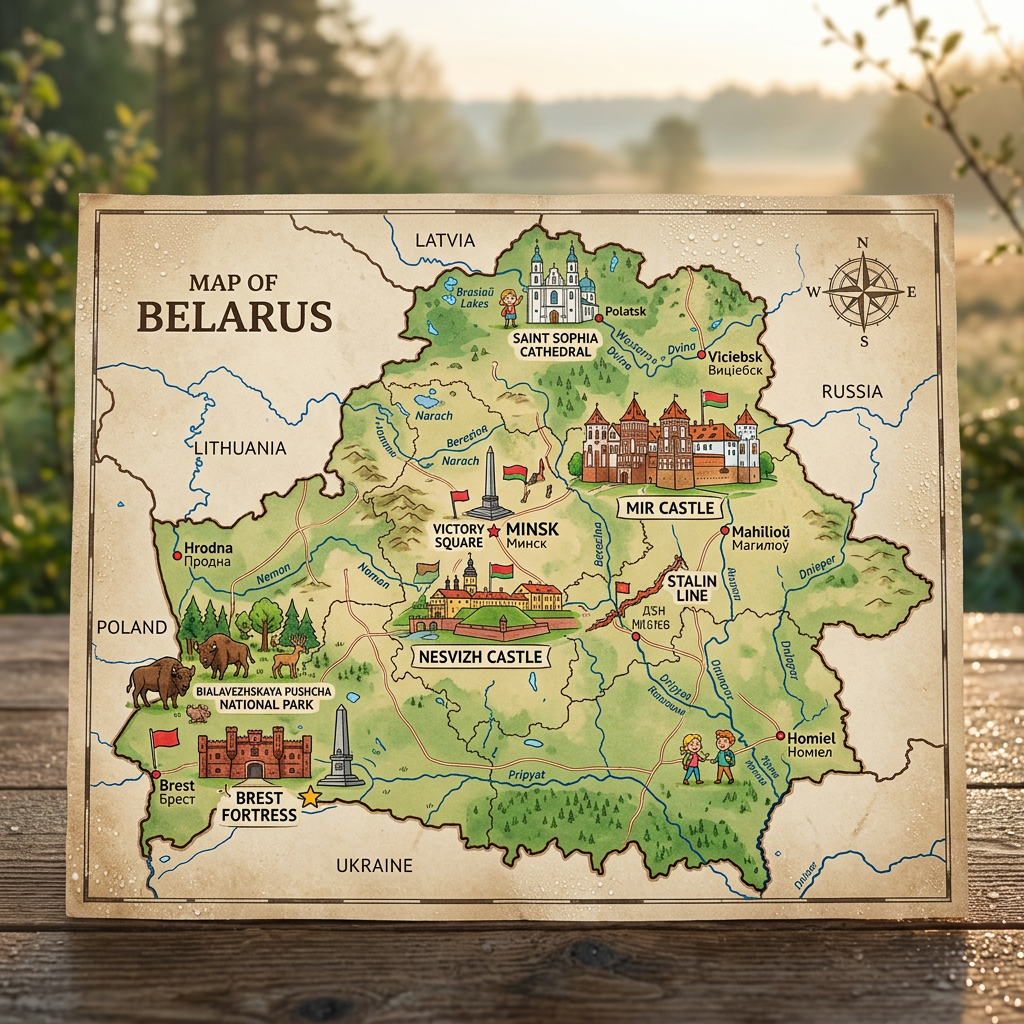
What you need to know about Belarus ?
Belarus is a country in Eastern Europe, bordered on all sides by other countries such as Ukraine, Poland, Russia, and Lithuania. The area of Belarus amounts to 207,600 km2, ranking it 84th in size compared to other countries in the world.
The population of Belarus is currently estimated at around 9.1 million people. With a total area of approximately 207,600 km² (80,200 sq mi), the country has an average population density of about 44 people per square kilometer, which is relatively low compared with many European countries.
The capital city, Minsk, is the country’s largest city and is home to nearly 2 million inhabitants. It serves as Belarus’s political, economic, industrial, and cultural center. Although Minsk is the most populous city in the country, it is not ranked among the world’s most densely populated cities.
Moreover, Belarus is home to the geographical center of Europe, which is Polotsk. In fact, there is a monument to this effect in the city. The telephone code in Belarus is 375, that is 00375 or +375.
The most popular cities in Belarus

Main attractions
Minsk
It is the capital of Belarus and also a very popular tourist destination. If you go there, you can enjoy the Gorky Central children’s parks located near the Belarusian Circus. There is also the Aleksandrovsky Garden: a very popular botanical garden. Finally, visit the botanical garden of the National Academy of Sciences as well as the Victory Park.
Brest
Brest is the largest city in Belarus, containing many historical monuments. Among them is the Brest Fortress. There are also other interesting places such as Sovetskaya Street, a pedestrian street full of cafes and restaurants to have a good time.
Nesvizh
Nesvizh is also a large city located 120 km from the capital. Tourists go there to visit the Nesvizh Castle as well as the Mir Castle. Don’t forget to visit the parks surrounding the castle and the churches of Nesvizh.
Polotsk
Polotsk was the former Belarusian capital. Currently, it is the cultural capital filled with interesting attractions such as the Polotsk Sophia Cathedral. It is also the geographical center of Europe, surrounded by many churches.
Grodno
This city is especially famous for the two castles it has. They are called the new and the old. There is also the Farny Church, the Pharmacy Museum, the old town, and various parks.
Where Are the cities located on the map?

Minsk
On the map, Minsk is located in the center of the country, that is between the foothills of the Minsk region. The distances between Minsk and Kiev, Warsaw, Moscow are respectively 437 km, 476 km, and 676 km in the northwest, northeast, and southwest directions from each city. Its geographical location is 53° 55′ 45″ north, 27° 29′ 46″ east.
Brest
The city of Brest is located in the West on the map, near Poland. The distances separating the city from Minsk and Warsaw are 328 km and 184 km respectively. Its geographical location is 52° 05′ north, 23° 42′ east.
Nesvizh
It is a city located to the Southwest of the capital and to the Northwest of Slutsk, at distances of 96 km and 62 km respectively. Geographical location: 53° 13′ 01″ north, 26° 40′ 01″ east
Polotsk
Crossed by the Dvina river, Polotsk is a city located to the Northwest of the Belarusian capital. The two cities are 193 km apart. Geographical location: 55° 29′ north, 28° 48′ east
Grodno
It is the city closest to Poland on the map. Only 15 km separate Grodno and the Polish border. It is crossed by the Neman river. Geographical location 53° 40′ north, 23° 49′ east
Belarus climate map
The climate of Belarus is characterized by heavy snowfall from December to March in winter. Summer, on the other hand, is hot and short. These features are typical of a temperate-continental climate with similarities to a moderate Central European climate.
The country averages 7°C throughout the year. And the climate is more or less uniform across all regions of Belarus due to the small size of Belarus. Temperatures are about -5° to 0°C in winter and 25 to 30°C in summer.
Winter lasts about 3 to 4 months during which strong winds and snowstorms occur in the country. Summer, on the other hand, lasts about 5 months; during this period Belarus is quite sunny and dry. This period is also marked by violent thunderstorms that occur especially in the late afternoon.
Spring and autumn are seasons influenced by the Atlantic influence. It will therefore be both humid and rainy, even snowy in the second half of October. Rain can occur in all seasons. Average precipitation reaches up to 600 mm.
Belarus financial map
The economy of Belarus experienced several periods of growth over recent decades, supported mainly by its industrial sector, international trade, and close economic ties with Russia. This growth helped improve living standards and gradually reduce the proportion of the population living below the poverty line.
In recent years, however, the economic situation has become more challenging. International sanctions, slower investment, geopolitical tensions, and the country’s strong economic dependence on Russia have affected its overall performance. The Belarusian economy continues to rely heavily on manufacturing, petrochemicals, agriculture, and exports, while the government is also seeking to diversify growth sectors to strengthen the country’s long-term economic resilience.
Here are some economic indicators:
- Current Currency: Belarusian Ruble (Br)
- Gross Domestic Product at nominal parity: approximately US$78 billion
- Gross Domestic Product at PPP: approximately US$250 billion
- Gross Domestic Product Growth : approximately 4.0%
- Gross Domestic Product per capita : approximately US$27,000
- Population below the poverty line: official data are limited, estimated at less than 6%
- Unemployment rate: approximately 3%
- Exports:approximately US$40 billion
- Public revenues:approximately US$30 billion
- Public expenditures: approximately US$31 billion
Demographic and Administrative Map of Belarus
Demographics of Belarus
The population of Belarus is currently estimated at around 9.1 million people, according to the latest demographic estimates. This represents just over 0.1% of the world’s population. In recent years, the country has experienced a gradual population decline due to low birth rates, an aging population, and migration trends.
Globally, Belarus ranks among the world’s medium-sized countries by population. Most residents live in the country’s major cities, especially Minsk, while several rural areas have experienced a gradual decline in population.

The population of Belarus has an average density of approximately 44 people per square kilometer, which is relatively low compared with many European countries. Around 80% of the population lives in urban areas, mainly in Minsk and the country’s other major regional cities. The median age is now around 41 years, while the fertility rate remains below the replacement level.
Life expectancy at birth is approximately 74 years, with women living longer on average than men. For several years, Belarus has experienced a gradual population decline, mainly because of low birth rates, population aging, and migration, although the country’s largest cities continue to attract most of its residents.
Administration of Belarus
The administrative map of Belarus was established in 1960 while Belarus was part of the USSR. Six regions make up Belarus, also called Oblasts, to which the city of Minsk with a special status is added.
The oblasts take their name from their administrative center. For example, Minsk is both the capital and the administrative center of the region of the same name voblast. The regions are then subdivided into Raions equivalent to districts. There are 118 Raions which are further subdivided into 102 towns and 108 urban localities.
The Oblasts: Brest; Homiel; Hrodna; Mahiliow; Minsk; City of Minsk; Vitebsk
The Raions:
- Baranavichy District
- Brest District
- Byaroza District
- Drahichyn District
- Hantsavichy District
- Ivanava District
- Ivatsevichy District
- Kamenets District
- Kobryn District
- Luninets District
- Lyakhavichy District
- Malaryta District
- Pinsk District
- Pruzhany District
- Stolin District
- Zhabinka District
- Akciabrski District
- Brahin District
- Buda-Kashalyowa District
- Chachersk District
- Dobruš District
- Gomel District
- Jeĺsk District
- Kalinkavichy District
- Karma District
- Khoiniki District
- Loyew District
- Lyelchytsy District
- Mazyr District
- Naroulia District
- Pietrykaŭ District
- Rahačoŭ District
- Rečyca District
- Svietlahorsk District
- Vietka District
- Žlobin District
- Žytkavičy District
- Ashmyany District
- Astravyets District
- Byerastavitsa District
- Dzyatlava District
- Hrodna District
- Iwye District
- Karelichy District
- Lida District
- Masty District
- Navahrudak District
- Shchuchyn District
- Slonim District
- Smarhon District
- Svislach District
- Vawkavysk District
- Voranava District
- Zelva District
- Barysaw District
- Byerazino District
- Chervyen District
- Dzyarzhynsk District
- Kapyl District
- Kletsk District
- Krupki District
- Lahoysk District
- Lyuban District
- Maladzyechna District
- Minsk District
- Myadzyel District
- Nyasvizh District
- Pukhavichy District
- Salihorsk District
- Sloutsk District
- Smalyavichy District
- Staryya Darohi District
- Stowbtsy District
- Uzda District
- Valozhyn District
- Vileyka District
- Asipovichy District
- Babruysk District
- Byalynichy District
- Bykhaw District
- Chavusy District
- Cherykaw District
- Drybin District
- Hlusk District
- Horki District
- Kastsyukovichy District
- Khotsimsk District
- Kirawsk District
- Klichaw District
- Klimavichy District
- Krasnapolle District
- Kruhlaye District
- Krychaw District
- Moguilev District
- Mstsislaw District
- Shklow District
- Slawharad District
- Beshankovichy District
- Braslaw District
- Chashniki Quarter
- Dokshytsy District
- Dubrowna District
- Haradok District
- Hlybokaye District
- Lepiel Quarter
- Liozna District
- Myory Quarter
- Orsha Quarter
- Pastavy Quarter
- Polotsk District
- Rasony District
- Sharkawshchyna District
- Shumilina District
- Syanno District
- Talachyn District
- Ushachy Quarter
- Verkhnyadzvinsk District
- Vitebsk District
Demolinguistic data
Belarus has two main dialects aside from the standardized reading. There is the Northeast dialect and the Southwest dialect. There is also the Middle Belarusian transitional dialect and another Western Polesian dialect.
The difference between the Northeast and Southwest dialects is primarily their geography. Indeed, they are separated by the transect linking Ashmyany, Minsk, Babruysk, and Homyel. Along this transect, there is a central Belarusian dialect zone.
There is also a dialect derived from Western Polish which is also a Ukrainian dialect located along the transect: Peuzhany, Ivatsevichy, Telekhany, Luninyets, Stolin.
FAQ-Belarus map: Geographical and demographic information
Belarus is an Eastern European country located between Russia, Ukraine, Poland, Lithuania, and Latvia. Its territory is mainly made up of plains, forests, and numerous rivers.
A map of Belarus helps locate the country’s major cities, borders, administrative regions, and transportation networks. It also highlights natural areas, lakes, and the country’s main rivers.
Belarus has a population of approximately 9 million people. Most of the population lives in urban areas, particularly in the capital city of Minsk and other major cities.
