
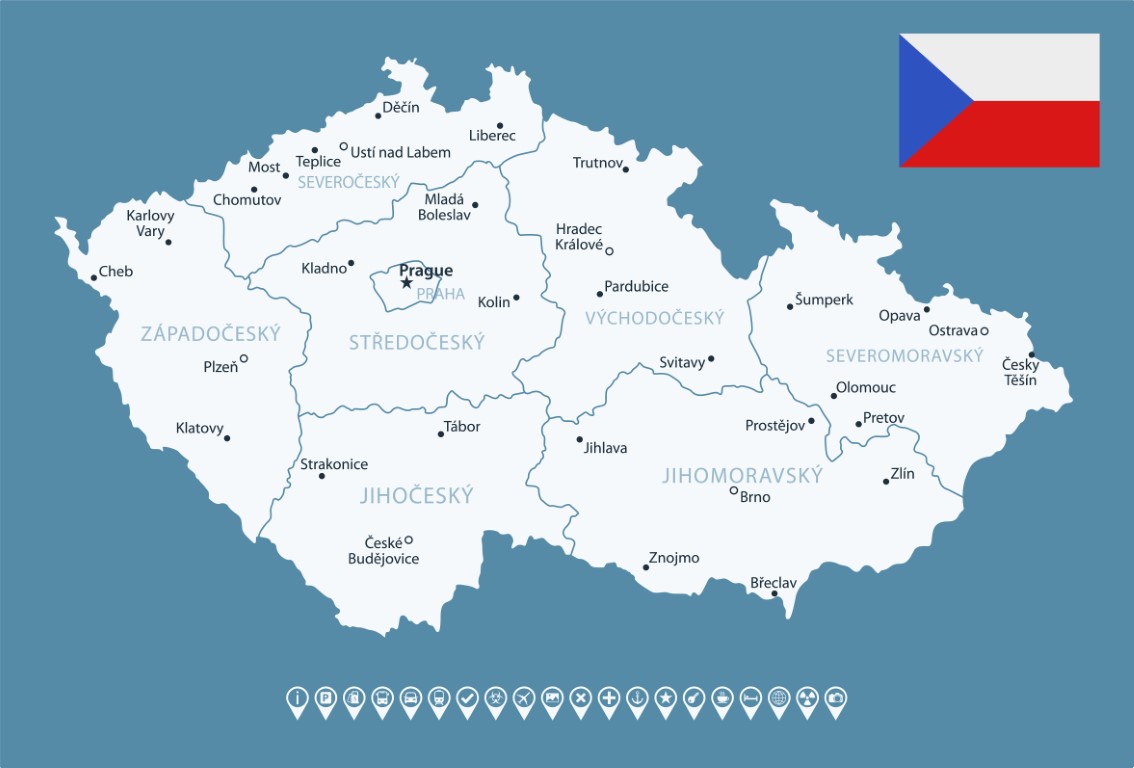
The Czech Republic is a Parliamentary Republic also called Czechia. The origin of the country was the former Czechoslovakia. Czechia is a landlocked country bordered by neighbors on all sides. The country is both a member of NATO and the European Union.
The official language of the country is Czech, and its capital is Prague. Today, Czechia is divided into 14 administrative regions, while the historical regions of Bohemia, Moravia, and Czech Silesia form its traditional territory. Czechia covers a total area of 78,871 km², and its population is estimated at 10,910,000 inhabitants. The country’s international telephone code is +420, also written as 00420.
Which countries border it?
The neighboring countries of the Czech Republic are Poland, Austria, Slovakia, and Germany. In total, the Czech borders measure 1881 km, with 658 km, 362 km, 215 km, and 646 km respectively for each neighbor.

Population of the Czech Republic
According to the latest estimates, Czechia has a population of around 10,910,000 inhabitants. This represents nearly 0.14% of the world’s population. In terms of population size, Czechia ranks around 89th among the world’s countries and territories.
Table of the main geographical characteristics of the Czech Republic
| Characteristic | Detail |
|---|---|
| Area | 78,866 km² |
| Capital | Prague |
| Population | About 10.7 million inhabitants |
| Official language | Czech |
| Highest point | Mount Sněžka, 1,603 meters |
| Main rivers | Vltava, Elbe (Labe), Morava |
| Geographical region | Central Europe |
Compared with the country’s land area of 78,871 km², the population density is approximately 138 inhabitants per square kilometer. In addition, nearly 75% of the Czech population lives in major urban areas, while the median age is around 43 years, reflecting a relatively ageing population.
What are the colors of the country?
The colors of the Czech Republic are red, white, and blue. The colors are arranged as follows: a horizontal white stripe, a red stripe, and a blue triangle on the hoist side. Legends say that this flag was inspired by the coat of arms of Bohemia and the blue indicates the state of Moravia. Here are the meanings of the colors of the Czech Republic:
- White: representative of the Czech people and inspires honesty and peace.
- Blue: symbol of truth, loyalty, and perseverance
- Red: strength, courage, and patriotism

What are the best cities to visit in the Czech Republic
Main tourist attractions and places of interest
- Prague: The capital, famous for its castle, Charles Bridge, and the astronomical clock.
- Český Krumlov: Picturesque town listed as a UNESCO World Heritage site, with a magnificent castle.
- Bohemian Switzerland National Park: Natural area with impressive rock formations, ideal for hiking.
- Kutná Hora: Known for the Sedlec Ossuary and St. Barbara’s Cathedral.
- Karlštejn Castle: Gothic fortress built in the 14th century, offering impressive views.
- Karlovy Vary Thermal Springs: Spa town renowned for its spas and mineral water springs.
- Giant Mountains (Krkonoše): Popular destination for winter sports and hiking.
Prague
Prague is certainly a very inspiring city. Founded around the 9th century, this city was the former territory of Roman emperors. It was only in 1993, after the division of Czechoslovakia, that Prague became the capital of the republic. You will see several ancient cathedrals in the city as well as other buildings reflecting medieval architecture.
Several interesting attractions are available in the capital. Notably, Prague Castle, which is the oldest and largest palace in the world. There are also other attractions such as the astronomical clock or ancient abbeys like Our Lady of Týn. Besides the ancient attractions, there is also Wenceslas Square and Charles Bridge. Finally, the city has many art museums and theater squares.
Kutna Hora
The city takes its name from the Bohemian monastery, which was the first in the region in 1142. The German occupation caused the city to be populated with several Gothic buildings. Among them are the five-nave cathedral as well as St. Barbara’s Church. You will also see the Italian Court, which was the former royal residence, the Stone House Museum, and finally, two Gothic churches.
Cesky Krumlov
Marked by the great Bohemian castle, this town was built at the end of the 13th century. It is crossed by the Vltava River, which allowed nature to settle there. Indeed, you will see several old buildings still in very good condition. Consequently, the town of Cesky Krumlov is a castle town that has preserved its medieval appearance. It mainly features cobbled streets leading you to various shops, restaurants with delicious dishes, and encounters with charming passersby.
Karlovy Vary
The town of Karlovy Vary is especially renowned for its thermal waters, which are reputed to cure certain illnesses. The thermal waters are present throughout the town and in some places, there are even ancient spas or old architecture designed for this purpose. Karlovy Vary is a large town in terms of area, and the old spa is still accessible to visitors.
Where the cities are located on the Czech Republic map ?

Prague
On the map of the Czech Republic, the capital is located in the western part of the country. Compared to the countries of Central Europe, the capital of Czechoslovakia is right in the center. Geographic coordinates: 50° 05′ 16″ north, 14° 25′ 14″ east
Kutna Hora
On the map of the Czech Republic, the city of Kutna Hora is located southwest of the capital. Geographic coordinates: 49° 56′ 54″ north, 15° 16′ 05″ east
Cesky Krumlov
It is an old town located in the southern section of the Bohemia region. This town is 141 km away from the capital. Geographic coordinates: 48° 48′ 39″ north, 14° 18′ 54″ east.
Karlovy Vary
The city of Karlovy Vary is a city located in the western section of the Czech Republic. It is 114 km away from the capital in the westward direction. Geographic coordinates: 50° 13′ 56″ north, 12° 52′ 17″ east.
Climate map of the Czech Republic
The Czech Republic has a moderate continental climate. This is explained by a very cold winter and a moderately warm summer with sunny days and cool nights. The entire territory experiences fairly consistent rainfall throughout the year. Precipitation ranges between 400 and 500 mm annually. In winter, the rain turns into snow.
Winter in the Czech Republic shows average temperatures around 0°C. Snow cover is moderate and the sun is often absent. Winter is strongly influenced by cold winds from the east and temperatures can drop to -25°C.
Spring lasts about 3 months, from early March to late May. At the beginning, this season still shows traces of cold, but as time passes, the latter part of the season is warmer with temperatures reaching up to 10°C.
Summer is warmer, with maximum sunshine during this season. However, there may be heavy rains in the afternoon. Additionally, nights are cooler with average temperatures of 12°C. Overall, summer temperatures are pleasant, ranging between 22 and 24°C.
Autumn is marked by cloudy skies and cooler temperatures than in summer. This season lasts from September to November. There may even be some rainfall during this season.
Prague:
In the capital, the average annual rainfall is 525 mm per year. Most of this precipitation occurs in summer, especially in the afternoon. In winter, frequent but short-lasting snow cover is observed. Moreover, sunshine in autumn and winter is very low. However, summer temperatures are higher than in other areas, ranging from 24 to 26°C.
Economic map of the Czech Republic
The economy of the Czech Republic has long been modeled on the economies of neighboring countries, notably Poland and Austria. This economy is based on free trade and is thus called a social market economy. The main activities in the Czech Republic are service exchanges, IT, and new technologies.
The Czech Republic is therefore a high-income state with an economy based on the European model. However, the official currency used is the Czech crown, but this does not prevent international trade from taking place. The country ranks 13th in terms of HDI and 14th in terms of the human capital index.
In percentage terms, the tertiary sector constitutes a significant part of the Czech economy, accounting for 37.5%. Other sectors such as services and agriculture represent 60% and 2.5% respectively. The Czech industry is mainly focused on metallurgy, electronics, and new technologies. Here are some economic indicators:
- GDP in nominal parity: 343 billion USD
- GDP in PPP: 620 billion USD
- Annual GDP growth rate: 2.4%
- GDP per capita in nominal parity: 31,400 USD
- GDP per capita in PPP: 56,800 USD
- Inflation rate: 2.5%
Administrative subdivisions and demolinguistic data

Administrative subdivisions
Czechoslovakia is divided into 13 regions including:
- South Bohemia (Jihočeský kraj)
- South Moravia (Jihomoravský kraj)
- Karlovy Vary (Karlovarský kraj)
- Hradec Králové (Královéhradecký kraj)
- Liberec (Liberecký kraj)
- Moravia-Silesia (Moravskoslezský kraj)
- Olomouc (Olomoucký kraj)
- Prague (Hlavní město Praha)
- Pardubice (Pardubický kraj)
- Pilsen (Plzeňský kraj)
- Central Bohemia (Středočeský kraj)
- Ústí nad Labem (Ústecký kraj)
- Vysočina (Kraj Vysočina)
- Zlín (Zlínský kraj)
These administrative subdivisions are further divided into 57 districts and then into municipalities.
Demolinguistic data
The vast majority of the population speaks Czech, which is the country’s official language and the native language of more than 95% of the inhabitants. Minority languages such as Slovak, Polish, Ukrainian, and German are also spoken in certain regions due to historical communities and immigration.
Czech belongs to the West Slavic language group, alongside Slovak and Polish. Although the historical regions of Bohemia, Moravia, and Czech Silesia have some linguistic particularities, standard Czech is used in government, education, the media, and everyday life.
The different dialectal variations are:
- Northeast Bohemian
- Central Bohemian
- Southeast Bohemian
- Bohemian-Moravian
- Central Moravian
- Eastern Moravian
The differences between these variations are only known orally. In writing, these dialects are all the same.
There are also linguistic minorities, notably the Silesian variety which is also part of the Western Slavic language group. This variation is subdivided into:
- Moravian Silesian
- Polish Silesian
There are also a few thousand Germanic speakers in the country, representing about 40,000 inhabitants.
FAQ – Czech Republic map: Geographical and demographic information
The Czech Republic is located in Central Europe and has no coastline. It shares borders with Germany, Poland, Slovakia, and Austria.
The Czech Republic has a population of approximately 10.9 million people. Its capital is Prague, which is the country’s main political, economic, and cultural center.
The country is made up of plains, hills, plateaus, and mountain ranges located mainly along its borders. Several rivers, including the Vltava and the Elbe, flow through the country and contribute to its diverse landscapes.
