
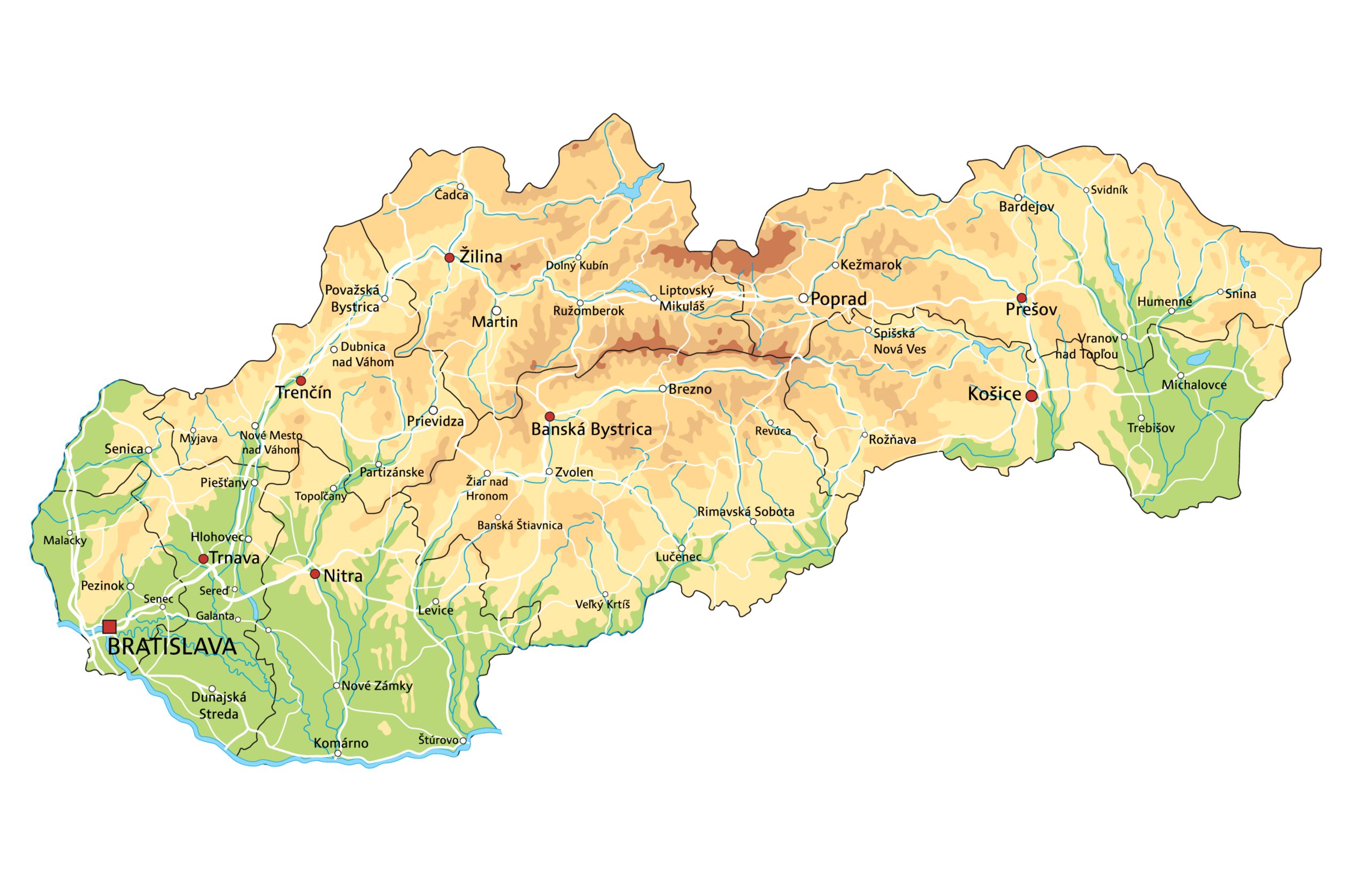
What you need to know about Slovakia ?
Slovakia is an exclusively landlocked country as it is bordered on all sides by neighboring countries. Its official name is the Slovak Republic with a territory covering an area of approximately 49,000 km2, and the Slovak topography is mainly dominated by mountain ranges.
The population of Slovakia is currently estimated at around 5.43 million inhabitants. Its largest city, which is also the country’s capital, is Bratislava. Slovakia’s telephone country code is +421 (or 00421).
Which countries border Slovakia?
The countries bordering Slovakia are Poland, Ukraine, Hungary, Austria, and the Czech Republic. These countries border Slovakia respectively to the North, East, South, West, and Northwest. The total length of Slovakia’s borders is 1672 km, subdivided as follows:
- Slovakia – Poland: 547 km
- Slovakia – Ukraine: 98 km
- Slovakia – Hungary: 669 km
- Slovakia – Austria: 106 km
- Slovakia – Czech Republic: 252 km

Population of Slovakia
According to the latest United Nations estimates, Slovakia’s population is approximately 5,474,900 inhabitants. This represents around 0.07% of the world’s total population. As a result, the country ranks 120th among the world’s most populous countries. With a land area of 49,035 km², Slovakia has a population density of approximately 112 inhabitants per km². Nearly 54% of Slovaks now live in urban areas.
What are the colors of the country?
The Slovak flag consists of three colored stripes. From top to bottom, the stripes are white, blue, and red. On the hoist side, there is the country’s coat of arms featuring a red shield.

Above, you will see a white cross and a chain of three blue mountains. The coat of arms reflects Christianity, and the mountain range represents Tatra, Fatra, and Matra. The blue color symbolizes unity and brotherhood in the country.
What are the best cities to visit in Slovakia ?
Bratislava
This city is the capital of Slovakia and a true museum in itself. Tourists come here to see the remnants of Slovak history and to understand the cultural events that often take place.
The city is a real crossroads for Jewish, Czech, and German histories due to ancient migration. It is enough to walk through the cobbled streets of the city center to come across an impressive castle built on a height.
Banská Bystrica
Banská Bystrica is a central Slovak city and at the same time a city bordered by mountain ranges. Formerly, this city was a mining town. Currently, you will see medieval buildings that recall the history of the Slovak uprising. There is also the main square of the city which reflects this said uprising.
Levoča
It is one of the oldest cities in Slovakia. What makes the city famous is its history dating back to the 13th century. This was the time when fires ravaged the city and thus destroyed the old Gothic architecture.
As a result, when you visit the city, you will only see buildings in the style of rebirth. Now, the city is part of the UNESCO heritage thanks to its ancient constructions such as the Church of St. James, the sculptures of Master Paul.
Nitra
Nitra is also a very old city and the former territory of the Principality of Nitra since the 9th century. It then passed under several controls, Hungarian, Austrian, and others. Currently, you will see several historical monuments such as ancient churches scattered throughout the city. These remind you of the city’s history and its strong Catholicism.
Kežmarok
The views in this city are absolutely magnificent because the first architectures of the city were built by German immigrants. Moreover, the remains of the noble Hungarian warrior Imre Tholoky are still visible in the city. Other interesting attractions in Kežmarok are the wooden church with its instruments, listed as a UNESCO World Heritage site. There is also the colorful church painted with mountains.
Where the cities are located on the Slovakia map ?
Bratislava
The Slovak capital is located in the southwest section. It is a border city as it lies between Austria and Hungary in addition to being the Slovak capital. Geographic coordinates: 48° 08′ 41″ north, 17° 06′ 46″ east
Banská Bystrica
On the Slovakia map, the city of Banská Bystrica is located in the central section between the banks of the Hron and the eastern slopes of the central mountains which are the Tatras and the Great Fatra. Geographic coordinates: 48° 43′ 57″ north, 19° 08′ 57″ east
Levoča
The city of Levoča is located in the Prešov region and in the Spiš section. Geographic coordinates: 49° 01′ 30″ north, 20° 35′ 30″ east
Nitra
On the Slovakia map, the city of Nitra is located in the western section. Geographic coordinates: 48° 18′ 25″ north, 18° 05′ 11″ east
Kežmarok
The city of Kežmarok is located in the Spiš region, its geographic coordinates: 49° 08′ 01″ north, 20° 25′ 35″ east
Slovakia climate map
The Slovak climate is a temperate continental climate. This means that winters are cold. Sometimes temperatures drop below zero. This leads to heavy snowfall or frost especially in mountainous regions. On the other hand, summers are quite warm with maximum sunshine during the day.

Temperatures during this season hover around 25°C but sometimes temperature peaks can occur up to 30°C. Often, the summer periods experience violent thunderstorms in the afternoon. Consequently, the annual rainfall in the country varies between 500mm and 1000mm in the high altitude regions.
The coolest seasons in Slovakia are autumn and winter, which are both quite cold, humid with some snowfall and morning fog.
The climate in the capital is quite representative of a temperate climate. This means that winter is quite cold with temperatures around 0°C. Temperatures in autumn are around 15°C. In contrast, summer is warmer with temperatures ranging from 25 to 27°C. Moreover, there are southern warm air masses that can cause temperature peaks up to 35°C. The annual rainfall is about 550 mm.
Economic map of Slovakia
The Slovak economic system is called mixed. It is a blend of a planned economy by a single government system. Slovakia’s economic growth has increased more and more since its incorporation into the EU.
Furthermore, it is strengthened by internal trade because the country is landlocked. Moreover, infrastructures facilitate the transport of industrial products. The Slovak industrial sector is also sustainable thanks to rising wages, a skilled workforce, and strong demand. The official Slovak currency is the Euro and here are some economic indicators:
- Basic salary: €816 per month
- GDP: US$154 billion
- GDP per capita: approximately US$28,100
- Unemployment rate: 5.3% of the active workforce
- Annual GDP growth: 2.1%
- Public debt: approximately 59%of GDP
Administrative subdivisions and demolinguistic data
Administrative subdivisions

The primary administrative subdivisions of Slovakia are the regions also called Kraje. There are 8 regions in total in Slovakia:
- Bratislava
- Trnava
- Trenčín
- Nitra
- Žilina
- Banská Bystrica
- Prešov
- Košice
After the regions, there are the districts which number 79
Here are the 79 Slovak districts:
- Bánovce nad Bebravou
- Banská Bystrica
- Banská Štiavnica
- Bardejov
- Bratislava I
- Bratislava II
- Bratislava III
- Bratislava IV
- Bratislava V
- Brezno
- Bytča
- Čadca
- Detva
- Dolný Kubín
- Dunajská Streda
- Galanta
- Gelnica
- Hlohovec
- Humenné
- Ilava
- Kežmarok
- Komárno
- Košice-okolie
- Košice I
- Košice II
- Košice III
- Košice IV
- Krupina
- Kysucké Nové Mesto
- Levice
- Levoča
- Liptovský Mikuláš
- Lučenec
- Malacky
- Martin
- Medzilaborce
- Michalovce
- Myjava
- Námestovo
- Nitra
- Nové Mesto nad Váhom
- Nové Zámky
- Partizánske
- Pezinok
- Piešťany
- Poltár
- Poprad
- Považská Bystrica
- Prešov
- Prievidza
- Púchov
- Revúca
- Rimavská Sobota
- Rožňava
- Ružomberok
- Sabinov
- Senec
- Senica
- Skalica
- Snina
- Sobrance
- Spišská Nová Ves
- Stará Ľubovňa
- Stropkov
- Svidník
- Šaľa
- Topoľčany
- Trebišov
- Trenčín
- Trnava
- Turčianske Teplice
- Tvrdošín
- Veľký Krtíš
- Vranov nad Topľou
- Zlaté Moravce
- Zvolen
- Žarnovica
- Žiar nad Hronom
- Žilina
Demolinguistic Data
The official language spoken in the country is Slovak. Originally, this language derives from the Old Slavic language. However, several speakers speak foreign languages. Here is a list of other minority Slovak speakers:
- Hungarian
- Carpathian Romani
- Czech
- Ruthenian
- Ukrainian
- German
- Croatian
- Polish
- Bulgarian
- Jews
FAQ-Slovakia map: Practical information and country overview
Slovakia is a Central European country bordered by the Czech Republic, Poland, Ukraine, Hungary, and Austria. It is a landlocked country with no coastline.
Bratislava is the capital and largest city of Slovakia. The country has a population of approximately 5.4 million people.
A map of Slovakia helps identify its major cities, mountain ranges, and national borders. It is also useful for planning a trip or exploring the country’s natural and cultural attractions.
