
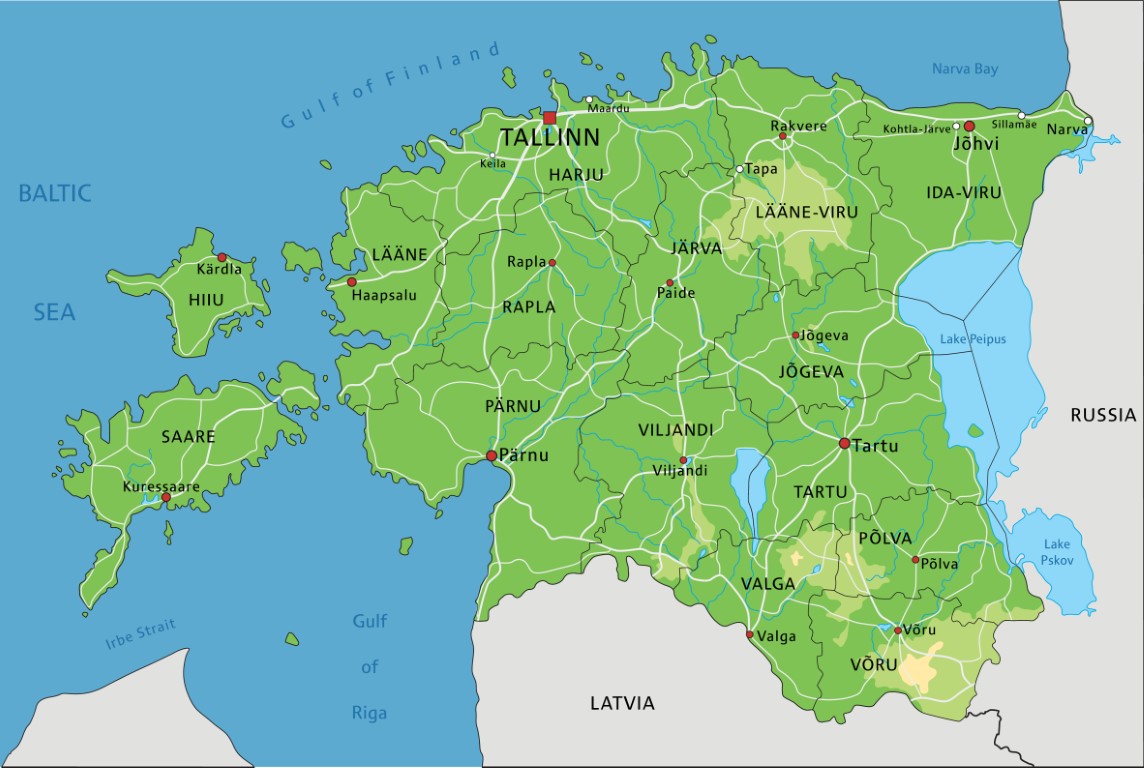
Officially called the Republic of Estonia, Estonia is a Nordic country. It is located to the east of the Baltic Sea in northern Europe, within the Gulf of Finland and to the south of it. It is also bordered by Latvia to the south and by Russia to the east, at some points by a lake called Peipus.
Estonia is also famous for the 2000 islands that make it up as well as the UNESCO World Heritage sites which are the old town of Tallinn and the Struve Geodetic Arc. The inhabitants of Estonia are called Estonians and are reputed to be among the most beautiful people in the world. The capital is Tallinn and the telephone code in Estonia is 372, that is +372 or 00372.
What color is the country?

Estonia has a flag composed of white, black, and blue colors arranged in horizontal stripes from bottom to top. The stripes are of equal size and the flag measures 165 cm long by 105 cm wide. The Estonian flag is also called “Sinimustvalge” and its colors are interpreted as follows:
- Blue: freedom
- Black: independence
- White: hope
Which countries border it?
The neighboring countries of Estonia are Russia, Latvia, Sweden, and Finland. These countries border Estonia respectively to the east, south, west, and north. The total border length of Estonia is 645 km with more than 50% represented by rivers, streams, or lakes.
Population of Estonia
Estonia’s population is currently estimated at around 1,370,000 inhabitants, with a still slightly negative population growth rate of about -0.4% per year. This trend is mainly due to a low birth rate and an ageing population, despite a more favourable migration balance. Life expectancy at birth is around 79 years. The sex ratio is approximately 88 men for every 100 women. The population is mainly composed of Estonians (69%), Russians (23%), Ukrainians (4%), Belarusians (1%), and Finns (1%).
What are the best cities to visit in Estonia?

Attractions in Estonia
Tallinn
Besides being the capital, it is also an ideal destination for your holidays. Indeed, Tallinn is a medieval old town as well as a very popular Hanseatic city. Stroll through the city’s alleys and observe houses dating from the 11th century as well as museums and galleries.
You can also walk to the city’s business center. This district features astonishing glass and steel skyscrapers as well as luxurious equipped hotels. Visit in the late afternoon or evening to enjoy some good times at the best restaurants and bars in Tallinn. At night, enjoy nighttime strolls in the center of Tallinn. Additionally, taxis are inexpensive, as are other public transports.
Tartu
The city of Tartu is especially known for being a university town as well as hosting several museums. It is also the second largest city in the country. In Tartu, you will have the pleasure of seeing singing festivals as well as theater plays.
The theater plays, concerts, and various festivals are all held outdoors. The most famous stage is the summer theater on the Emajõgi river.
Pärnu
The city of Pärnu is also an old seaside resort. It is very famous for its port, fine white sandy beaches, and intoxicating festivities. The beaches of Pärnu often host funfairs and various concerts in the evening.
Enjoy the “best sun in Estonia” and stroll along the seaside. Young people can roller skate on playgrounds or, for the more adventurous, go canoeing or jet skiing. The ideal place for this is the Pärnu river joining the sea and leading to the nearby islets.
Other historical attractions in Pärnu include the Eliisabet church from 1747, converted into a concert hall, the Jekateriina church, and the red tower.
Narva
Narva is known for its proximity to Russia, making it a border city. Its main attraction is Hermann’s Castle, which offers a view of the Russian castle on the other side of the Narva river.
You can fully enjoy your visit to the city as concerts and open-air festivals take place almost every night. Some of these festivities are even held in the heart of Narva castle. Other historical sites in the city include the Narva-Jõesuu resort and the Laagna parks. There is also the traditional Kuremäe monastery.
Where the cities are located on the map ?

Tallinn
On the Estonia map, the city of Tallinn is located in the northern section near the Gulf of Finland. This city is 80 km from the Finnish capital (Helsinki). Geographic coordinates: 59° 26′ 00″ north, 24° 43′ 50″ east
Tartu
The Estonia map shows that the city of Tartu is located in the southeast section of the country. It is 185 km away from the capital: geographic coordinates: 58° 22′ 44″ north, 26° 43′ 12″ east.
Pärnu
It is a large coastal city located in the southern section on the Estonia map. Geographic coordinates: 58° 23′ 00″ north, 24° 30′ 00″ east
Narva
The city is located in the northern part of the Estonia map. It is situated close to the Russian border. Geographic coordinates: 59° 22′ 33″ north, 28° 11′ 46″ east
Estonia climate map
According to the Estonian climate map created by Köppen and al, the Estonian climate is considered Baltic continental. It is characterized by a cold winter and a mild, stormy summer. It is one of the coldest countries in the Baltic states. Estonian cities display more or less the same climate, but coastal areas often experience frost in winter, especially the northern coastal regions near the Gulf of Finland.
Winter in Estonia: marked by continental cold, temperatures fluctuate around -3 and -6°C in areas near the capital and the northeast regions. This results from air masses coming from Russia, also called Arctic winds. The coldest month is December because the sunlight is too weak and the days are shorter than the nights. The lowest temperatures can sometimes reach -40°C.
Spring in Estonia: this season is marked by days longer than those in summer. However, the months of April and May can experience sudden drops in temperature that can bring snow and frost. The second half of April is marked by a notable increase in temperature until the end of May. Temperatures will then be warmer than at the beginning of the season.
Summer in Estonia: it is the best time to visit the country as temperatures range between 20 and 22°C. Night temperatures, however, are between 11 and 12°C, even 14°C in the western coastal areas. Rain is also frequent during this season and sometimes, sunshine is low due to cloudy skies.
Autumn in Estonia: this period is marked by temperature instability. The season is both rainy and snowy. It is especially in October that a notable drop in temperature occurs, which can bring frost and sudden snowfalls. The autumn period is also marked by short and noticeably cold days.
Climate of some Estonian cities
Tallinn: In the capital, the climate is cold and temperate. This is reflected by high rainfall, with the rainiest periods occurring in summer. According to estimates, the average annual temperature is about 5.3°C and the rainfall is 671mm.
Tartu: The city experiences a fairly cold winter with significant snowfall during the winter periods. On the other hand, summer is hot, dry, and rainy at the same time. The average annual temperature is 5°C with an annual rainfall of 599mm.
Pärnu:
The climate of Pärnu is quite similar to that of the capital. The city’s average annual temperatures range between 5 and 6°C. The climate is quite cold even in summer but there is ideal sunshine on summer days. Rainfall mainly occurs in summer and early afternoon. The annual rainfall is 675 mm.
Economic map of Estonia

Around 75% of Estonia’s GDP is generated by the services sector. The remainder is shared between industry and agriculture, accounting for approximately 23% and 2% of the economy respectively. The country’s main industries include information technology, electronics, wood processing, food manufacturing, and mechanical equipment. Agriculture mainly focuses on cereal production, dairy products, vegetables, and livestock farming.
The country has abundant forest resources and remains one of Europe’s leading producers of oil shale, while rapidly expanding its renewable energy sector. Estonia’s official currency is the euro (EUR). According to the latest estimates, Estonia’s nominal GDP is approximately 43 billion dollars, with a GDP per capita of around 31,000 dollars. Annual GDP growth is estimated at about 1.5%. Here is some additional information:
- Unemployment:7.6% of the labour force
- Public debt as % of GDP: 23
- Annual inflation rate: 3.5%
- Economic sectors as % of GDP: Industry 23%, Services 75%, Agriculture 2%
Administrative subdivisions and demolinguistic data
Administrative subdivisions
There are 15 administrative regions in total in Estonia. In their language, they are called maakonad or maakons.
The 5 regions are:
- Harju
- Hiiu
- West Viru
- East Viru
- Jarva
- Jogeva
- Oues
- Rapla
- Parnu
- Viljandi
- Tartu
- Valga
- Polv
- Voru
- Saar
The regions are governed by a prefecture. After the regions, there are the “omavalitsus” or municipalities, numbering 213 with 183 rural municipalities and 30 urban municipalities.
Demolinguistic data
According to the demolinguistic map of Estonia, the dialects are divided into two parts: the Northern dialect and the Southern dialect.
- The Northern dialects are: Rannikumurre, Saarte murre, Läänemurre, Keskmurre, and Idamurre, which are respectively the coastal, island, western, central, and eastern dialects.
- The Southern dialects are: Mulgi murre, Tartu murre, Võru murre,
FAQ – Estonia map: Geographical and demographic information
Estonia is located in Northern Europe on the eastern coast of the Baltic Sea. It shares borders with Latvia to the south and Russia to the east.
Estonia has a population of approximately 1.4 million people. Its capital is Tallinn, which is the country’s main political, economic, and cultural center.
The country is covered by vast forests, numerous lakes, peat bogs, and more than 2,000 islands in the Baltic Sea. Its landscape is mostly flat, creating a wide variety of natural environments.
