
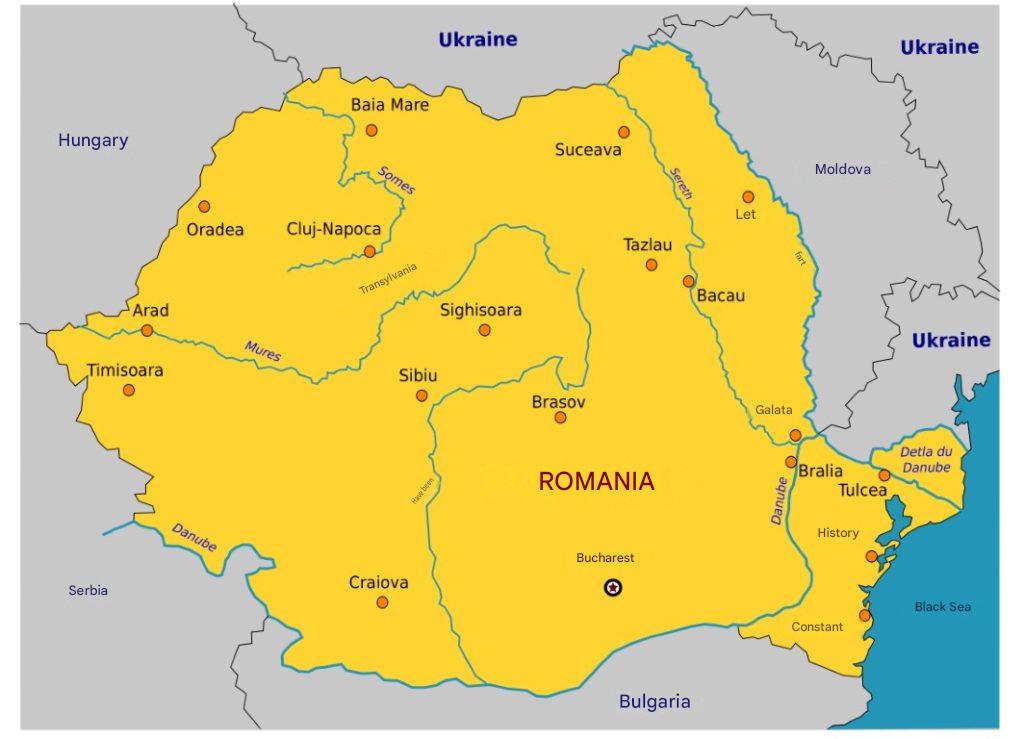
On the map of Europe, Romania is a country located in Central Europe. Its location is between Central Europe, Eastern Europe, and Southeastern Europe. The country shares borders with: Bulgaria, Hungary, Moldova, Serbia, and Ukraine.
Romania is separated from Turkey by a maritime border in the Black Sea. The country covers 238,397 km², an area comparable to that of the United Kingdom, making it one of the largest countries in Central and Eastern Europe.
Romania currently has about 18.8 million inhabitants, a population that has been continuously declining for several years due to a negative natural balance and significant emigration, especially to France, Italy, and Spain. The population density is 82 inhabitants/km², with a median age of 43.5 years and an urban population representing about 55% of the total.
The capital is Bucharest, the most populous city in the country with nearly 2 million inhabitants, and the main economic, cultural, and political center of Romania. The official language is Romanian, a Latin language inherited from Roman colonization, which distinguishes Romania from its Slavic neighbors.
The best cities in Romania
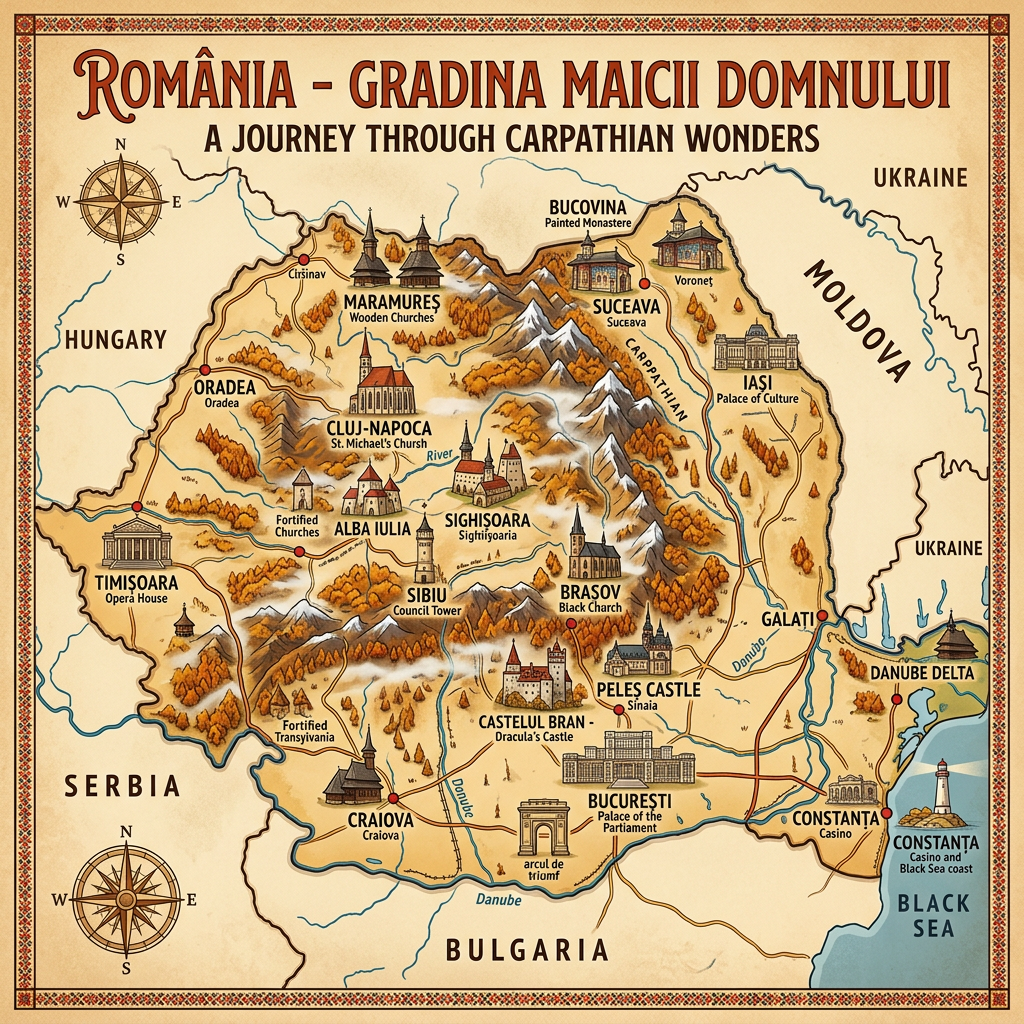
Main attractions in Romania
Main tourist attractions and places of interest
- Bucharest: The capital, known for the Palace of the Parliament, one of the largest administrative buildings in the world.
- Bran Castle: Often associated with the myth of Dracula, located in a picturesque mountainous region.
- Transylvania: Region famous for its beautiful landscapes, medieval villages, and castles.
- Danube Delta: One of the largest biosphere reserves in Europe, perfect for wildlife observation.
- Painted Monasteries of Bucovina: Historic monuments listed as UNESCO World Heritage sites, adorned with impressive frescoes.
- Cluj-Napoca: A dynamic university city with a rich cultural scene and historic sites.
- Transfăgărășan Road: One of the most spectacular roads in Europe, crossing the Carpathian Mountains.
Bucharest
The capital of Romania will certainly be your first destination in the country. You can visit green parks and 17th-century Orthodox churches as well as museums. There is also the Palace of the Parliament, which is the largest in the world. Also visit the Mitropolia Palace as well as luxury villas and sumptuous buildings.
- Brasov
- Constanța
- Cluj-Napoca
- Sibiu
- The service sector: the largest contributor to GDP, it represents more than 56% of economic activity and employs nearly half of the active population
- The industrial sector: about 27% of GDP, with strengths in metallurgy, automotive manufacturing, oil refining, and textiles. It is the historical backbone of the Romanian economy, attractive to foreign investors due to a competitive workforce
- The agricultural sector: about 4.5% of GDP, with significant cereal production. Romania is the 7th largest agricultural producer in the EU, although the potential of arable land remains largely underexploited
- GDP: approximately 353 billion euros (2024)
- GDP per capita: about 18,500 euros
- GDP growth: +1.5% in 2025, +2.4% forecast in 2026
- Unemployment rate: around 5.9%, slightly decreasing
- Inflation rate: about 4.9% in 2025, among the highest in the EU
- Public deficit: about 9.3% of GDP in 2024, subject to an EU excessive deficit procedure
- Public debt: about 55% of GDP
- Dacoromanian: It is the basis of the language officially spoken in the two Romanian-speaking countries
- Aromanian or Macedonian Romanian: Dialect spoken in Greece, North Macedonia, Bulgaria, Kosovo, and Serbia.
- Meglenoromanian: Very old dialect formerly spoken in North Macedonia and Greece.
- Istroromanian: Very old dialect formerly spoken in Istria (peninsula of Croatia and Slovenia)
Visit Brasov, a city renowned for the Carpathian Mountains as well as the medieval center. Brasov is among the most popular tourist destinations in Romania because of its baroque buildings and gothic churches. Tourists also go there for the diverse restaurants and cafes to have a good time.
People visit Constanta for its seaside resorts and beautiful beaches, not to mention the historic buildings and ancient museums. Among these attractions: the National Museum of History and Archaeology, which is full of artifacts and marble tombs. Constanta also has sumptuous hotels and restaurants to enjoy seafood while relaxing on the shores of the Black Sea.
Cluj-Napoca is the second largest city in Romania. The main attractions are the architecture, art, and old churches. Cluj-Napoca also includes cultural centers scattered around. You can also visit amusement parks and the National Art Museum.
Sibiu is a city with Germanic aspects; it is the city with the largest German community in the country. This old Romanian city offers very ancient architecture as well as the old citadel and Huet Square. Visitors go there to see opera, theater, and film festivals.
Where the cities are located on the map ?

1. Bucharest
The capital is located in the southwest region of the map. That is, close to the Black Sea and 60 miles from Bulgaria. Geographic coordinates: 44° 24′ North, 26° 05′ East
2. Brasov
Brasov is located in the center of the Romania map. It is 166 km away from the capital and is surrounded by the Carpathian Mountains in the Bârsa region. Geographic location: 45° 39′ N, 25° 36′ E
3. Constanta
Constanta is located to the east of the Romania map, on the shores of the Black Sea. Its geographic location: 44° 10′ 24″ N, 28° 38′ 18″ E
4. Cluj-Napoca
Cluj-Napoca is a city located in the northwest of Romania. Cluj-Napoca is 440 kilometers away from the capital. Geographic location: 46° 46′ 48″ N, 23° 33′ 34″ E
5. Sibiu
Sibiu is located in the center of Romania (geographical center) and south of Transylvania. Geographic location 45° 48′ N, 24° 09′ E
Table on the main geographical features of Romania
| Feature | Detail |
|---|---|
| Area | 238,397 km² |
| Capital | Bucharest |
| Population | About 19.1 million inhabitants |
| Official language | Romanian |
| Highest point | Mount Moldoveanu, 2,544 meters |
| Main rivers | Danube, Mureș, Olt |
| Geographical region | Eastern Europe, on the Black Sea |
Romania financial map
The Romanian economy
Despite real progress since its accession to the EU in 2007, Romania remains one of the poorest countries in Europe, with about 32% of the population at risk of poverty or social exclusion, the highest rate in the European Union. The massive migration of workers to Western Europe has also significantly reduced the available local workforce.
The economy is based on three main pillars:
Some key indicators:
Romania climate map
Romania experiences hot summers and long cold winters characteristic of a temperate continental climate. The entire country experiences heavy snowfall for 4 months, from December to March. Temperatures vary between 8°C and 11°C from north to south. Mountain temperatures range from 2.6°C to 12°C.
The warmest part of Romania is in the South. Winter temperatures range from 0 to 5°C and summer from 25 to 39°C. The warmest southern area is in the Transylvania districts. This zone has cool night temperatures and moderate daytime temperatures in summer. However, temperatures are very cold in winter, below 0°C. The average rainfall is 700 mm per year, somewhat higher in the mountains (1000 mm per year).
Rainfall is lower on the coasts (400 mm per year). Rain falls often throughout the year, somewhat less in spring, and very stormy in summer, especially in mountainous areas.
Bucharest
The capital’s temperatures can become very cold in winter, around -15°C. Frost may even occur. In summer, however, temperatures are very hot and can exceed 35°C. Rainfall levels reach 595 mm per year with heavy rains from May to August, especially in the afternoons. Between November and February, sunshine is low.
Cluj-Napoca
Summer in Cluj-Napoca is very hot with more than 6 hours of sunshine per day. During the rainy seasons, precipitation reaches 595 mm and the wettest periods extend from May to August, especially in the afternoon. Winter precipitation turns into snow or frost.
Constanta
The largest city in Romania experiences frequent temperature variations averaging 1.5°C to 23°C from January to July. Rainfall is not as heavy as in other cities in summer, especially on the Black Sea. However, sunshine lasts longer in summer and temperatures reach 23 to 24°C from July to August.
Demographic and administrative map of Romania
Demography of Romania
Romania currently has about 18.8 million inhabitants, or 0.23% of the world population, ranking it 70th worldwide by population. This figure is continuously declining year after year due to a negative natural balance and persistent emigration to Western Europe.
The country covers 238,397 km² with a density of 82 inhabitants/km², very unevenly distributed between urban areas and countryside. Just over half of the population, about 55%, lives in large cities, including Bucharest which alone concentrates nearly 2 million inhabitants.
The median age is 43.5 years, reflecting an aging population, a major demographic challenge for the country in the coming decades.
Administration of Romania

Romania is a unitary and indivisible republic, with a president elected by universal suffrage for a 5-year term. Legislative power is exercised by a bicameral parliament composed of 331 deputies and 136 senators, elected for 4 years.
Territorially, the country is organized into three administrative levels: counties, subdivided into municipalities, towns, and communes. Localities of significant economic importance receive municipality status, governed by specific legislation.
Alba, Arad, Argeș, Bacău, Bihor, Bistrița-Năsăud, Botoșani, Brăila, Brașov, Bucharest, Buzău, Călărași, Caraș-Severin, Cluj, Constanța, Covasna, Dâmbovița, Dolj, Galați, Giurgiu, Gorj, Harghita, Hunedoara, Ialomița, Iași, Ilfov, Maramureș, Mehedinți, Mureș, Neamț, Olt, Prahova, Sălaj, Satu Mare, Sibiu, Suceava, Teleorman, Timiș, Tulcea, Vâlcea Râmnicu, Vaslui, Vrancea.
Counties are divided into towns, municipalities, and communes.
Demolinguistic map of Romania
The official language in Romania is Romanian, which is also spoken in Moldova. The dialects from which it is derived are:
Romania is located in Eastern Europe, bordered by the Black Sea to the east, and shares its land borders with five countries: Bulgaria to the south, Serbia to the west, Hungary to the northwest, Ukraine to the north and east, and Moldova to the east.
Romania is surrounded by Bulgaria, Serbia, Hungary, Ukraine, and Moldova, with an opening to the Black Sea to the east.
Romania is located in Europe.
