
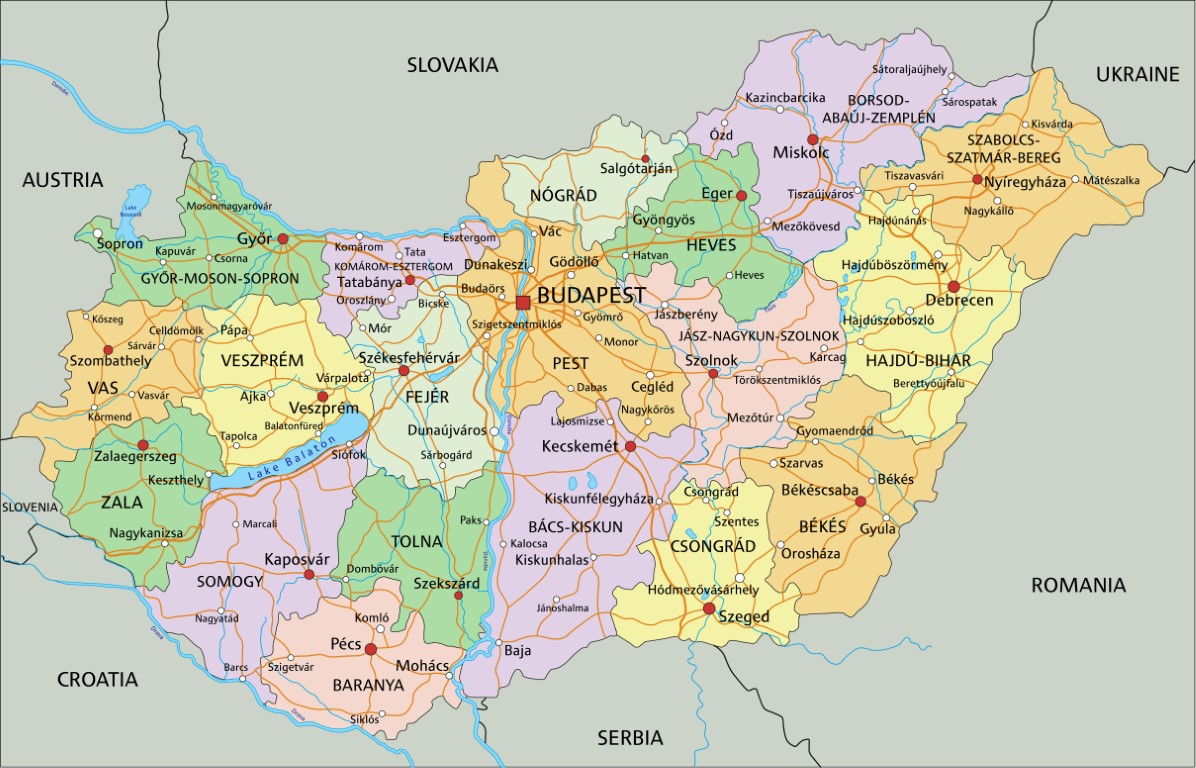
Being a country located in the center of Central Europe, Hungary has the status of “a unitary constitutional republic.” The inhabitants of the country are called Hungarians, and the capital of the country is Budapest, which is also the largest city.
It is a medium-sized country in Central Europe, covering an area of 93,030 km². In addition, Hungary is a landlocked country with no direct access to the sea. Its population is estimated at around 9.6 million inhabitants. The official language is Hungarian, and the national currency remains the Hungarian forint (HUF).
Since joining the European Union in 2004, the country has also been part of the Schengen Area since 2007. It is also a member of the United Nations, NATO, the WTO, the World Bank, the Council of Europe, and the Visegrád Group. Hungary’s international dialing code is +36 (or 0036).
What color is the country’s flag?
The Hungarian flag has a single design for the state flag, the merchant ensign, and the state ensign. The flag is a superposition of three colored stripes from bottom to top: green, white, red. The proportions of the flag are 1×2. The colors signify strength, faith, and hope for red, white, and green respectively.

Which countries border Hungary?
The countries bordering Hungary are: Austria, Serbia, Croatia, Slovenia, Romania, Ukraine, and Slovakia, and the borders have been as such since the First World War. The total length of Hungary’s borders is 2,009 km, subdivided as follows:
- Hungary – Croatia border: 329 km
- Hungary – Romania border: 115 km
- Hungary – Serbia border: 151 km
- Hungary – Slovakia border: 677 km
- Hungary – Slovenia border: 102 km
- Hungary – Ukraine border: 103 km.

Population of Hungary
The population of Hungary is estimated at around 9.6 million inhabitants according to the latest estimates. This represents approximately 0.12% of the world’s population. According to the global population ranking, Hungary now occupies 95th place.
The country covers an area of 93,030 km², giving it a population density of about 103 inhabitants per km². Life expectancy at birth is approximately 76 years, and the country continues to record a low birth rate, resulting in natural negative population growth.
Nearly 72% of Hungarians live in major urban areas. The main ethnic groups are Hungarians, who make up the overwhelming majority of the population, followed by the Roma and German minorities, along with several other officially recognized communities.

What are the best cities to visit in Hungary?
Budapest
Budapest is not only the capital of the country, but also the most populous and largest city in terms of area. It features architectures representing the neo-contemporary era, modern arts, and classical architecture. Among these buildings are: the parliament building and the Fishermen’s Bastion.
Budapest is also a historic site worth visiting. Among its countless museums is the House of Terror. You can also enjoy thermal baths as the city is nicknamed the thermal capital of Europe.
Eger
An ideal city for strolling, Eger is a complex housing exhibition museums and perched castles. It also includes unique bars and restaurants to taste Hungarian specialties. Take a tour of the wine cellars and cross the valleys of the beautiful women. Eger also has a basilica and hiking trails along with Turkish hot bath pools.
Szeged
This city is located in the southeastern part of Hungary, bordered by the banks of the Tisza. The climate is pleasant and visitors can see parks and take a coffee break during their visit. It is a cultural city as it hosts a university center, and festivals and theaters are often held there. Once in the city, you will also notice the shapes of residences with baroque architecture.
Pecs
Located in the southern part of the country, Pecs is a pleasant and very old city founded 20 centuries ago by the Romans. Pecs is bustling with museums and mosques. The city also has several green heights and orchards, making Pecs a refined local wine producer. It is also a university city, so the atmosphere is lively and the city is always animated.
Debrecen
After the capital, Debrecen is the largest and most populous city. It was also the former capital and is full of religious sites and several museums. The most important attractions in Debrecen are the Golden Church and Saint Anne’s Cathedral. The most popular museum is the Deri Museum, which houses numerous artifacts and works of art. A significant portion of Debrecen’s population is made up of students.
Where are the cities located on the Hungary map ?

Budapest
On the map of Hungary, Budapest is located between the Danube and the Transdanubian Mountains. Geographic coordinates:
47° 29′ 54″ north, 19° 02′ 27″ east
Eger
On the map of Hungary, Eger is located in the central northern section. Geographic coordinates: 47° 53′ 56″ north, 20° 22′ 29″ east.
Szeged
On the map of Hungary, Szeged is a city located in the southern section, near the Romanian border. Geographic coordinates: 46° 15′ 18″ north, 20° 08′ 42″ east
Pecs
Located in the southern part of the Hungary map, Pecs is part of the Baranya county. Geographic coordinates: 46° 04′ 17″ north, 18° 13′ 59″ east
Debrecen
On the map of Hungary, the city of Debrecen is only 220 km away from Budapest. Geographic coordinates: 47° 32′ 00″ north, 21° 38′ 00″ East
Hungary climate map
The climate of Hungary is characterized by a cold winter and a fairly warm summer. The other seasons are marked by mild temperatures but with sudden drops or rises. These characteristics are typical of a temperate continental climate.
The country also experiences precipitation spread throughout the year, although it is less dense. Winter is snowy and sometimes there is frost, especially from May to August. The climate is more or less uniform throughout the country because the altitude differences are very small.

The winter months, which begin at the end of the year, are subject to a foggy sky and morning mists. The season is snowy but the amounts are less significant. However, the country sometimes experiences cold Russian winds that cause the temperature to drop to -20°C.
Sunshine is quite pleasant in summer. The months of June, July, and August are characterized by thunderstorms that occur in the early afternoon. Warm southern winds blow and increase temperatures up to 35°C.
Climatic characteristics in the capital:
The capital shows an average temperature of -1.5°C in winter and in summer the average temperature is 21°C. The annual rainfall is 610 mm, with a minimum of 35 mm and a maximum of 70 mm per month. Winter in Budapest is quite harsh, unlike summer which has maximum sunshine.
Economic map of Hungary
Hungary is one of the most developed economies in Central Europe thanks to its diversified industry and strong openness to international trade. The country is classified as a high-income economy and stands out for its highly competitive manufacturing sector.
Hungary also enjoys a high level of human development and relatively moderate income inequality. According to international rankings, it is among the leading economies in Central Europe, with GDP per capita above the regional average.
The Hungarian economy relies mainly on exports and foreign trade, supported by its strategic location in the heart of Europe. A large share of its trade is conducted with member states of the European Union. Its main economic sectors include the automotive industry, electronics, chemical manufacturing, food processing, services, and information and communication technologies.
Here are some economic indicators
- Current currency: Hungarian Forint
- Nominal GDP (billion USD): approximately 220
- GDP in PPP (billion USD): approximately 480
- GDP growth rate :around 0.5%
- GDP per capita : approximately USD 22,000 (nominal) and around USD 49,000 (PPP).
- Unemployment rate among active population: approximately 4.3%
Administrative subdivisions and demolinguistic data
Administrative subdivisions
The administrative subdivisions of Hungary are respectively: 19 counties also called megyék and 174 districts. Some Mégyei or counties have the status of a city with county rights. Since they are located in an urban area, they are called Urban counties.
Here is the list of Hungarian counties:
Baranya, Bács-Kiskun, Békés, Borsod-Abaúj-Zemplén, Budapest, Csongrád-Csanád, Fejér, Győr-Moson-Sopron, Hajdú-Bihar, Heves, Jász-Nagykun-Szolnok, Komárom-Esztergom, Nógrád, Ravageur, Somogy, Szabolcs-Szatmár-Bereg, Tolna, Vas, Veszprém, Zala
The counties with city status number five, they are: Pest county, Fejér county, Csongrád-Csanád county, Zala county, and Győr-Moson-Sopron county. The names of these cities are: Érd, Dunaújváros, Hódmezővásárhely, Nagykanizsa, and Sopron.
Demolinguistic data
The main language in Hungary is Hungarian as the majority of the people speak it, about 90% of the inhabitants. Although this language was included as a language of instruction in 1997, it was only officially recognized in 2012. Now, all official discourse related to education, politics, economy, and culture must be conducted in Hungarian. However, there are exceptions that are not official. They are called national minorities who can use Hungarian as a 2nd language.
Now let’s talk about dialects
The Hungarian language has many variants depending on the regions. Here are the subdivisions:
- Transdanubian dialect:
- Western dialect
- Central dialect
- Southern dialect
- South dialect (plains and plateaus)
- North dialect (palóc)
- Dialect in Tisza-Kris
- Szekler dialect
- Moldavian dialect
Know that the Transdanubian region is the westernmost part of the country.
FAQ-Hungary map: Geographical and demographic information
Hungary is a landlocked country in Central Europe bordered by seven neighboring countries. A map helps visualize its strategic location between Western and Eastern Europe.
A map of Hungary shows the main cities, regions, rivers such as the Danube, and the country’s landscapes. It also helps identify the national borders and the main transportation routes.
Hungary has a population of nearly 9.6 million people, with a large share living in urban areas. Budapest, the capital, is by far the country’s largest city and its main economic and cultural center.
