📋 Key point: Personally, I believe that answering the question of the exact number of countries in the world mainly depends on the diplomatic criteria used, particularly the official recognition by the United Nations. This institution generally counts 195 or 197 depending on the status of observer states. Understanding these legal nuances is essential to grasp the complexity of global geopolitics.
195 countries is the most commonly used reference number to answer the question “how many countries are there in the world?”. It adds up 193 United Nations member states, the Holy See, and the State of Palestine, which have the status of non-member observer states.

I led an educational conference on international borders and the status of nations last January 12, bringing together about fifty geography enthusiasts. This experience allowed me to observe that the distinction between UN member countries and unrecognized nations still raises many questions.
Some lists, however, announce 197, or even 330 entities. They do not add up exactly the same realities: sovereign states, dependent territories, freely associated countries, or entities with contested status. The correct answer therefore depends on the chosen scope, the date considered, and the role assigned to the UN.

| 🌍 | Reference answer: 195 countries according to the count combining UN members and the two observer states. |
| 🏛️ | UN Members: 193 states sit as members of the United Nations. |
| 👁️ | Observer States: the Holy See and the State of Palestine complete the generally accepted total. |
| 🗺️ | Expanded count: some lists reach 197 by adding the Cook Islands and Niue. |
| 📋 | Territorial lists: a cultural or geographical inventory can count 330 entities. |
| 📅 | To date: an international status can evolve, while a list sometimes remains unchanged for several years. |
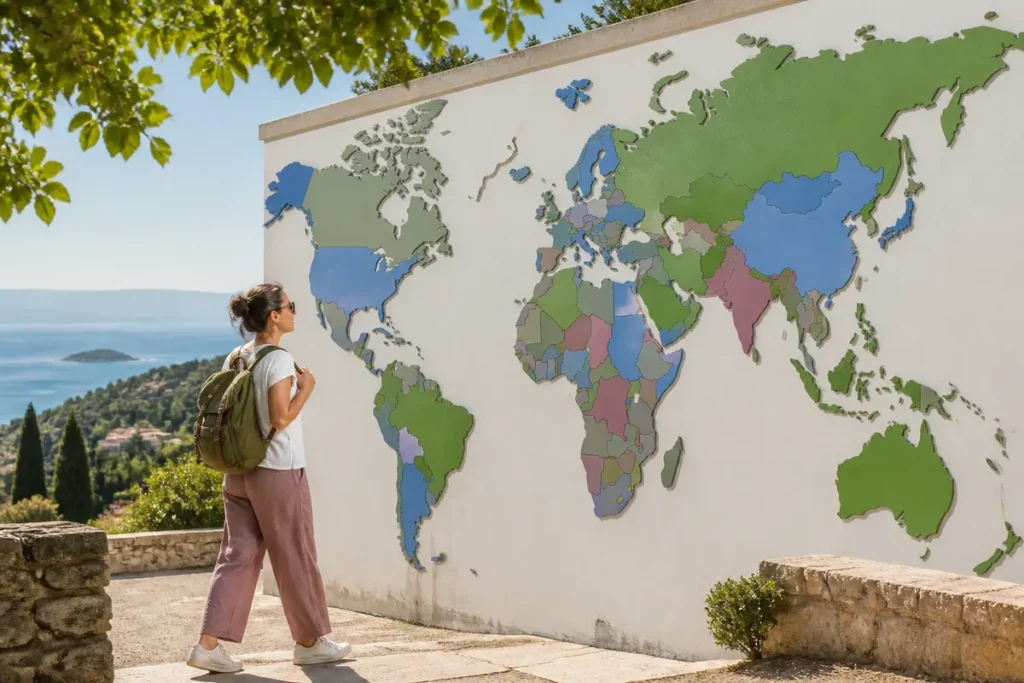
For further reading, I recommend this cartographic exploration which complements this topic well. The wall map of the world also provides useful insights. You can also check the ideal period to visit Asia, discover the countries to visit there, or read our article on map design.
How many countries are there in the world today?
The generally accepted number is 195 countries. This corresponds to 193 UN member states, plus the Holy See and the State of Palestine as non-member observer states; this convention meets most educational, journalistic, and cultural uses.
193 UN Member States and 2 Observer States

The total of 195 is a counting convention, not a natural boundary. The UN recognizes members and assigns special statuses, but it does not provide a single definition of the common word country for all geographic lists.
To verify the basis of the calculation, consult the list of UN member states and the page dedicated to non-member observer states. These pages are more reliable than an automatic counter whose update date is sometimes invisible.
The answer to remember for a quiz is therefore simple: 195. If the exercise asks exclusively for UN members, the answer becomes 193.
Why do some lists mention 197 or 330 countries?
The numbers 197 and 330 correspond to expanded scopes. The first generally adds the Cook Islands and Niue, often presented as states in free association; the second may include territories, dependencies, and geographical entities that a count of sovereign states excludes.
The figure of 197 adds two particular entities
The number of sovereign countries in the world has more than tripled since the creation of the United Nations in 1945, rising from about fifty founding members to over 190 states today following waves of decolonization and state dissolutions.
The Cook Islands and Niue have internal autonomy and maintain their own international relations, while being associated with New Zealand. Some lists count them as countries for political or practical reasons. Their inclusion then leads to 197.
This version is useful in certain inventories, especially when they seek to list destinations or entities with distinct administrations. It does not replace the count of 195 for questions concerning UN members and observer states.
197 or 330 countries therefore does not indicate a miscalculation. The disagreement concerns the category chosen and the degree of autonomy required to speak of a country.
Why can a list reach 330 entities?
An inventory of 330 generally mixes several categories: sovereign states, overseas territories, dependencies, autonomous communities, and areas that have a geographic code or their own political identity.

A flag, a local currency, a parliament, or a statistical code is not enough to automatically transform a territory into a state. The United Nations geographic nomenclatures actually use the broader category of country or area, which does not only cover independent states.
For a travel list, counting 330 entities can follow a collecting logic. For a geography test, the figure of 195 remains the safest choice. Here, the context really decides.
⚠️ Classic trap: Equating the number of countries recognized by the UN with the number of participants in international sports competitions such as the Olympic Games or the Football World Cup, which include non-sovereign territories.
What is the difference between a country, a state, and a territory?
A country is a common word, often used to designate a State. A State has a political and legal organization, while a territory may belong to another State while having its own institutions, its flag, or broad administrative autonomy.
Criteria Associated with a Sovereign State
The 1933 Montevideo Convention is frequently used to present four elements: a permanent population, a defined territory, a government, and the capacity to enter into relations with other States. These criteria help analyze an entity, without by themselves producing an automatic vote of international recognition.
⚠️ Classic trap: Equating the number of countries recognized by the UN with the number of participants in international sports competitions such as the Olympic Games or the Football World Cup, which include non-sovereign territories.
The territory does not need to be perfectly accepted by all its neighbors for an entity to exercise political power. A permanent population does not mean that every inhabitant holds the same nationality. An effective government must administer a space and a population, with sufficient stability to act beyond a mere claim.
International recognition adds a diplomatic dimension. Governments may recognize an entity as a State, while others refuse this recognition for historical, territorial, or strategic reasons.

💡 Practical advice: Always refer to the official lists of the United Nations when drafting institutional or educational documents requiring absolute diplomatic rigor.
Dependent Territories, Associated States, and Disputed Entities
Dependent territories remain attached to a sovereign State, even when they have a local government or strong autonomy. Freely associated States maintain a more flexible relationship with another State. These categories may be included in a geographic inventory, then excluded by a diplomatic list.

Taiwan and Kosovo illustrate another difficulty: their institutional reality and international presence are not reflected by membership in the UN. Taiwan does not have a member seat at the Organization, while Kosovo is also not a member. Including them in a total of 197 is a matter of scope choice, not universal recognition.

Western Sahara also raises a question of status and disputed territory. It is impossible to decide here for each list without examining its precise definition, its update date, and the authority it considers competent.
To deepen the distinction between sovereignty, observers, and territories, consult this analysis on the 195 official countries in the world. It complements the count without turning a diplomatic convention into absolute geographical truth.
How are the 195 countries distributed around the world?
✅ Key points
Clear legal framework provided by international institutions
Standardization of official lists for cartographers
Easier understanding of global geopolitical dynamics
🔻 Limitations
Ongoing controversies over the status of certain disputed territories
Constant evolution of borders and mutual recognitions
Lack of absolute universal consensus among different states
The most commonly cited geographical distribution lists 54 countries in Africa, 48 in Asia, 44 in Europe, 35 in the Americas, and 14 in Oceania. However, the breakdowns differ depending on the classification of a transcontinental country or the way North America, Latin America, and the Caribbean are grouped.
Africa, Asia, and Europe
Africa has 54 countries in the generally cited distribution. Asia has 48 and Europe 44. These numbers mainly serve to organize a map or a list; they do not change the global total of 195.

The sum of these zones depends on the chosen breakdown. A country located between Europe and Asia can be classified differently depending on the nomenclature. The UN notably uses the M49 classification for its statistical data, but this nomenclature does not constitute a universal list of sovereign countries.
Simulateur de décompte mondial des nations
Visualisez le nombre de pays selon l’organisation de référence
Référentiel institutionnel :
Total des entités comptabilisées :
Americas and Oceania
One presentation separates North America, with 2 countries, Latin America and the Caribbean, with 33 countries, and then Oceania, with 14 countries. Another groups the Americas and obtains 35 countries. Both readings can coexist without changing the total of 195.
Geography thus serves to locate states, not to decide their status alone. To consult an alphabetical list and compare names, use the list of countries of the world, always checking the announced date and scope.
How has the number of countries evolved over time?
The number of states increased with independence and decolonization, then was modified by separations, reunifications, and the disappearance of certain states. The current figure must therefore never be detached from the studied period and the definition used.
Before 1945, some historical summaries put forward 53 countries. With decolonization, the number of states increased sharply to reach counts close to 197 depending on the scopes used. These historical values are not directly comparable to 195, which associates UN members with the two observers.
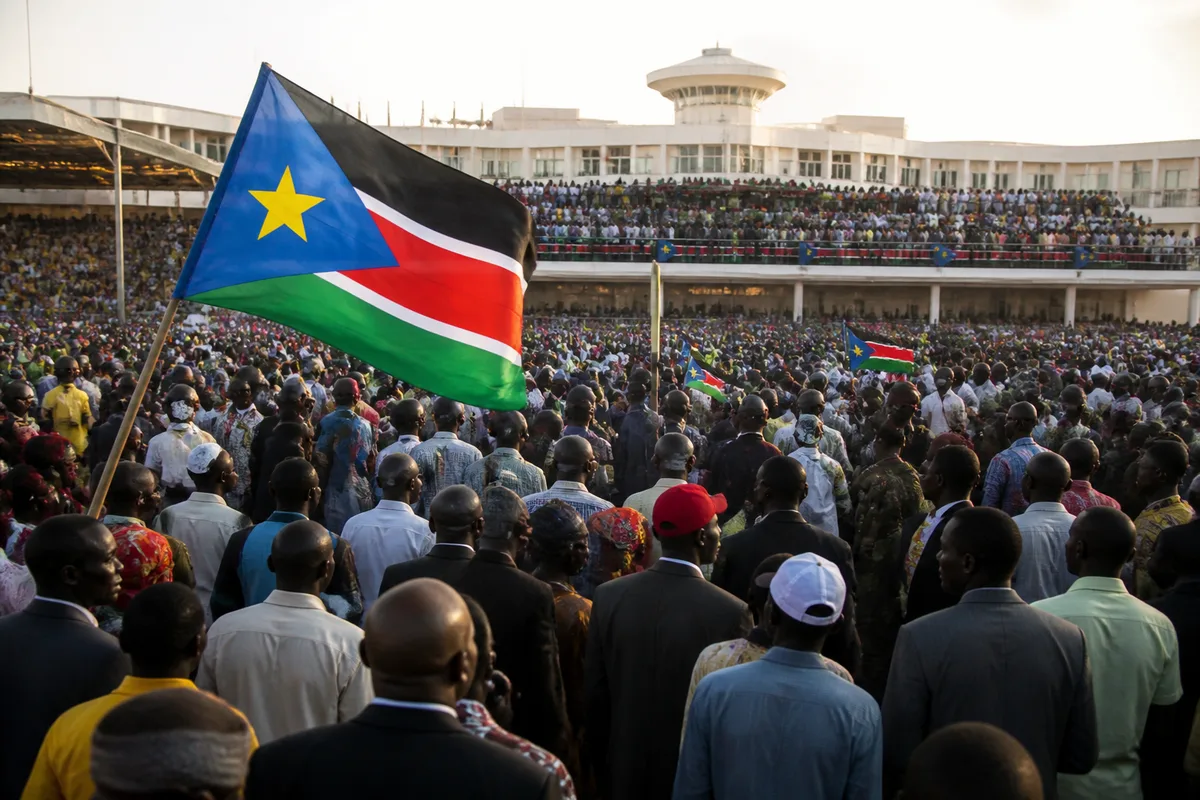
South Sudan declared its independence on July 9, 2011, then was admitted to the UN on July 14, 2011. These two dates show why the expression last country must be specified: last independence and last admission to the UN do not necessarily designate the same event.
A future modification could come from a new independence, broader diplomatic recognition, or an institutional transformation. It would not be integrated simultaneously into all databases: some prioritize the UN, others geography or administrative uses.
Frequently asked questions about countries of the world
What is the largest country in the world?
Russia is the largest country in the world by total area, with approximately 17.1 million square kilometers according to commonly published geographic data. The exact value may vary depending on the method of calculating land and inland waters.
What is the smallest country in the world?
Vatican City is the smallest state in the world by area, with about 0.44 square kilometers. Its territory is located in the heart of Rome, and its status as an independent state explains its inclusion in the count of 195.

Why do some rankings mention 211 countries or teams?
Sports organizations do not only count UN member states. FIFA, for example, ranks national football associations, which can include territories or entities whose diplomatic status does not correspond to the total of 195 countries.

For a homework assignment, quiz, or general knowledge answer, write: 195 countries, including 193 UN members and 2 observer states. If the questionnaire asks for another definition, name it before giving the number.
Useful sources to consult
United Nations → list of the 193 member states → verification of the basis of the count → check the consultation date.
UN, Non-Member Observer States → status of the Holy See and the State of Palestine → understand the addition that leads to 195 → do not confuse observer with member.
M49 Geographical Nomenclature → statistical classification of countries or areas → compare world regions → do not use it alone as a definition of sovereignty.
Why does the total number of countries vary according to sources?
The total varies depending on international diplomatic recognition, the status of autonomous territories, and the affiliation criteria adopted by each global organization.
What are the two permanent observer states at the United Nations?
The Holy See, representing the Vatican State, and the State of Palestine hold non-member observer status within the international organization.
How many countries are officially counted according to the classic tally?
The traditional figure of 195 countries is retained, corresponding to the 193 UN member states plus the two observer states.