
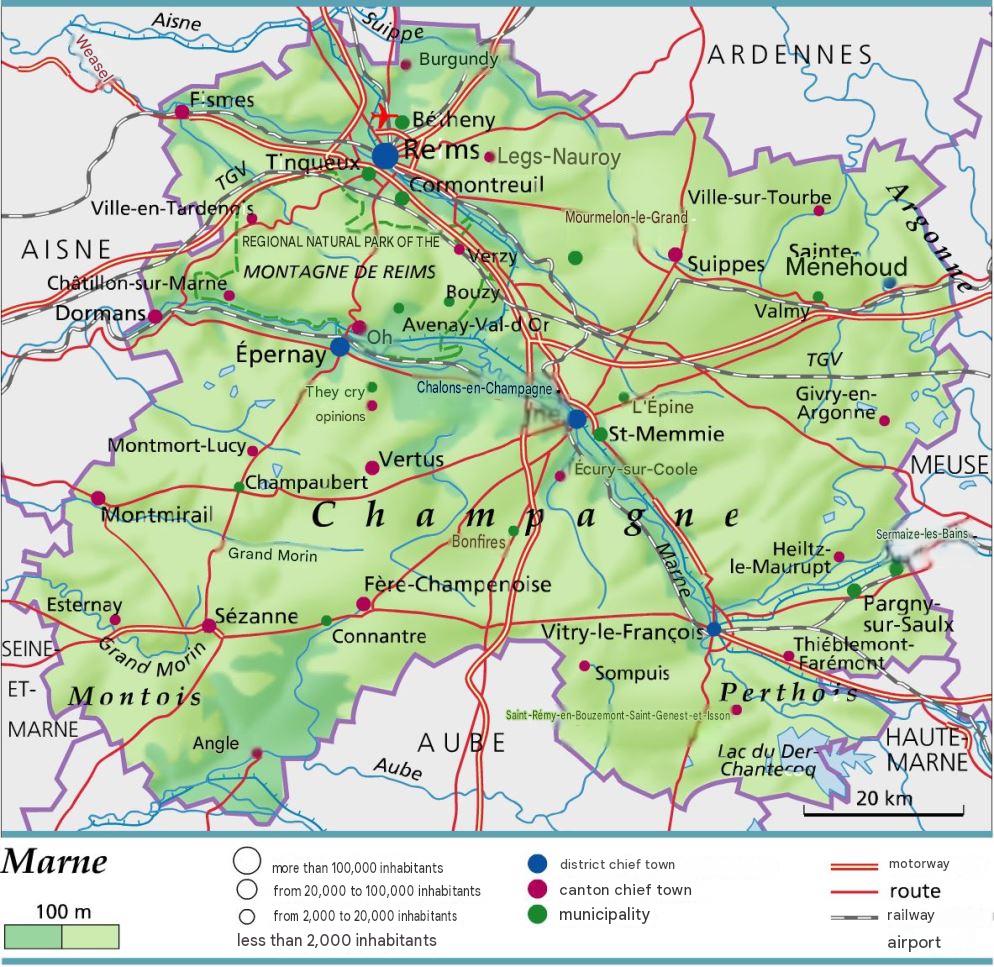
What you need to know about the Marne department ?
We present to you here the Marne department, which is actually the French department number 51. The reason for this department’s name is, in fact, the fact that the Marne river runs through it. The region to which this department belongs is called Grand-Est.
In fact, it is one of the 83 oldest French departments dating back to 1790. Its capital, largest city, and prefecture is called Châlons-en-Champagne, its sub-prefectures are called Reims, Epernay, Vitry-Le-François. Indeed, department 51 is led by Christian Bruyen, president of the departmental council of said department 51.
Regarding demographics, department 51, Marne, currently has a population of 573,188 inhabitants, and its territory covers an area of 8,162 km², giving the department a population density of approximately 70 inhabitants per km². Administratively, the Marne department is divided into 4 arrondissements, 5 legislative constituencies, 23 cantons, 14 intermunicipal authorities, and 613 municipalities.
What are the neighboring departments of the Marne department?
Since it is a department that is part of the Grand-Est region, its neighboring departments are actually: the Ardennes department which borders it to the north. Then, there is the Meuse department which borders it to the east, the Haute-Marne department which borders it to the southeast. Then to the south and southwest, there are Aube and the Seine-et-Marne department. And finally, to the west, there is the Aisne department.

What is the climate like in the Marne department?
Being located in the eastern part of the Paris basin, Marne experiences a somewhat degraded maritime climate. Of course, the climate in this area is somewhat continental. It is characterized by cool winters and mild summers, with lower but consistent precipitation throughout the year. The current rainfall is 51 mm per year. Regarding sunshine hours, the average is 1,705 hours per year. Marne has several climatic zones:
In Épernay
There are degraded maritime-type climates. Consequently, the region’s climate is characterized by extreme conditions. That said, we regularly experience storms, tornadoes, and hail. But speaking of snow, during the year, we have about 10 centimeters of snow.
In Reims
Indeed, when talking about the climate of Reims, its climate is characterized by a temperate and humid oceanic climate. We see that in winter, the temperature is quite mild and the humidity is fairly constant. But sometimes these winters are a bit harsh, and summers sometimes stormy and dry. When we really talk about sunshine duration in the region, we observe a period when the year 1705 was mainly summery. Moreover, the annual rainfall is 604 mm, with an average of 122 rainy days per year.
What are the most important cities in the Marne department?
We have ranked these cities according to the number of tourists they receive. So, here are the 10 best cities you should visit in the Marne department:
- Nogent-sur-Marne
- Saint-Maur-des-Fossés
- Joinville-le-Pont
- Charenton-le-Pont
- Vincennes
- Le Perreux-sur-Marne
- Créteil
- Saint-Mandé
- Fontenay-sous-Bois
- Bry-sur-Marne
What are the largest municipalities in the Marne department?
To make this ranking, we referred to the area of each municipality in the Marne department:
- Sommepy-Tahure
- Courtisols
- Souain-Perthes-lès-Hurlus
- Montmirail
- Sompuis
- Soudron
- Fère-Champenoise
- Sainte-Menehould
- Reims
- Trois-Fontaines-l’Abbaye
In the current second ranking of the municipalities of Marne, we grouped them according to the density of inhabitants per km2.
- Reims
- Épernay
- Tinqueux
- Cormontreuil
- Saint-Memmie
- Châlons-en-Champagne
- Vitry-le-François
- Bétheny
- Fismes
- Sézanne

FAQ – Marne map
A Marne map helps locate the department’s main cities, roads, and administrative boundaries. It also provides an overview of vineyards, rivers, and neighboring municipalities.
A map is useful for planning a trip, organizing a route, or locating a place of interest. It also helps users better understand the department’s geography and territorial organization.
A detailed Marne map is available in printed form from certain organizations or in digital format on various specialized platforms. It may include municipalities, road networks, landforms, and the department’s main points of interest.
