
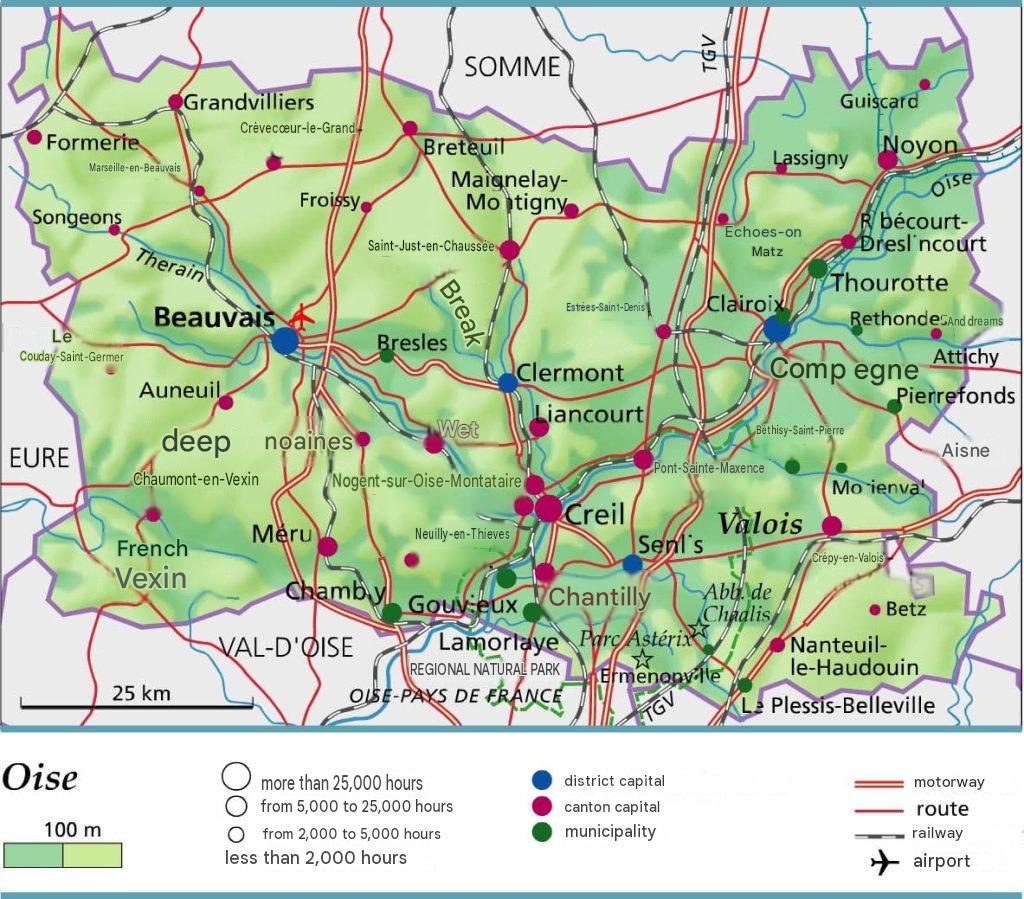
A department of forests, valleys and plains, Oise is known for its castles, charming villages and rich heritage. The map helps plan a Beauvais–Compiègne–Chantilly itinerary, using the A1, A16, N31 motorways and secondary roads.
What you need to know about the Oise department ?
Here is the Oise department, identified by the number 60 and located within the Hauts-de-France region. It takes its name from the Oise river, which runs through the territory in its center.
The inhabitants of Oise are called Isariens. The department currently has about 829,419 inhabitants, over an area of 5,860 km², which corresponds to an average density of 142 inhabitants per km².
The prefecture of the department is Beauvais, while Clermont, Compiègne, and Senlis are its sub-prefectures.
Administratively, the department is organized into 4 arrondissements, 7 legislative constituencies, 21 cantons, 21 intercommunalities, and 670 communes.

Which Departments Border the Oise Department?
Formerly, the territory occupied by department 60 was part of the Picardy region. Moreover, it is the department in the country closest to its capital. Its neighboring departments are actually the department of Eure, the Val-d’Oise department, the Somme department, the Seine-et-Marne department, the Seine-Maritime department, and the department of Aisne.
| Element | Details |
|---|---|
| Region | Normandy |
| Prefecture | Alençon |
| Sub-prefectures | Argentan, Mortagne-au-Perche |
| Population | ~280,000 inhabitants |
| Area | ~6,100 km² |
| Relief & Hydrography | Perche hills, bocage, valleys of the Sarthe, Orne, and Huisne rivers, state forests |
| Climate | Degraded oceanic: cool winters, mild summers, regular rainfall |
| Economy | Agri-food, livestock, wood sectors, green tourism, spa tourism (Bagnoles-de-l’Orne) |
| Key Sites | Bagnoles-de-l’Orne, Perche Regional Natural Park, National Stud of Le Pin, Alençon |
| Access | A28 and N12 towards Caen/Le Mans/Paris, TER trains to Caen and Le Mans |
What Is the climate like in the Oise department?

Climate of the Oise department
The Oise department benefits from a degraded oceanic climate, characterized by cool winters, moderately warm summers, and generally regular precipitation. Temperatures here are among the coolest in northern France, especially during the day.
Beauvais
Beauvais has a degraded oceanic climate, related to its distance from the sea (about 90 km). The hills of the Pays de Bray mitigate some of the precipitation, resulting in an annual total slightly below the regional average, even though rainy episodes are frequent. Mist regularly appears, especially in autumn and winter.
There are about 41 windy days per year, mostly coming from the west or southwest. The warmest months — June to September — have average temperatures above 20 °C.
Senlis
Senlis also has a degraded oceanic climate. Its distance from the Paris metropolitan area limits urban influence on local temperatures. In the absence of a dedicated weather station, the closest data come from Creil, located only 8 km away.
Precipitation contrasts between seasons are moderate.
- The wettest period is autumn (September to November, about 183 mm).
- The driest is spring (March to May, about 165 mm).
Senlis experiences on average 124 days of rain with at least 1 mm per year.
Clermont
Clermont is subject to a moderate oceanic climate, characterized by cool and sometimes unstable winters, and relatively warm but rarely stifling summers. Altitude and local relief influence the distribution of precipitation:
- the heights receive more rain,
- while the Brêche valley remains more sheltered.
The wind is more felt in elevated areas, notably towards Cambronne-lès-Clermont, and less noticeable on the slopes.
The main towns of the Oise department
Here are the most important and largest towns in the department:
- Beauvais
- Compiègne
- Creil
- Nogent-sur-Oise
- Senlis
- Noyon
- Crépy-en-Valois
- Méru
- Pont-Sainte-Maxence
- Montataire
What are the largest municipalities in the Oise department?
To make this ranking, we referred to the area of each municipality in the Oise department.
- Compiègne
- Fontaine-Chaalis
- Morienval
- Senlis
- Méru
- Beauvais
- La Neuville-en-Hez
- Saint-Jean-aux-Bois
- Gouvieux
- Pierrefonds
Regarding this second ranking of the municipalities in the Oise department, we have grouped them according to the density of inhabitants per km2:
- Beauvais
- Creil
- Senlis
- Crépy-en-Valois
- Montataire
- Compiègne
- Nogent-sur-Oise
- Noyon
- Méru
- Pont-Sainte-Maxence
For your local reference points, start with the map of Orne. If you extend eastward, compare it with the map of Eure-et-Loir, and to the south with the map of Sarthe. On the Normandy coast side, organize your connections via the map of Calvados to link Orne and the coast.
FAQ: Map of Orne
Yes, it highlights the valleys of the Huisne and Sarthe, the forest massifs, and the small roads ideal for a slow road trip.
A map detailing relief and marked trails allows alternating greenways, Perche forests, and loops around Bagnoles-de-l’Orne.
It clearly positions the A28 and N12, as well as the TER train stations, to calibrate travel times and stops.
