
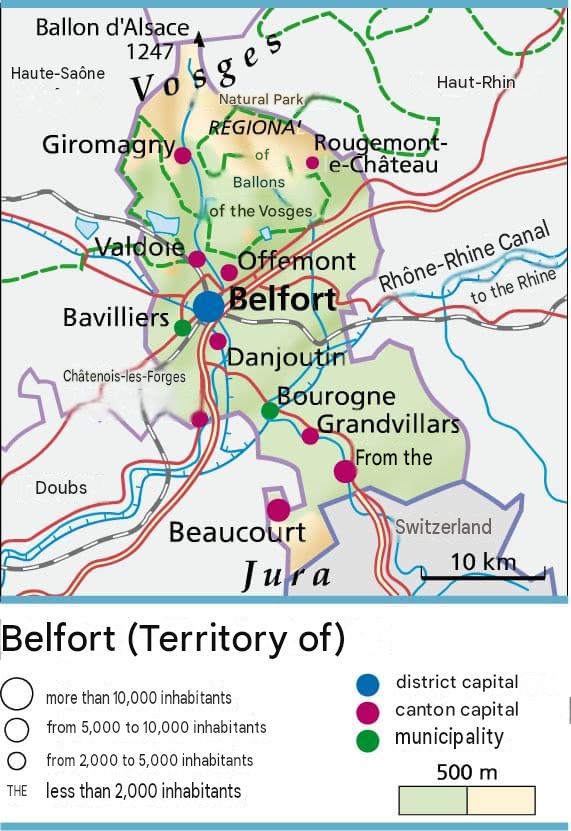
What you need to know about the Territoire de Belfort department ?
We will present here a department called the Territoire de Belfort, created from the maintenance of the Belfort arrondissement within France after Alsace returned to France in 1919. According to the postal and INSEE numbering, it is department 90, which is an integral part of the Bourgogne-Franche-Comté region. This department does not have a sub-prefecture and, furthermore, its chief town and prefecture is called Belfort. The department has 139,654 inhabitants and its density is 229 inhabitants per km², due to the fact that the surface area of the department is 609 km². Administratively, this department is divided into a single arrondissement, 2 legislative constituencies, 9 cantons, 3 intercommunal entities, and 101 communes.

What are the neighboring departments of the Territoire de Belfort department?
Since the Territoire-de-Belfort department is an integral part of the Bourgogne-Franche-Comté region, its neighboring departments are: in the Grand Est region, the Vosges and Haut-Rhin departments which border it respectively to the North and Northeast. Then, there is the Haute-Saône department, followed by the Doubs department which borders it to the South and Southwest. The Territoire de Belfort department also shares a border with Switzerland through the Canton of Jura which borders it to the South and Southeast.
What is the climate like in the Territoire de Belfort department?
Indeed, the climate type of the Belfort territory is considered continental, or at least semi-continental. This type of climate is influenced by the fact that there is a corridor between the Vosges and Jura mountains that leads directly to Burgundy, and this corridor allows many winds coming from the east of the country to enter.
Spring
The fact is that, geographically, department 90 could never really have true springs in the strict sense. There is a lot of freshness and mildness, and these conditions are really conducive to temperature variations. The fact is that there is a big drop compared to Alsace, which causes a lot of discrepancy in terms of rainfall. It is observed that rainfall is moderate and consistent.
Summer
In the Territoire de Belfort, there is a lot of contrast with very variable temperatures. It is also the case that sometimes temperatures can be high, even reaching 30°C when in the plains. Then, this summer period is very humid because the precipitation could even cause thunderstorms.
Autumn
This is the shortest season because winter arrives very quickly and brings a lot of rain. It is even the season when snow gradually begins to fall from the second half of November. It is therefore observed that there is a lot of snowfall starting from early September. These snowfalls are light and accompanied by fog, and there is much more humidity at night.
Winter
This is what makes a semi-continental climate really like this; these winters are really cold, especially when ascending in altitude. In fact, the coldest month is January. It is also during this period that there is a lot of snowfall. Temperatures in this season could even reach 0°C, but may rise a bit during the day.
What are the most important cities in the Territoire-de-Belfort department?
We have compiled this list of the 10 main cities in the Territoire-de-Belfort. So, here are the 10 most populated cities in the department:
- Belfort,
- Delle,
- Valdoie,
- Beaucourt,
- Bavilliers,
- Danjoutin,
- Offemont,
- Giromagny,
- Grandvillars,
- Essert,

What are the largest communes in the Territoire-de-Belfort department?
To establish this ranking, we referred to the area of the communes in the Territoire-de-Belfort department, so here are the 10 largest communes of the 90:
- Lepuix
- Florimont
- Belfort
- Rougemont-le-Château
- Grandvillars
- Bourogne
- Réchésy
- Étueffont
- Suarce
- Lachapelle-sous-Chaux
FAQ: Territoire-de-Belfort map
The Belfort Citadel dominates the city with its famous stone Lion. The Ballon d’Alsace offers a magnificent panorama of the surrounding mountains.
Summer is ideal for hiking and cycling in the heart of nature. Winter allows you to enjoy snow activities in the Vosges mountains.
A car is very practical for reaching isolated hiking trails. The urban bus network allows you to travel easily throughout the Belfort area.
