
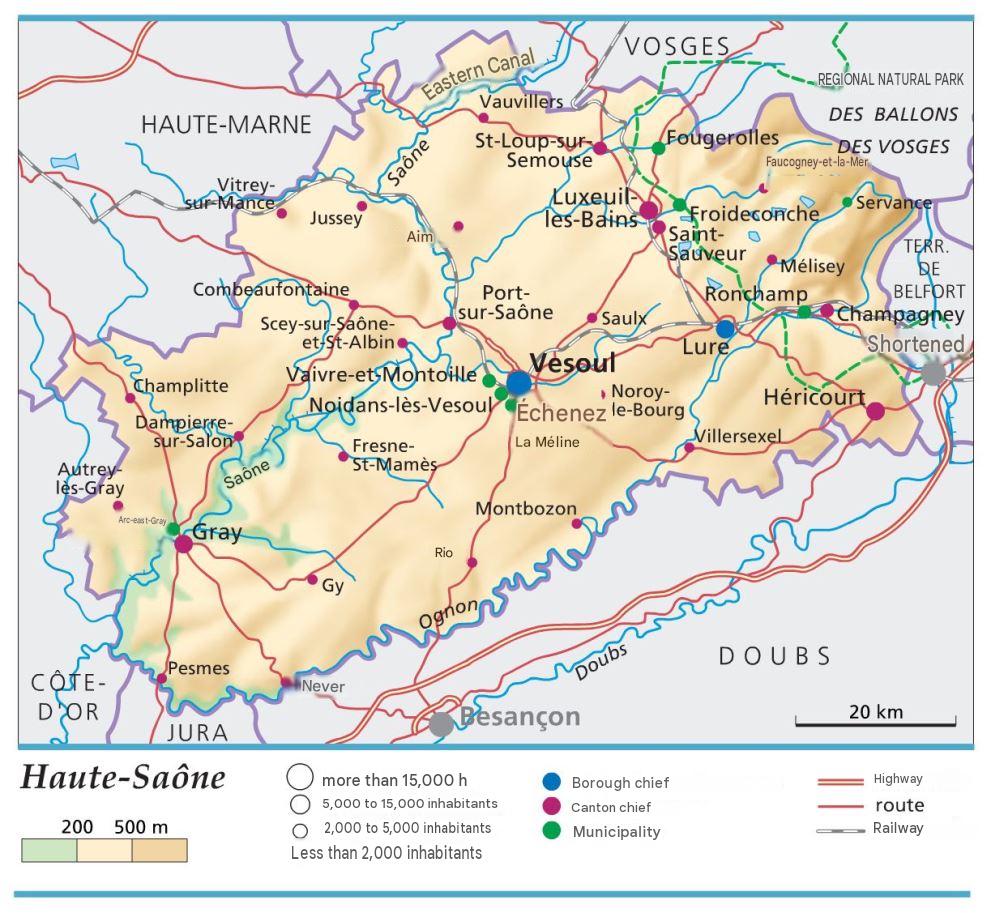
A nature-focused region situated between the Vosges and the Saône Valley, ideal for forest walks, thermal spa visits, and exploring small towns of character. The map helps connect Vesoul, Lure, and Luxeuil, and serves as a base for exploring the Ognon and Saône valleys.
What you need to know about the Haute-Saône department ?
Department number 70, Haute-Saône, belongs to the Bourgogne-Franche-Comté region. Located in eastern France and without a coastline, it is distinguished by a rural landscape marked by hills, forests, and rivers.
| Element | Details |
|---|---|
| Region | Bourgogne-Franche-Comté |
| Prefecture | Vesoul |
| Sub-prefectures | Lure, Luxeuil-les-Bains |
| Population | ~235,000 inhabitants |
| Area | ~5,360 km² |
| Relief & hydrography | Plateaus and hills, first Vosges foothills, valleys of the Saône and Ognon, extensive forests |
| Climate | Degraded oceanic with continental influence: possible cold winters, mild summers |
| Economy | Agri-food, wood-forest, metallurgy/industrial SMEs, spa tourism (Luxeuil) |
| Key sites | Vesoul, Luxeuil-les-Bains, Plateau des Mille Étangs (bordering), Ognon valley, towns with character |
| Access | Road routes to Besançon, Belfort, Langres; TER train stations to Besançon and Belfort |
Its prefecture is Vesoul, which is also the most populous city in the department. Among other important urban centers are Gray, Luxeuil-les-Bains, Héricourt, Lure, and Champlitte, the latter being one of the largest municipalities in the territory.
The inhabitants of Haute-Saône are called Hauts-Saônois. The department has approximately 235,313 inhabitants, over an area of 5,360 km², resulting in an average density of about 44 inhabitants per km².
Administratively, Haute-Saône is organized into 2 arrondissements, 2 legislative constituencies, 17 cantons, and 539 communes.

Which departments border the Haute-Saône department?
Indeed, the Haute-Saône department has other departments from the Bourgogne-Franche-Comté region as neighbors, including the Côte-d’Or department, as well as the Doubs department, the Haute-Marne department, the Vosges department, the Jura department, and finally, the Territoire de Belfort department.
What is the climate like in the Haute-Saône department?
It is currently known that the climate in department 70 is of 3 different types:
- First, there is the oceanic type: this climate is strongly characterized by windy and pseudo-cyclonic disturbances causing a lot of precipitation (both in terms of frequency and quantity).
- Next, there is the continental climate type: this type is strongly influenced by the distance from the sea, meaning there is no longer climate regulation related to the sea. As a result, temperature variations are striking and sometimes there is a lot of frost and snowfall in winter, whereas in summer, droughts are extreme.
- Finally, there is the mountain-type climate which is a kind of climate mainly found in the mountain ranges of the Vosges. This climate is mainly influenced by the fact that one moves up in latitude, and in areas reaching high altitudes, extreme temperatures are observed during the winter period.
The proximity of the Vosges and Jura mountains has also influenced local weather patterns. The two reliefs acted as barriers preventing air masses coming from the west from crossing Switzerland. The water levels of the Doubs and the Vosges Saône areas are sensitive to orographic precipitation, and the Ballon de Servance is one of the wettest places in France. Locally, the presence of hunting water levels, such as those of Mille Etangs, reduces water pressure at the end of spring, when most of the water composing the lake acts to regulate temperature in summer.
For your local reference points, first consult the map of Haute-Saône. Continue east with the map of the Territoire de Belfort and south with the map of Doubs. To the southwest, complete your itinerary with the map of Haute-Marne to plan effective inter-department connections.
What are the most important cities in the Haute-Saône department?
Regarding the best cities for tourist destinations, that is, the cities in the 70 department most frequented by tourists, there are:
- Vesoul
- Luxeuil-les-Bains
- Gray-la-ville
- Champagney
- Saint-Loup-sur-Semouse
- Champlitte
- Echenoz-la-Méline
- Vaivre-et-Montoille
- Héricourt
- Navenne
What are the most important communes in the Haute-Saône department?
To make this list, we referred to the population density per km2 of each commune in Haute-Saône:
- Champlitte
- Servance-Miellin
- Aillevillers-et-Lyaumont
- Beaujeu-Saint-Vallier-Pierrejux-et-Quitteur
- Jussey
- Fougerolles-Saint-Valbert
- Champagney
- Fouvent-Saint-Andoche
- Dampierre-sur-Linotte
- Noroy-le-Bourg
Regarding this second ranking of communes in the Haute-Saône department, we grouped them according to occupant density per km2:
- Vesoul
- Luré
- Gray
- Champagney
- Échenoz-la-Méline
- Héricourt
- Luxeuil-les-Bains
- Fougerolles-Saint-Valbert
- Saint-Loup-sur-Semouse
- Port-sur-Saône

FAQ: Map of Haute-Saône
A Map of Haute-Saône detailing secondary roads and valleys makes it easy to connect the three hubs and the surrounding villages.
Yes, maps with simplified relief and forests highlight hollows, edges, and viewpoints along the Saône and Ognon rivers.
Spring and summer for hikes and water bodies, autumn for forests; winter can be colder on the heights near the Vosges.
