
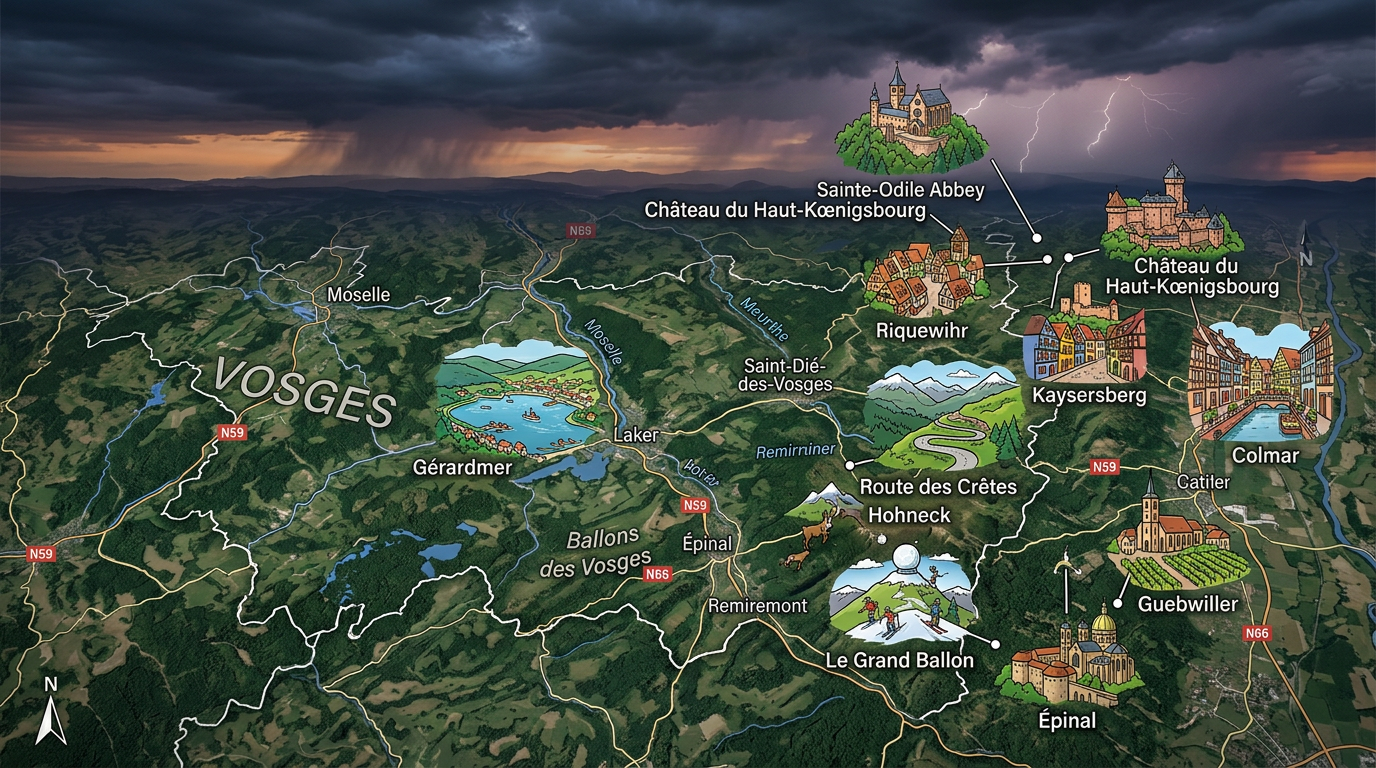
What do you need to know about the Vosges department?
We invite you to discover with us a department of France located in the northeastern part of the country. More precisely, this department was part of the region that was formerly located in the area once occupied by the Grand-Est region. This department is called the Vosges department, it is numbered 88, and the region to which it belongs is the Grand-Est region.
In fact, it is one of the oldest departments dating back to the French Revolution, that is to say in 1790. Its territory was formerly the province of Lorraine, but also included parts of the communes of Franche-Comté and Champagne. This department has a prefecture, which is also its administrative center, called Epinal; however, it has two sub-prefectures, namely: Neufchâteau and Saint-Dié-des-Vosges.
Demographically, the Vosges department has a population of 360,600 inhabitants (official population as of January 1, 2026), known as the Vosgiens. With a total area of 5,874 km², the population density is approximately 61.4 inhabitants per km². Administratively, the department is currently divided into 3 arrondissements, 4 legislative constituencies, 17 cantons, 11 intercommunalities, and 503 communes.

What are the neighboring departments of the Vosges department?
Indeed, since the Vosges department belongs to the Grand-Est region, its neighboring departments are: the Meurthe-et-Moselle department which borders it to the north along with the Meuse department. Then, there are the Bas-Rhin department and the Haut-Rhin department which border it to the east, and finally, there is the Territoire-de-Belfort department and the Haute-Saône department and the Haute-Marne department.
What is the climate like in the Vosges department?
Specifically, the climate of the Vosges department would be described as oceanic. However, this climate is somewhat more continental due to its western part, more precisely, the Vosges Massif.
Strictly speaking, the winter period is very pronounced because it is very harsh with temperatures even around -10°C and dropping down to -30°C at altitudes of 1,000 meters. Winter in the Vosges department lasts a bit longer than in the rest of the Grand-Est region.
In other words, this winter period mainly occurs between November and March. Now let’s talk about the summer period: in fact, it is a time when there are more thunderstorms and higher temperatures, around 30°C on average in the shade.
Approaching or inside the Vosges, many clouds influence temperature and precipitation. This means that rainfall is much more abundant in the western part of the department and much less significant in the eastern part of the department, specifically in the city of Colmar.
Now let’s talk about rainfall, it is really significant when approaching the massif (that is, the Vosges massif). This results in an amount of rainfall around 1,400 mm per year and sometimes, this precipitation reaches 2,000 mm when ascending the heights of Mount Hohneck at a little over 1,366 meters.
What are the most important cities in the Vosges department?
These cities that we present to you are the cities with the largest population in department 88, that is to say the Vosges :
- Epinal
- Gérardmer
- Saint-Dié-des-Vosges
- Vittel
- Mirecourt
- La Bresse
- Remiremont
- Battexey
- Neufchâteau
- Rambervillers
What are the largest municipalities in the Vosges department ?
To establish this ranking, we referred to the area of the municipalities in the Vosges department, so here are the 10 largest municipalities in 88:
- Le Val-d’Ajol
- Épinal
- La Bresse
- Gérardmer
- Xertigny
- Hadol
- Saint-Dié-des-Vosges
- Rupt-sur-Moselle
- Ban-sur-Meurthe-Clefcy
- Cornimont

FAQ: Vosges map
You can check the official French Hiking Federation website or use specialized applications. These resources provide accurate routes that are updated regularly.
Yes, it is recommended to print your routes on durable paper or download them for offline access. Make sure to have a sufficient margin around the desired area to facilitate any adjustments.
Most modern interactive maps clearly display essential shelters, springs, and supply points. Always check the legend to identify these specific icons before you set off.
