
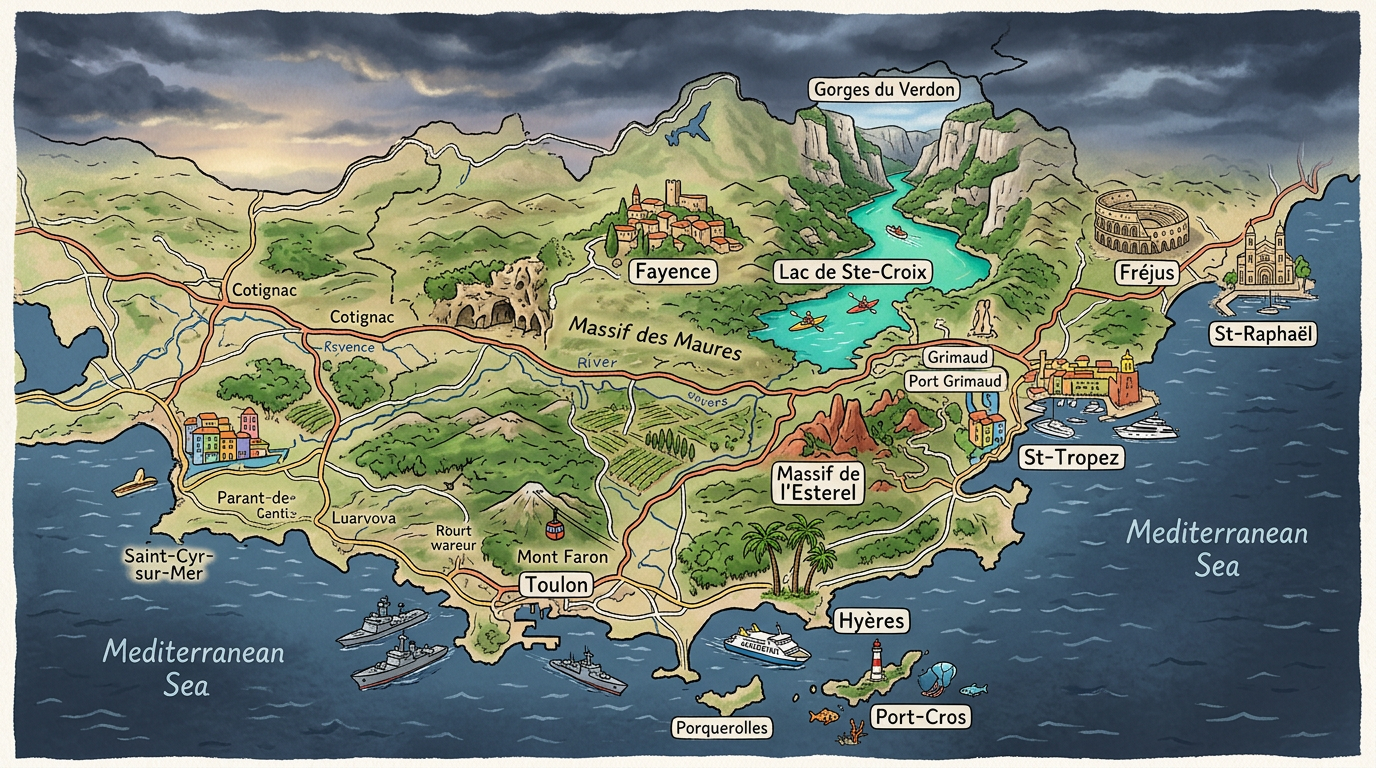
What you need to know about the Var department ?
We offer you to discover a department that is part of the Provence-Alpes-Côte d’Azur region. It is actually department 83, called the Var department. Its name mainly comes from the fact that it is bordered on its eastern section by a river with the same name.
The fact is that the department was once attached to the County of Nice and after the annexation of Grasse, a district in the area of the Alpes-Maritimes department, the river that gave its name to the Var department was no longer part of its territory. The Var department has a capital which is also its prefecture called Toulon, while its sub-prefectures are called Brignoles and Draguignan.
Let us now talk about the demographics of the Var department; its inhabitants are called Varois and currently number 1,148,000. Their density is approximately 190 inhabitants per km², due to the fact that the department’s surface area is 6,032 km². Administratively, department 83 is divided into 3 arrondissements, 8 legislative constituencies, 23 cantons, 12 inter-municipal cooperation structures, and 153 communes.

Which departments border the Var department?
Since the Var department is an integral part of the Provence-Alpes-Côte d’Azur region, its neighboring departments are: the Bouches-du-Rhône department which borders it on its eastern section. Then, there is the Vaucluse department and the Haute-Provence department which border it on its northern section, next is the Alpes-Maritimes department which borders it on its eastern section. Finally, the department has a coastline on the Mediterranean Sea along its southern section.
What is the climate like in the Var department?
The climate of the Var is mostly classified as Mediterranean type. That means the climate shows a lot of dryness in summer and also extremely high temperatures. However, in the small northern part of the department, the climate is more mountainous and is mainly characterized by frost during winter and also mild winters influenced by proximity to the sea.
Regarding precipitation, it is during autumn that they are the most abundant, meaning that at this time showers are frequent and precipitation amounts even reach 900 mm in more than 700 communes of the department.
Regarding snow cover in the department, winter periods are strongly subject to snow cover of 10 to 14 days per year for sites located at around 800m altitude. This mainly applies to the high-altitude territory of Haut-Var. However, for the higher inland areas, namely the interior massifs, some heavy snowfalls of about 10 cm thickness are noted. But snow levels exceeding 50 cm are also sometimes found in areas of the territory situated at about 500 m altitude.
Now let’s talk about the wind; the western part of the department is strongly subjected to the Mistral. This is actually a kind of cold wind coming from a corridor called the “Rhone corridor”. The opposite part, namely the East, is instead influenced by winds coming from the sea and rising from the valleys of the Argens.
Temperatures in the Var department are very variable, especially since in winter, average temperatures hover around 5°C. Summer periods, on the other hand, show temperatures around only 23 to 24°C.
In the off-seasons, the average annual temperatures are close to 13°C. When you go a little further inland, the winter becomes a bit less harsh, with temperatures around 8°C in winter and 15 to 25°C in summer. When you get closer to the sea, the climate is much milder because during the winter period, the temperature hovers around 10°C. However, during the summer period, it is much hotter, with temperatures that can even reach 25 to 27°C.
What are the most important cities in the Var department?
We have compiled this list of the 10 cities in department 83, the Var department. These cities are ranked by occupancy order, that is, by population density per km2.
- Toulon
- La Seyne-sur-Mer
- Hyères
- Fréjus
- Draguignan
- Saint-Raphaël
- Six-Fours-les-Plages
- La Garde
- La Valette-du-Var
- La Crau

What are the largest communes in the Var department?
To establish this ranking, we referred to the area of the communes in the Var department, so here are the 10 largest communes of the 82.
- Signes
- Hyères
- Aiguines
- Collobrières
- Roquebrune-sur-Argens
- Fréjus
- Bormes-les-Mimosas
- Rians
- Saint-Raphaël
- Seillans

FAQ: Var map
You can visit the Var tourist office website or specialized hiking platforms. These resources allow you to accurately view coastal trails and beach access points.
Yes, interactive maps from the prefecture services display real-time accessibility for forest areas. It is essential to check this information before any excursion into wooded zones.
Several tourist offices offer thematic maps dedicated to wine routes and estates. These documents will effectively guide you through the department’s most renowned wine regions.
