
What You Need to Know About Angola
Angola is a country in Southern Africa, officially called the Republic of Angola due to its status as a constitutional presidential republic.
- The capital and largest city is Luanda.
- The area of Angolan territory is 1,246,700 km², making it the 23rd largest country in the world.
- Its population is estimated at about 37.8 million inhabitants in 2025, ranking Angola 37th worldwide in terms of population.
The country is a member of many international and regional organizations, including the ECCAS, the SADC, the OPEC, the CPLP, the ICGLR, and the ZPCAS.
The international dialing code for Angola is +244 (00244).
Countries Bordering Angola
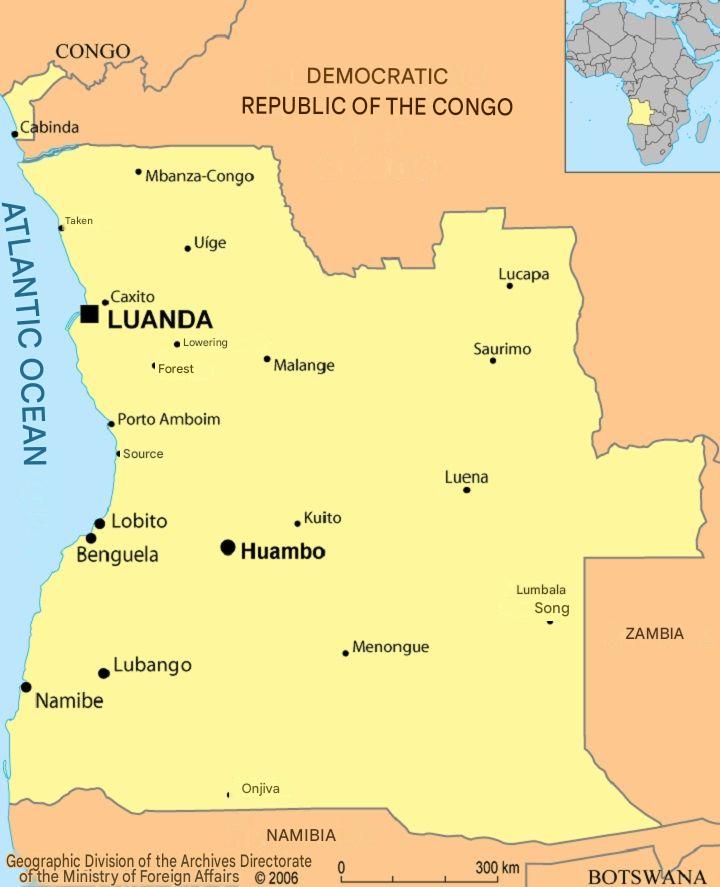
The borders of Angola extend over 5,198 km. The country shares its boundaries with:
- the Democratic Republic of the Congo (to the north and northwest),
- the Republic of the Congo (to the northwest),
- Zambia (to the east and southeast),
- Namibia (to the south).
To the west, Angola is bordered by the Atlantic Ocean.

The map of Angola shows a country in Southern Africa, bordered by the Democratic Republic of the Congo to the north, Congo-Brazzaville via the Cabinda enclave, Zambia to the east, and Namibia to the south. Its Atlantic coastline, over 1,600 km long, hosts the capital Luanda and important port infrastructures.
The Colors of Angola
The Angolan flag is divided into two horizontal bands:
- red (upper part),
- black (lower part).
In its center is a yellow emblem composed of:
- a five-pointed star,
- a half gear wheel (symbol of workers and industry),
- and a machete (symbol of the peasantry and struggle).
These elements recall the history of independence, national unity, and the country’s resources.

- The black color represents the African continent
- The red color represents the blood shed during the struggle for independence
- The yellow color symbolizes the country’s mineral wealth.
- The half gear symbol represents the hard work of Angolans and the five-pointed star represents internationalism and progress.
Table – Angola: Geographical and Demographic Information
| Element | Key Information |
|---|---|
| Total area | 1,246,700 km² |
| Capital | Luanda |
| Neighboring countries | Democratic Republic of the Congo, Republic of the Congo (Cabinda), Zambia, Namibia |
| Coastline | ~1,600 km on the Atlantic Ocean |
| Estimated population | ~37 million inhabitants (2025) |
| Population density | ~29 inhabitants/km² |
| Relief | High plateaus, coastal plains, desert in the south (Namib) |
| Climate | Tropical in the north, semi-arid in the south, temperate on the high plateaus |
| Official language | Portuguese |
| Economic resources | Oil, diamonds, minerals, agriculture |
| Particularity | The country has the enclave of Cabinda, separated from the rest of its territory by the DRC |
Additional points on the map of Angola
- Angola is located in Southern Africa, with a vast Atlantic coastline.
- Its physical map shows coastal plains, a central high plateau, and semi-desert areas in the south.
- The country shares its borders with the DRC, Zambia, Namibia, and Congo-Brazzaville.
- Luanda, its capital, is a rapidly growing port metropolis.
- The economy mainly relies on the export of oil and diamonds.
The best cities in Angola

Luanda
The capital shows many contrasts both in social differences and infrastructural variations. It directly faces the Atlantic Ocean with beaches experiencing the crashing of waves while watching ships pass by. You will see modern infrastructures as well as small old huts. It is a very active and developing city. It is a very attractive and welcoming city with small street restaurants and warm inhabitants.
Benguela
Benguela is the most appreciated city by tourists who come to the country. You will see several railways with international destinations. The city’s architecture is dominated by Portuguese constructions. You can also enjoy the seaside adorned with beautiful small beaches; these are the best places to recharge. In short, Benguela is a must-see site when you take a short tour of the country.
Kissama
Drive about 70 km south of the capital and you will see a magnificent city named Kissama. It is a beautiful city with a national park that is home to endemic fauna and flora. African wildlife species are protected there and can be observed in their natural environment. You will see buffaloes, elephants, and sea turtles.
Financial Map of Angola
The economy of Angola is dominated by oil exploitation and mineral deposits (diamonds, iron, copper, gold). Long weakened by civil wars and political crises (1975–2002 then 2014–2016 with the fall in oil prices), the economy has nevertheless begun a gradual recovery.
Today, the country is the 2nd largest oil producer in sub-Saharan Africa (after Nigeria) and a member of the OPEC.
Hydrocarbons represent about 90% of exports and more than 70% of public revenues.
Angola’s main trading partners are: China (top client), the European Union, India, and the United States.
Economic Data of Angola (2025)
- Official currency: Angolan Kwanza (AOA)
- Nominal GDP: ~122 billion USD
- GDP (PPP): ~260 billion USD
- GDP per capita (nominal): ~3,200 USD
- GDP per capita (PPP): ~6,900 USD
- GDP growth: ~3%
- Inflation: ~15% (heavily impacted by the depreciation of the Kwanza)
- Official unemployment rate: ~6–7% (but high underemployment, especially among youth)
- Public debt: ~85% of GDP
Climate Map of Angola
Due to the large size of Angolan territory, its climate is varied. Moreover, the country is located in the southern hemisphere and borders the Atlantic Ocean. Angola’s climates are divided into 3 types:
- The tropical zone: humid tropical climate
- The coasts: desert and semi-desert climate
- The plateau: subtropical climate
The tropical zone is located in the northernmost part of the country. This zone experiences a humid tropical climate with a rainy season and a hot season. Temperatures in this area range between 25 and 26°C from October to May and reach 35°C in the following months. The eastern part of this territory experiences frequent sunshine combined with cloudy skies during rainy periods.
The coastal areas experience a desert climate in the southern part, a semi-desert climate in the central section, and semi-arid in the northern part. Sometimes all of these coastal areas experience intermittent rains with often cloudy skies. Winter occurs between June and October, and the rainy seasons between October and May. Temperatures range between 26 and 27°C between February and April and 20°C between July and August.
The central plateau has a subtropical climate with a rainy season and a hot season. Annual rainfall ranges between 1200 and 1600 mm. During the hot periods, sunshine is maximal but rains occur in the afternoon between October and April.
Demographic, Demolinguistic and Administrative Map of Angola

Demography of Angola
The population of Angola is estimated at about 37.8 million inhabitants in 2025. The country shows one of the highest demographic growth rates in the world, at about 3.3% per year.
- Fertility rate: ~5.2 children per woman
- Birth rate: ~37 ‰
- Mortality rate: ~8 ‰
- Life expectancy: ~61 years (59 years for men, 63 years for women)
- Median age: ~16.8 years → extremely young population
- Sex ratio: ~98 men per 100 women
Administrative Division of Angola
The territory is subdivided into:
- 18 provinces
- 163 municipalities
- 618 communes
The 18 provinces of Angola
- Bengo
- Benguela
- Bié
- Cabinda
- Cuando Cubango
- Cuanza Norte
- Cuanza Sul
- Cunene
- Huambo
- Huíla
- Luanda
- Lunda Norte
- Lunda Sul
- Malanje
- Moxico
- Namibe
- Uíge
- Zaïre
Demolinguistic Data of Angola
The Angolan population is composed of several ethnic groups:
- Ovimbundu: ~37 %
- Mbundu (Kimbundu) : ~24 %
- Bakongo : ~13 %
- Lunda-Tchokwe : ~5 %
- Nganguela : ~6 %
- Nyaneka-Humbé : ~5 %
- Hereros : ~1 %
- Ovambo : ~1 %
- Xindonga : ~1 %
- Mixed race : ~2 %
- Khoisan : a few thousand people
Languages
National languages : Umbundu, Kimbundu, Kikongo, Chokwe, Nyaneka, Fiote, and other Bantu languages
Official language : Portuguese (in its Angolan Portuguese variant)
FAQ – Angola map: 3 questions
Angola is in Southern Africa, between Namibia to the south, Zambia to the east, and the DRC to the north, with a wide Atlantic coastline.
The capital is Luanda, located on the Atlantic coast.
The country is characterized by its high plateaus, coastal plains, the Namib desert to the south, and an enclave to the north (Cabinda).
