
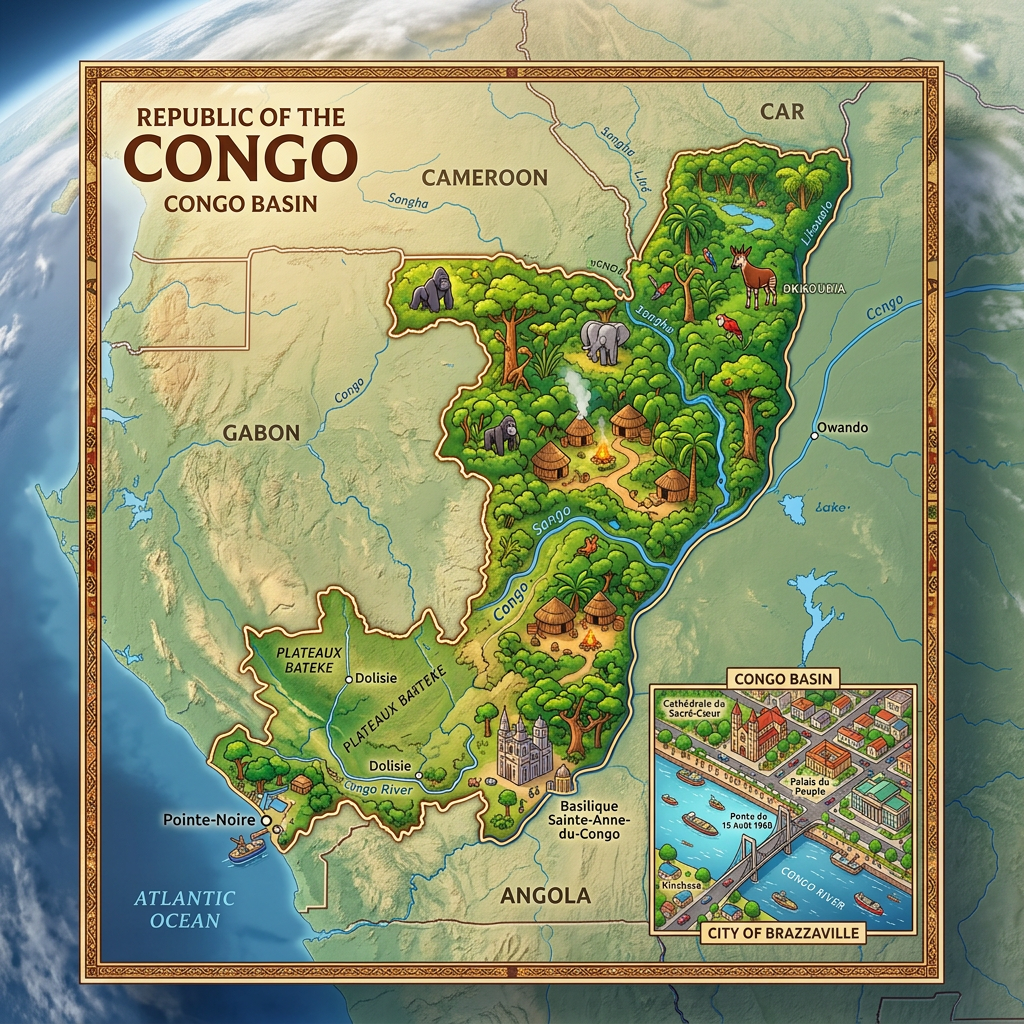
What you need to know about Congo ?
The Democratic Republic of Congo (DRC) is an African state with the status of a semi-presidential constitutional republic.
- Its area is 2,345,409 km², making it the 2nd largest country in Africa and the 11th largest in the world.
- Its population is estimated at about 102 million inhabitants in 2025, placing the DRC at 4th in Africa and 15th worldwide in terms of population.
- The capital and largest city is Kinshasa, which has more than 15 million inhabitants.
- The official language is French, but the country also has four national languages: Lingala, Swahili, Kikongo, and Tshiluba.
The majority of Congolese are Christians (mostly Catholics and Protestants, with a minority of Kimbanguists and other denominations).
The international telephone code of the DRC is +243.
Table – Congo: geographic and demographic information
| Element | Key Information |
|---|---|
| Total Area | 342,000 km² |
| Capital | Brazzaville |
| Neighboring Countries | Gabon, Cameroon, Central African Republic, Democratic Republic of Congo, Angola (Cabinda) |
| Coastline | ~170 km on the Atlantic Ocean |
| Estimated Population | ~6 million inhabitants (2025) |
| Population Density | ~18 inhabitants/km² |
| Relief | Plateaus, equatorial forests, river valleys |
| Climate | Equatorial in the north, humid tropical in the south |
| Official Language | French |
| Economic Resources | Oil, timber, minerals, agriculture |
| Special Feature | Brazzaville and Kinshasa (DRC) are the two closest capitals in the world, separated by the Congo River |
Additional points on the map of Congo
- Located in Central Africa, Congo straddles equatorial forests and coastal zones.
- The country shares a long border with the Democratic Republic of Congo to the east.
- Its Atlantic coastline is short but strategic.
- Brazzaville is located opposite Kinshasa, the capital of the DRC, on the other side of the Congo River.
- The demographic map shows a population concentrated in the south, notably around Brazzaville and Pointe-Noire.
Where is Congo on the world map?
On the world map, Congo is located on the African continent. Specifically, its location is in central Africa. Congo’s neighbors are: the Republic of Congo, South Sudan, Uganda, Rwanda, Burundi, Tanzania, Zambia, and Angola. It borders the Atlantic Ocean to the west.

Population of Congo
The population of the Democratic Republic of Congo is estimated at about 105 million inhabitants in 2025. The country is experiencing strong demographic growth, with an annual growth rate of 2.33%.
Sex ratio: about 100 men for 100 women
Fertility rate: 5.7 children per woman
Birth rate: 32.8 ‰
Mortality rate: 9.4 ‰
Life expectancy: 58.1 years (on average)
Median age: 18.8 years → the Congolese population is therefore extremely young
What are the colors of the country?
The flag of the DRC is a blue flag with a yellow 5-pointed star in the upper left corner. A diagonal red stripe with yellow edging divides the flag in two. The red color symbolizes the blood of the martyrs, the yellow represents gold and mineral wealth, and the blue symbolizes peace. The star is a symbol of the country’s future.

What are the best cities to visit in Congo?
Kinshasa: The capital is a sprawling city buzzing with energy as well as being huge. It is often compared to the African New York. Here, you can enjoy a boat ride or picnic on the banks. The city market is also fun and you can enjoy the small cafés on the boulevard.
Lubumbashi: It is a magnificent city offering several tourist attractions including historical sites such as Kasombo prison, university clinics, and several important buildings. There are also cultural sites including the national museum, the Halle de l’étoile, and the old Kiwele athenaeum. Finally, you can visit the Lubumbashi zoo, the animal sanctuary (J.A.C.K), and the Katangese identity square.
Climate map of Congo
The country’s location on the equator influences its climate. Towards the central sections, the climate is equatorial and to the north and south of the equator, the climate becomes tropical. Scientists divide the Congolese territory into 4 geographical zones. The equatorial zone is located in the central section. Its temperatures range between 23 and 26°C and the annual rainfall is 1,765 mm (Kisangani) and 2000 mm (Tshuappa). The tropical zones (2) have temperatures between 22 and 27°C and annual rainfall of 1415 mm (Kinshasa). The high altitude zones have temperatures between 16 and 22°C and annual rainfall of 1200 mm (Lubumbashi)Economic map of Congo
Economic data of Congo
According to the IMF and the World Bank, Congo is a developing country; it is a state benefiting from the “Heavily Indebted Poor Countries Initiative” program. Its economy is mainly agricultural with an embryonic system. Its industry, however, is dominated by oil exploitation by international companies. There is also a predominance of forestry exploitation in the country and some agro-food processing and cement activities. Here is the economic data of Congo:
- Currency: CFA franc
- GDP in nominal parity: 7.799 billion USD
- GDP in purchasing power parity: 29.16 billion USD
- Nominal GDP growth rate: -3.6%
- GDP per capita in purchasing power parity: 6,700 USD
- Inflation rate: -0.4%
- Poor population: 46.5%
- Unemployment: 36%
- Exports: 5.238 billion USD
- Imports: 3.519 billion USD
Administrative and demolinguistic Data

Administrative subdivisions
11 provinces make up the Congolese territory including the capital Kinshasa:
- Haut-Congo
- Western Kasai
- Bandundu
- Lower Congo
- Maniema
- North Kivu
- South Kivu
- Equateur
- Eastern Kasai
- Katanga
- Kinshasa
Demolinguistic data
Main ethnic groups in the Democratic Republic of Congo
| Class | Subclasses / Groups | Estimated percentage |
|---|---|---|
| Bantus | Luba (18%), Mongo (17%), Kongo (12%), Rwandophones (Hutus & Tutsis ~10%) | ~80% |
| Sudanese | Ngbandi, Ngbaka, Mbanja, Moru-Mangbetu, Zande | ~10% |
| Nilotics | Alur, Lugbara, Logo | ~5% |
| Hamites | Hima | <2% |
| Pygmies | Mbuti, Twa, Baka, Babinga | ~3% |
There are also 250 ethnic languages, but the most dominant are:
- Bembe
- Bera
- Mongo
- Mpuono
- Shi
- Kanyok
- Lega-shabunda
- Tetela
- Zande
- Ngala
- Ntoma
- Phende
- Budu
- Luba-shaba
- Mbole
- Kinyarwanda
- Songe
- Budza
- Chokwe
- Fulero
FAQ: Congo map: geographic and demographic information
The capital of the Congo is Brazzaville, located on the banks of the Congo River. It is the country’s main political and economic center.
The Congo covers an area of approximately 342,000 km². A large part of its territory is covered by dense tropical forests.
According to recent estimates, the Congo has a population of more than 6 million inhabitants. Most of the population lives in urban areas, with a high concentration in major cities.
