
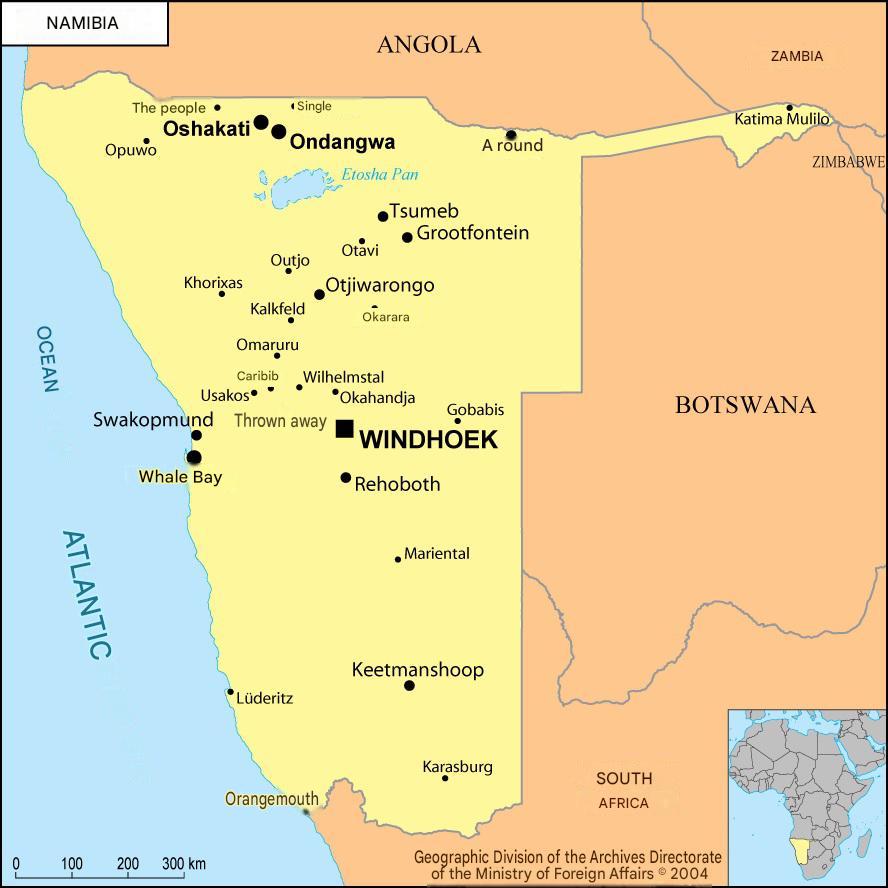
What you need to know about Namibia ?
Namibia is a presidential republic located in Southern Africa. Its territory covers an area of 825,615 km², making it one of the largest countries on the African continent, while its population is estimated at around 3.2 million inhabitants in 2026. Its capital city is Windhoek, which is also the country’s largest city.
Additionally, the country is a member of the SADC, the UN, and the AfDB, and the country calling code is 264.
Colors of Namibia
The Namibian flag is a rectangular flag. It is crossed by a red diagonal band starting from the bottom left side and joining the top right side. The upper triangle formed is blue and the lower triangle is green. The triangular parts and the diagonal are separated by two thin white stripes. In the upper left blue corner, there is a yellow 12-rayed sun.
- Blue represents the blue of the sky, the ocean, and all that represents water
- Green symbolizes the natural parts of the country (vegetation and forests)
- Red symbolizes the strength of the people as well as the struggle for the future
- The white stripes represent unity and peace, and the sun represents a zest for life and freedom

Best Places to Visit in Namibia?
Windhoek
According to received information, it is a very clean and very safe city, one of the rare qualities in Africa. The tourist attractions in Windhoek are the Eros and Auas mountains as well as colonial-style architecture.
Swakopmund
If you like seaside resorts, you will find them here. The city is very popular with backpackers; moreover, you will have access to beautiful beaches, but the water will be cold due to ocean currents and fog.

Walvis Bay
As its name indicates, this city faces the sea. This is the reason for its industrialization focused on seafood production and sea salt production. You can also enjoy good times in the city’s restaurants or stay in hotels.
Where is Namibia located on the world map?
On the world map, Namibia is located on the African continent, precisely in Southern Africa. Its direct neighbors are South Africa, Botswana, Zambia, and Angola. These countries border it to the south and southeast, east, northeast, and north. The country borders the Atlantic Ocean on the west side.

Climate of Namibia
The climate of Namibia is considered to be of the austral type. That is why it is divided into two seasons: the austral summer and the austral winter.

During the summer (which generally takes place between October and April), the Namibian territory is subject to stifling heat waves especially inland. Daytime temperatures can reach 45°C and the night is cooler. However, on the coast, temperatures are lower and fluctuate between 25 and 30°C.
During the winter (which generally takes place between May and September), the Namibian territory shows temperatures ranging between 15 and 25°C. Coastal areas are more consistent in terms of temperatures but inland, there could be unexpectedly varying temperatures.
The coasts are sometimes subject to the Benguela currents which, combined with the warm Hadley air, induce thick fogs.
Administrative division of Namibia
The Namibian territory is divided into 14 administrative regions which are then divided into 121 constituencies.
Here are the 14 regions of Namibia:
- Kunene
- Omusati
- Oshana
- Ohangwena
- Oshikoto
- Kavango West
- Kavango East
- Zambezi
- Erongo
- Otjozondjupa
- Omaheke
- Khomas
- Hardap
- ǁKaras

Here are the 121 constituencies of Namibia
Aminius
Anamulenge
Arandis
Aranos
Berseba
Daures
Daweb
Eengodi
Eenhana
Elim
Endola
Engela
Epembe
Epukiro
Epupa
Etayi
Gabaon
Gobabis
Grootfontein
Guinas
John Pandeni
Judée Lyamboloma
Kabbe North
Kabbe South
Kalahari
Kamanjab
Kapako
Karasburg East
Karasburg West
Karibib
Katima Mulilo Rural
Katima Mulilo Urban
Katutura Central
Katutura East
Keetmanshoop Rural
Keetmanshoop Urban
Khomasdal
Khorixas
Kongola
Linyanti
Mankumpi
Mariental Rural
Mariental Urban
Mashare
Moses ǁGaroeb
Mpungu
Mukwe
Musese
ǃNamiǂNus
Ncamagoro
Ncuncuni
Ndiyona
Ndonga Linena
Nehale LyaMpingana
Nkurenkuru
Ogongo
Ohangwena
Okahandja
Okahao
Okakarara
Okaku
Okalongo
Okankolo
Okatana
Okatyali
Okongo
Okorukambe
Olukonda
Omaruru
Omatako
Ompundja
Omulonga
Omundaungilo
Omuntele
Omuthiyagwiipundi
Onayena
Ondangwa Rural
Ondangwa Urban
Ondobe
Onesi
Ongenga
Ongwediva
Oniipa
Onyaanya
Opuwo Rural
Opuwo Urban
Oranjemund
Oshakati East
Oshakati West
Oshikango
Oshikuku
Oshikunde
Otamanzi
Otavi
Otjinene
Otjiwarongo
Otjombinde
Outapi
Outjo
Rehoboth Rural
Rehoboth Urban East
Rehoboth Urban West
Ruacana
Rundu Rural
Rundu Urban
Samora Machel
Sesfontein
Sibbinda
Swakopmund
Tobias Hainyeko
Tondoro
Tsandi
Tsumeb
Tsumkwe
Uukwiyu
Uuvudhiya
Walvis Bay Rural
Walvis Bay Urban
Windhoek East
Windhoek Rural
Windhoek West
Economy of Namibia
The Namibian economy ranks 128th in the world based on GDP per capita. In Africa, it is the 8th best performing in terms of GDP per capita but the 11th best performing in terms of the HDI.
This economy relies exclusively on the exploitation of mineral resources. Namibia also conducts several trade exchanges with neighboring countries such as exports of diamonds, lead, zinc, silver, tungsten, uranium, copper, and gold.
The country’s imports mainly consist of petroleum products, chemicals, and various equipment. Here are some economic data about Namibia:
- Current currency: Namibian Dollar
- Gross Domestic Product at Purchasing Power Parity (PPP): approximately USD 34 billion
- Annual GDP growth rate: approximately 3.5%
- GDP per capita at Purchasing Power Parity (PPP): approximately USD 10,500
- Inflation rate: approximately 4.5%
- Population living below the poverty line: approximately 17%
- Unemployment rate: approximately 36–37%, one of the highest in Africa
- Exports of goods and services: approximately USD 7.5 billion
- Imports of goods and services: approximately USD 7.8 billion
- Public debt: approximately USD 9 billion
- External debt: approximately USD 12 billion
Namibia population and linguistic Data
The Namibian population currently numbers 2,630,073 inhabitants with an annual demographic growth rate of 1.91%. The fertility rate of Namibians is 3.21 children per woman and the birth rate of 26.8 ‰ is higher than the mortality rate of 7.7 ‰.
The life expectancy of a Namibian at birth is 64.4 years, with 62.7 years for men and 66.2 years for women. The median age of the population is 21.4 years, indicating an extremely young population. The sex ratio of the total population is 96 men to 100 women.
The languages used in the country are English as the official language, Afrikaans, German as well as Bantu languages and Khoisan languages. The dominant ethnic groups in the country are blacks (85%), whites (7%), and multiple origins (8.5%). The people’s religions are: Christianity (80 to 90%) and African beliefs (10 to 20%).
FAQ – Namibia map: Geographic and demographic information
Namibia is located in southwestern Africa and is bordered by the Atlantic Ocean. It shares borders with Angola, Botswana, Zambia, and South Africa.
Namibia has a population of approximately 3 million people in 2025. Its population density is among the lowest in Africa due to its vast desert territory.
Namibia covers an area of approximately 825,615 km². The country is known for its diverse landscapes, including the Namib Desert, savannas, and arid plateaus.
