
What You Need to Know About Burundi
The State of Burundi is a constitutional republic located in East Africa. Its political capital is Gitega, while Bujumbura remains the economic capital and the main commercial center of the country. The official languages spoken by the population are French, Kirundi, and, since 2014, also English.
The total area of Burundian territory is 27,834 km², housing an estimated population of 13.2 million inhabitants in 2025, which corresponds to a very high density of about 474 inhabitants per km².
The country’s telephone code is +257 (00257).
Table – Burundi: Geographic and Demographic Information
| Element | Key Information |
|---|---|
| Total Area | 27,834 km² |
| Political Capital | Gitega |
| Economic Capital | Bujumbura |
| Neighboring Countries | Rwanda, Tanzania, Democratic Republic of Congo |
| Coastline | No access to the sea, but bordered by Lake Tanganyika |
| Estimated Population | ~14 million inhabitants (2025) |
| Population Density | ~503 inhabitants/km² (one of the highest in Africa) |
| Relief | High plateaus, mountains, valleys, shores of Lake Tanganyika |
| Climate | Tropical tempered by altitude |
| Official Languages | Kirundi, French, English |
| Economic Resources | Coffee, tea, subsistence farming |
| Special Feature | Landlocked East African country with a very high population density |
Additional Points on the Map of Burundi

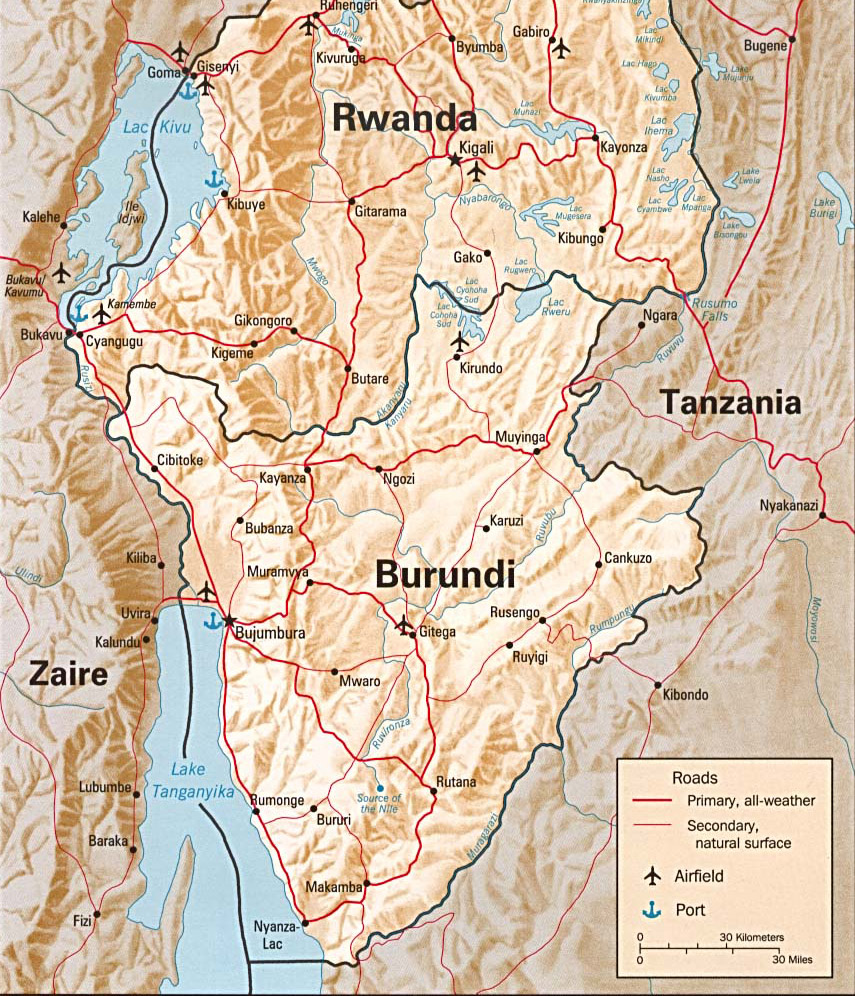
- Burundi is located in East Africa, landlocked between Rwanda, Tanzania, and the Democratic Republic of Congo.
- Its physical map shows a mountainous and hilly relief, with high altitudes.
- The country has no direct access to the sea but has a coastline on Lake Tanganyika, one of the largest and deepest lakes in Africa.
- Gitega is the political capital, while Bujumbura remains the economic center.
- Burundi is known for its coffee and tea crops.
Colors of Burundi
The flag of Burundi is a rectangular flag divided by a white “X” and in its center a white disc with three red six-pointed stars.
On the four sides of the flag forming the boundaries of the “X” are isosceles triangles: red above and below and green on the left and right.
Green symbolizes hope and optimism, white represents peace and clarity, and red represents the blood of the martyrs. The stars represent the Hutu, Twa, and Tutsi ethnic groups.

Best Places to Visit in Burundi?
Gitega: The capital of the country was once named Kitega. It is the largest city in the country but also a Burundian monument in itself. You will see all the administrative buildings as well as the useful establishments in a large city (shopping center, hotels, bars…)
Bujumbura: Despite the small size of this city, it is one of the most beautiful in the country. It is not as developed as the capital but that is what makes its charm: many traditional restaurants, French cuisine. There is also the Living Museum which traces the colonial past and the cultural history of the country.
Bururi: Located in the southern part of the country, it is a sparsely populated city but with a fascinating history and culture. Tourists go there to recharge or use the city as a starting point for other new destinations.
Where is Burundi located on the world map?
Burundi is a country located on the African continent. It is situated in the East of continental Africa and is landlocked between Rwanda, the Democratic Republic of the Congo, and Tanzania. These countries border it respectively to the North, West, and East.

Climate of Burundi
The Burundian Climate is a tropical climate with varying temperature differences in various regions. The central zone displays cool climates almost year-round with average temperatures of 20°C. In surrounding areas like Lake Tanganyika, for example, summer temperatures are a bit higher (23°C) and in winter around 16°C.
Throughout the Burundian territory, rainfall is inconsistent, being higher in the Northwest section. The hot and dry periods also mark the tropical climate and generally occur between December and January as well as June to August. The wet and rainy periods show between 13,000 and 16,000 mm of precipitation per year and take place between February and May.


Administrative Division of Burundi
The Burundian territory is subdivided into 18 provinces:
- Cankuzo
- Gitega
- Rutana
- Ruyigi
- Karuzi
- Kayanza
- Kirundo
- Muyinga
- Ngozi
- Bururi
- Makamba
- Rumonge
- Bubanza
- Bujumbura Mairie
- Bujumbura Rural
- Cibitoke
- Muramvya
- Mwaro
The provinces are in turn subdivided into 117 communes
The last level of subdivision of the Burundian territory is the Hills, which number 2,638.
Burundi Economy
The economy of Burundi is one of the least performing in the world. In this economic structure, the Agricultural sector is very dominant and represents about 32.9%. Moreover, the Burundian territory is landlocked and poor in resources, which reduces the possibilities for industrial development. On the other hand, food agricultural production is mainly focused on food products (cereals, rice, and vegetables). Here are some economic data:
- Current currency: Burundian Franc
- GDP in nominal terms: 3.436 billion USD
- GDP in purchasing power parity: 8.202 billion USD
- Annual growth rate: Nominal parity 0.5% Purchasing power parity: 1.8%
- GDP per capita in nominal terms: 307 USD
- GDP per capita in purchasing power parity: PPP
- Foreign aid: 90.7 million USD
- State fiscal reserves: 412.2 million USD
Population and linguistic data

Relief map of Burundi
The population of Burundi is estimated at 11,865,821 inhabitants. The annual growth rate is 2.85%, which reflects a strong demographic dynamic. The average age is 17.7 years, indicating a very young population.
The birth rate is significantly higher than the death rate, with 36 ‰ compared to 6.2 ‰. The migration rate is negative, estimated at -0.8 migrants per 1,000 inhabitants. The male/female ratio is 103 men for 100 women.
Ethnically, the population is mainly composed of Hutus, Tutsis, and Twas (Pygmies). Regarding religion, the distribution is as follows: 62.1% Catholics, 23.9% Protestants, 7.9% Muslims, and a minority share of traditional or undeclared beliefs.
FAQ – Burundi map
Burundi is in East Africa, between Rwanda, Tanzania, and the Democratic Republic of Congo.
The political capital is Gitega, but Bujumbura remains the economic capital.
It is a mountainous and landlocked country, with a coastline on Lake Tanganyika and a high population density.
