
What you need to know about Rwanda ?
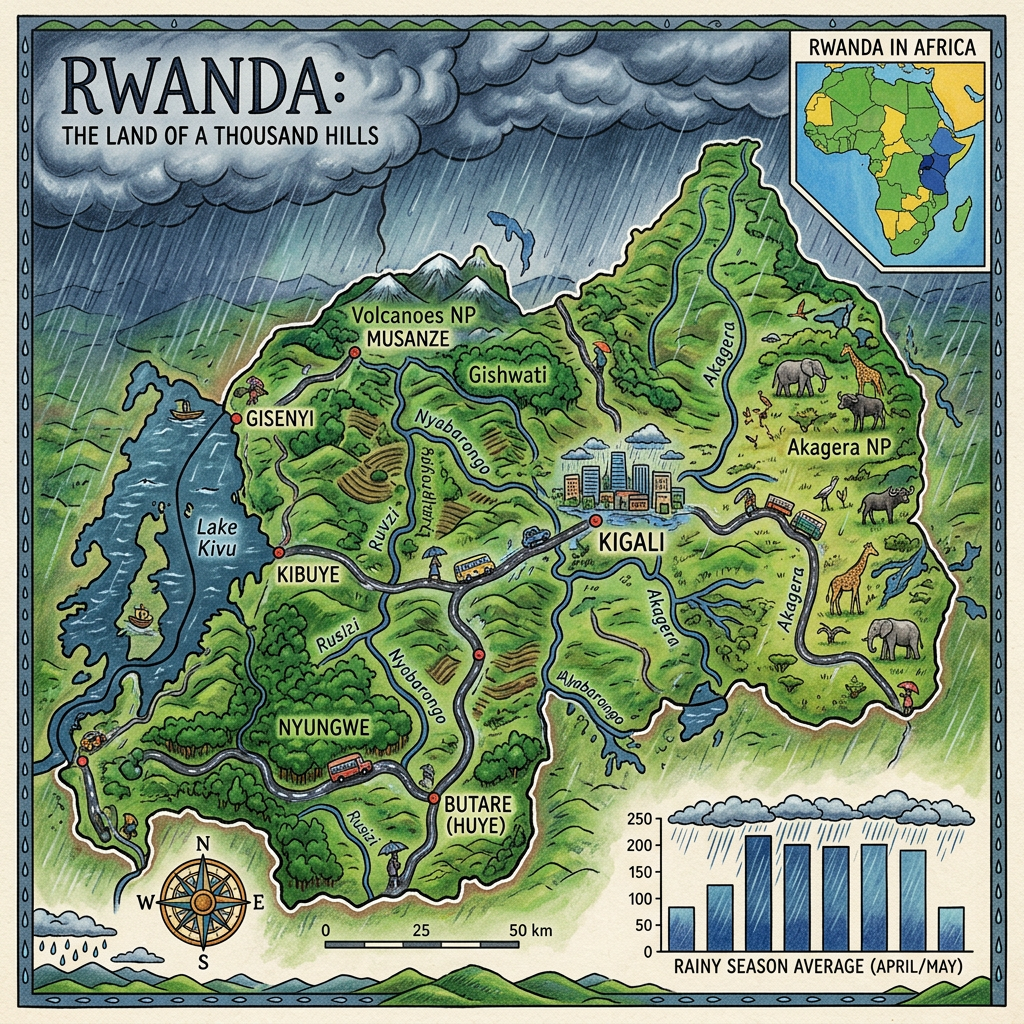
Rwanda is a republic located in East Africa. Its territory covers an area of 26,338 km², and its population is estimated at around 15 million inhabitants in 2026, making it one of the most densely populated countries on the African continent. Its capital and largest city is Kigali.
The country is a member of several international organizations including COMESA, the AfDB, and the CIR. The country’s telephone code is 250.
Colors of Rwanda
The Rwandan flag is a rectangular flag composed of 3 horizontal stripes from top to bottom: blue, yellow, and green, with the blue stripe being twice as thick as the others. At the fly end and in the upper corner is a yellow sun with 24 rays.

Best places to visit in Rwanda
Kigali
The capital is the center of the country but also a cultural city. It has experienced several historical events such as German colonization and was a former site of genocide. But what has especially marked the city is the exponential industrialization through mining industries, processing industries, as well as automotive industries.
Butare
This city is also called Huye; it is a student city because there is a real buzz of universities here. Moreover, it is a historic city, the capital of the country during German colonization. Today, it is a magnificent city and the cradle of the country’s scientific research.
Nyanza
This is a very old city full of ancestral castles of the monarchs who succeeded one another. You will see the old king’s palace as well as the alleys and dusty roads of the city. It was formerly a major capital before the colonization of the country but is probably also the richest city.
Where is Rwanda located on the world map?
On the world map, Rwanda is located in continental Africa. It is situated in the central west and is landlocked between the Democratic Republic of Congo, Uganda, Tanzania, and Burundi.

Climate of Rwanda
The geographical location of Rwanda on the equator indicates that the country’s climate is of a temperate equatorial and humid type. The center of the territory shows a semi-arid climate.
There are two rainy seasons which occur respectively between March and May and October and December. Year-round temperatures in the country range between 20 and 21°C in the eastern parts of the country. On the central high plateaus, temperatures range between 17.5°C and 19°C.
Maximum rainfall usually occurs between March and May and the second less rainy season; annual rainfall ranges between 908mm and 2669mm.
Administrative division of Rwanda
The Rwandan territory is divided into 5 provinces called Intara, which are further divided into 30 districts called Akarere.
Here are the 5 provinces of Rwanda:
- Northern Province
- Eastern Province
- Southern Province
- Western Province
- Kigali Province
Economy of Rwanda
The Rwandan economy has become increasingly efficient over the past 10 years. The reason for this is that the country has implemented fiscal policies that have contributed to a 6% GDP growth and an inflation rate reduced to less than 6%.

The dominant sector in the country is the services sector, which represents about 51.5% of GDP, and agriculture, which accounts for 30.9% of GDP. Industrial products include cement, agricultural products, and the textile industry. Here are some economic data of the country:
- Official currency: Rwandan Franc
- Nominal GDP: approximately USD 17 billion
- GDP at Purchasing Power Parity (PPP): approximately USD 42 billion
- Annual GDP growth rate: approximately 7.0%
- GDP per capita at Purchasing Power Parity (PPP): approximately USD 2,700
- Inflation rate: approximately 5%
- Population living below the national poverty line: approximately 38%
- Unemployment rate: approximately 16% of the labour force (broad definition, including underemployment)
Population and linguistic data of Rwanda
Currently, the Rwandan population numbers 12,712,431 inhabitants and the demographic growth rate is 2.3%. The birth rate is 29.8 ‰ and the mortality rate is 6.3 ‰. The life expectancy of a Rwandan at birth is 64.5 years, including 62.6 years for men and 66.5 years for women.
The male/female sex ratio is 96 men to 100 women. The population migration rate is -0.5%. Here are the languages used in the country: Kinyarwanda, English, and French as native languages, and Kiswahili as the national language.
The ethnic groups composing the population are: Hutu (83%), Tutsi (16%), Twa (1%), the religions in the country are: Protestants and Adventists (40.5%), Catholicism (43.7%), Islam (2.0%), and Others (4.7%).
FAQ – Rwanda Map: Geographic and demographic information
Rwanda is a landlocked country located in East Africa, within the Great Lakes region. It shares borders with Uganda, Tanzania, Burundi, and the Democratic Republic of the Congo.
Rwanda has a population of approximately 14.5 million people in 2025. Despite its small size, it is one of the most densely populated countries in Africa.
Rwanda covers an area of approximately 26,338 km². Its landscape is mainly composed of hills and mountains, earning it the nickname “the land of a thousand hills.”
