
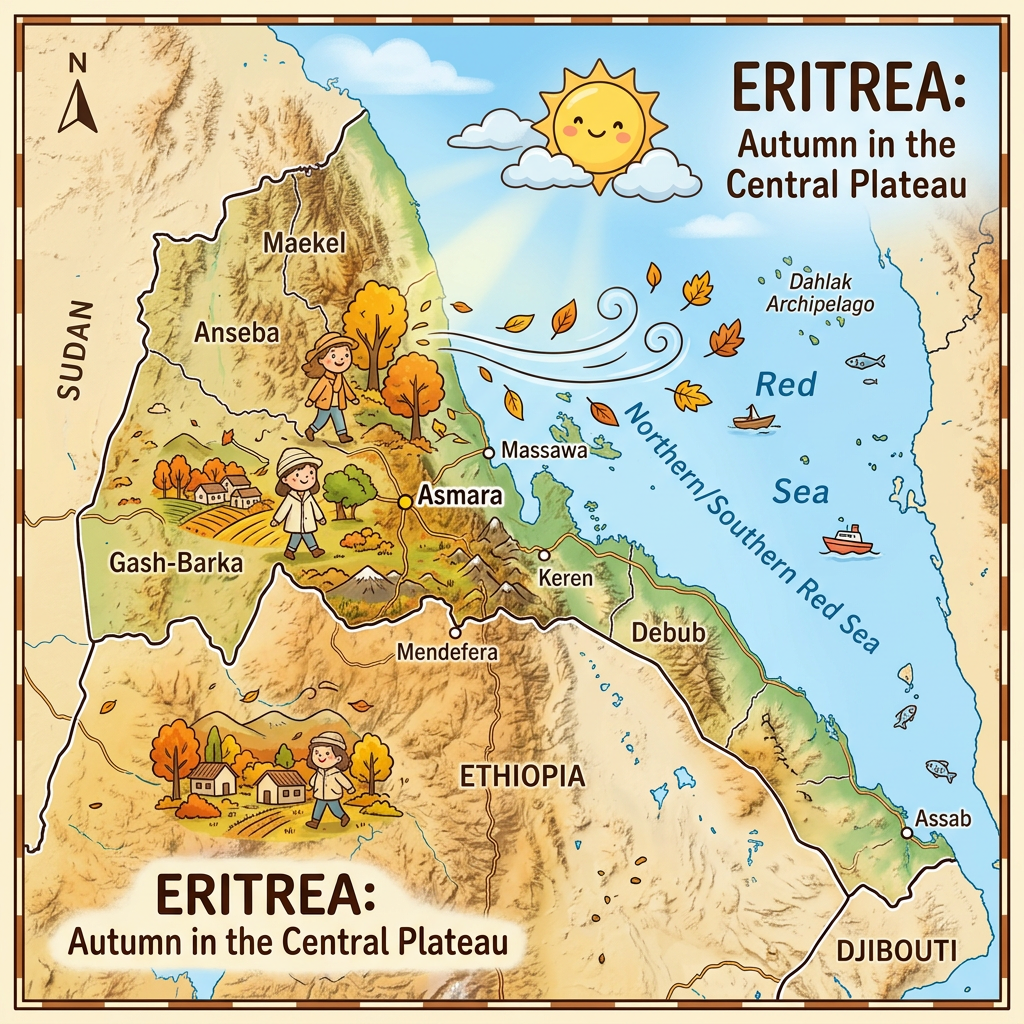
Eritrea often intrigues due to its position in East Africa and the diversity of its landscapes. It is a country whose contours become fully meaningful when consulting a map of Eritrea. Whether you are passionate about geography or simply curious to discover African territories, exploring the various physical and political maps helps to better understand this little-known country, wedged between the Red Sea and several significant neighbors.
Table – Eritrea: geographical and demographic information
| Element | Key Information |
|---|---|
| Total area | 117,600 km² |
| Capital | Asmara |
| Bordering countries | Sudan, Ethiopia, Djibouti |
| Coastline | Over 1,100 km on the Red Sea |
| Estimated population | ~3.7 million inhabitants (2025) |
| Population density | ~31 inhabitants/km² |
| Relief | High plateaus, desert areas, coastal plains |
| Climate | Semi-arid to desert, temperate in the mountains |
| Main languages | Tigrinya, Arabic, English |
| Economic resources | Gold, copper, salt, agriculture, fishing |
Let’s discover together how the map of Eritrea reveals much more than borders: it offers a rich insight into its provinces, main cities, and its role within the Horn of Africa.
The map of Eritrea: general overview and location
When observing a map of Eritrea, one immediately notes its strategic location. The country is situated in the Horn of Africa, this emblematic region of East Africa shaped like a triangle. Bordered by the Red Sea to the east, Eritrea also shares land borders with several key states on the African continent.

The study of the local geography is facilitated by the many available maps, which highlight the diversity of the relief and administrative divisions. These graphical representations assist both students and travelers in locating the main points of interest and communication routes.
Additional points on the map of Eritrea
- Eritrea has a long strategic coastline on the Red Sea.
- The country shares its land borders with Ethiopia, Sudan, and Djibouti.
- The physical map reveals a strong contrast between the temperate high plateaus and the arid coastal plains.
- Eritrea is home to many islands, including the Dahlak archipelago.
- Its capital, Asmara, is listed as a UNESCO World Heritage site for its Italian modernist architecture.
Which countries border Eritrea?
Eritrea is bordered by three countries: Sudan to the northwest, Ethiopia to the south, and Djibouti to the southeast. A large part of its eastern border opens onto the Red Sea, thus offering over 1,000 kilometers of coastline.

This maritime façade gives Eritrea a strategic importance for international trade but also shapes its coastal landscapes. The proximity of these neighbors greatly influences Eritrean history and culture, visible both on political maps and through the testimonies of the inhabitants.
The map of Eritrea illustrates a country in the Horn of Africa bordered by the Red Sea. It highlights its borders with Sudan to the west, Ethiopia to the south, and Djibouti to the southeast. This strategic positioning gives it major geopolitical importance in the Horn of Africa region.
Where is the capital Asmara located?
Asmara, the capital of Eritrea, occupies a central place on most maps, nestled on the central plateau at about 2,300 meters altitude. Its privileged position ensures a mild climate and spectacular landscapes.
Administrative and urban maps reveal how much Asmara is the political, economic, and cultural heart of the country. Locating it helps better understand the demographic distribution and the importance of roads connecting the capital to other main cities.
Administrative organization and major regions of Eritrea
On a political and administrative map of Eritrea, one can see its division into six regions, sometimes called zobas. Each has a capital, its own identity, and a specific place in the national economy. This administrative network helps structure daily life and local public services.

The distinction between administrative divisions also helps grasp the political issues specific to each province, as well as their unique history. This organization dates back to the late 1990s, when the country adopted a decentralized structure after its independence.
How many provinces or regions are there in Eritrea?
Eritrea has six major administrative regions: Maekel (center), Anseba (northwest), Gash-Barka (west), Debub (south), Northern Red Sea and Southern Red Sea. Each displays marked geographical specificities, ranging from fertile highlands to arid stretches bordering the sea.
Within each region, there are local subdivisions that promote proximity management. This administrative organization is clearly visible on official maps, allowing easy identification of capitals and their exchanges with the capital Asmara.
What are the main cities of Eritrea?
Besides the capital, several main cities stand out according to the maps. Massawa and Assab, major ports on the Red Sea, play a crucial role in trade. Keren, located in the north, attracts with its agricultural and sporting dynamism.
Other urban centers such as Mendefera, Barentu, and Dekemhare also make the territorial organization lively. These secondary hubs are essential to understand life outside Asmara and observe the interaction between rural areas and modern agglomerations.
- Asmara: political and cultural capital
- Massawa: historic port on the Red Sea
- Keren: multifunctional center in the north
- Assab: strategic port city in the southeast
- Mendefera: administrative hub of the south
Landscapes, nature, and reliefs through physical maps
One cannot talk about Eritrea without mentioning the richness of its reliefs. The physical maps display a wide variety of landscapes: central mountains, coastal plains, and desert areas on the outskirts. Altitudes fluctuate rapidly, giving rise to unique and sometimes spectacular panoramas.
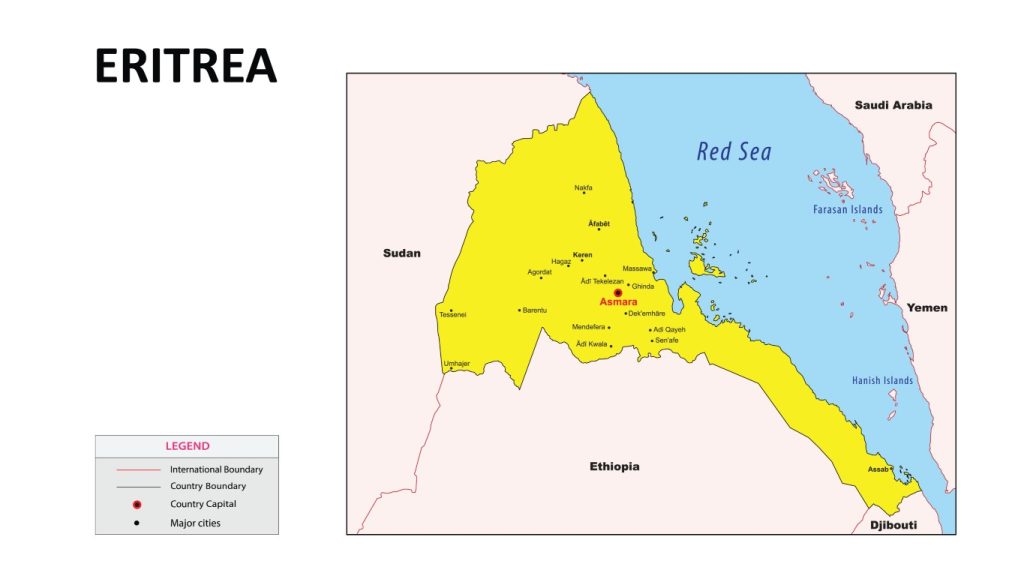
Analyzing a physical map means noticing the predominance of the central plateau, the true backbone of the country. This cartographic data helps anticipate climatic conditions, but also to imagine travel routes adapted to each type of terrain.
What impact does the Red Sea have on Eritrean geography?
Bordering the entire eastern facade, the Red Sea strongly influences the climate, economy, and lifestyles of Eritreans. Fishing activities, maritime trade, and beach tourism directly benefit from this situation.
The marine maps notably illustrate the presence of a string of islands, some of which remain preserved. Their representation also shows access to the main ports, true economic lungs for Eritrea. The sea thus serves as a vital axis, both for daily life and for the country’s commercial strategy.
How does natural diversity manifest on the map?
From mountains reaching over 3,000 meters to lowlands near sea level, the contrast is striking. The maps also list several rivers, although seasonal, which irrigate valleys and crops.
These natural elements divide the territory into distinct zones, each hosting specific vegetation and wildlife. Taking the time to read a physical map of Eritrea therefore offers much more than a simple overview, as it allows for preparing discoveries and hikes with full knowledge of the terrain.
Difference between political, administrative, and physical maps of Eritrea
Knowing which map to use really depends on the intended purpose. If a political map will highlight national borders and main cities, an administrative map will detail more the internal divisions and regional boundaries.
A physical map, on the other hand, will prioritize the study of relief, waterways, and remarkable natural spaces. Careful observation of these different versions allows cross-referencing information to refine understanding and movement within the territory.
What do the political and administrative maps of Eritrea reveal?
The former show the positioning of international borders, essential to place Eritrea on the regional chessboard. They also indicate major road axes and connections between the main cities, providing an effective overview.
Administrative maps, on the other hand, display regional subdivisions, highlighting provincial capitals and local districts. For any official procedure or logistical organization, this format proves valuable.
When should you prioritize reading a physical map?
Hikers, farmers, or geology enthusiasts have every reason to consult this type of document. The physical map reveals elevations, alluvial plains, and mountain ranges, thus allowing the planning of routes or infrastructures.
Assessing topography through color shades quickly gives an idea of densely populated areas versus uninhabited regions. This tool combines pragmatism and an invitation to discovery for those wishing to explore Eritrea differently.
FAQ – Eritrea map: 3 questions
Eritrea is located in the Horn of Africa, on the edge of the Red Sea, between Sudan, Ethiopia, and Djibouti.
The capital is Asmara, known for its unique architectural heritage.
The country is distinguished by its high plateaus, arid coastal plains, and its long coastline along the Red Sea.
