
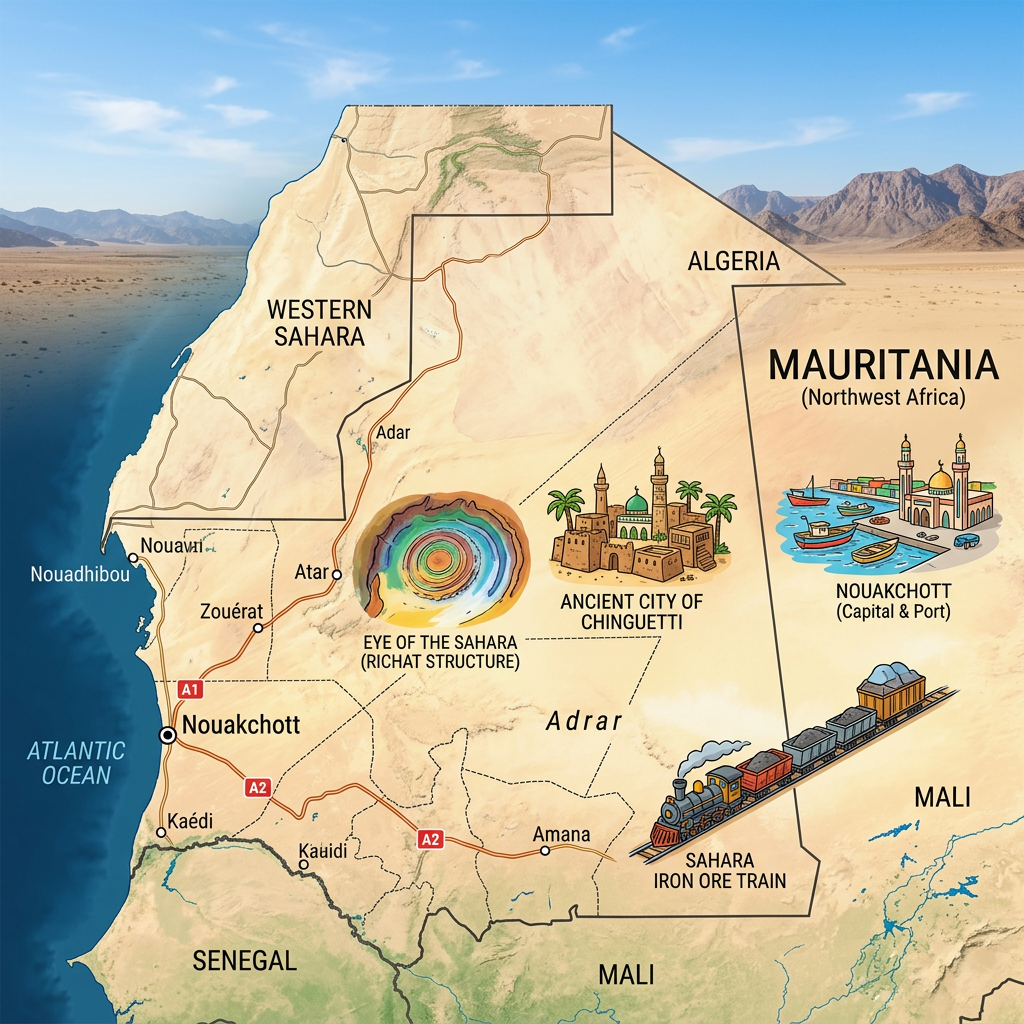
What you need to know about Mauritania ?
Mauritania is an African Islamic state, it holds the status of the Islamic Republic of Mauritania and its area is 1,030,700 km2, making it the 29th largest in the world.
The population of Mauritania is estimated at approximately 5.46 million inhabitants in 2026, ranking the country 123rd in the world by population. Its population density is about 5 inhabitants per square kilometer, making it one of the least densely populated countries in Africa.
The capital of Mauritania is Nouakchott, which is also the country’s largest city, with an estimated population of more than 1.56 million inhabitants in 2025.
Mauritania is a member of several international organizations including the UN and the African Union, and the country’s telephone code is 222.
Colors of Mauritania
The Mauritanian flag is a rectangular flag with a 2:3 ratio. It is composed of three horizontal stripes, two red and one green in the middle. The green stripe is three times the size of the red stripes.
In the center of the green stripe is a crescent moon and a star, both yellow in color. The green color, the star, and the crescent moon symbolize the Islamic religion. The red color symbolizes the blood of the country’s martyrs.

Best places to visit in Mauritania?
Chinguetti:
It is a city that resulted from the development of the Sahara sand dunes. It is marked by spacious streets, brick towers, and several fortresses that were once the homes of the Berbers and Almoravids during the Middle Ages. This is why Chinguetti is part of the UNESCO World Heritage. Additionally, there is
Nouakchott:
The capital of Mauritania is a very lively city that encompasses ruins from ancient times. You will see contrasts between the slums and nomadic barrios. Moreover, it is a fishing city bustling with vendors, merchants, residents, and nomads passing through the city.
Atar:
It is surely the heart of Mauritania, but its proximity to Western Sahara makes it a magnificent attraction. The city serves as a starting point for other regions such as the Richat structure or the Sahara oases because, in addition, you will have at your disposal several restaurants and hotels to stay in.
Where is Mauritania located on the world map?
On the world map, Mauritania is located on the African continent, more precisely in the Western section. The country’s neighbors are Algeria, Mali, and Senegal, which border it respectively to the North-Northeast, East, and South-Southeast and Southwest. It is also bordered by Western Sahara to the North.

Climate of Mauritania
The climate of Mauritania is arid-desertic, which explains the low population density per km2. Almost the entire Mauritanian territory has experienced several consecutive droughts that have led to the desertification of the country.
The climate tends to be temperate along the coasts due to the river winds that raise the humidity of the area slightly. In the southern and southeastern sections, there is more greenery because rainfall exists and ranges between 50 and 150mm per year.
On the other hand, there is a warm breeze bringing sandstorms that can bury crops or sometimes villages, which are constantly at risk of being turned into deserts. This wind is called Khamsin or harmattan.
As one moves further inland, temperatures rise a bit more than on the coasts. They can then reach up to 50°C. Finally, there are no distinct seasons but only unexplained heat waves.
Administrative division of Mauritania
The Mauritanian territory is divided into 12 Wilayas plus a district for the capital. These Wilayas are then subdivided into Mouaghtaas or departments, numbering 44. The last level of subdivision consists of communes (numbering 216)
Here are the Wilayas:
- Adrar
- Assaba
- Brakna
- Dakhlet Nouadhibou
- Gorgol
- Guidimaka
- Hodh Ech Chargui
- Hodh El Gharbi
- Inchiri
- Nouakchott
- Tagant
- Tiris Zemmour
- Trarza
Here are the Mouaghataas of Mauritania:
Aoujeft
Atar
Chinguetti
Ouadane
Barkewol (Aftout)
Boumid
Guerou
Kankossa
Kiffa
Aleg
Bababé
Boghé
M’Bagne
Magta-Lahjar
Kaédi
M’Bout
Maghama
Monguel
Ould Yengé
Sélibabi
Amourj
Bassikounou
Djiguenni
Néma
Oualata
Timbedra
Aïoun El Atrouss
Kobenni
Tamchekett
Tintane
Dar Naim
Teyareth
Toujounine
Ksar
Sebkha
Tevragh Zeïna
Araffat
El Mina
Riyadh
Moudjeria
Tichitt
Tidjikdja
Bir Moghreïn
F’rick
Zouerate
Boutilimit
Keur Macène
Merdra
Ouad Naga
R’Kiz
Rosso
Economy of Mauritania
The economy of Mauritania is strongly influenced by Agriculture, which represents a significant share of the country’s GDP.
When the climate and weather conditions hinder agriculture, the exports and exploitation of mineral and iron ore deposits contribute to the increase in GDP. Moreover, these industrial exploitations represent 50% of total exports.
There is also the fishing sector, which allows the country to be self-sufficient in seafood but also for exports. However, Mauritania does not yet have agro-food industries to process them. Here are some economic data of Mauritania:
- Nominal GDP: approximately USD 14.35 billion in 2026
- GDP at Purchasing Power Parity (PPP): approximately USD 43.91 billion in 2026
- Annual GDP growth rate: 4.4% in 2026
- GDP per capita (nominal): approximately USD 3,033
- GDP per capita (PPP): approximately USD 9,280
- Inflation rate: approximately 2.5%
- Population below the poverty line: approximately 28.2% of the population
- Unemployment rate: approximately 10% of the labor force
- Government revenue: approximately USD 3.8 billion
- Government expenditure: approximately USD 4.2 billion
Population and language data of Mauritania
The population of Mauritania currently stands at 4,005,475 inhabitants with an annual demographic growth rate of 2.14%. The birth rate and death rate are respectively 2.99% and 0.78%, and the infant mortality rate is 5.05%.
The life expectancy of a Mauritanian at birth is 63.8 years, with 61.4 years for men and 66.2 years for women. The average age of the population is 20.7 years, indicating a very young population.
The sex ratio of the Mauritanian population is 93 women for every 100 men. The most spoken languages in the country are: Arabic, Pulaar, Soninke, Wolof, French, Hassaniya, Berber, Bambara.
FAQ – Mauritania Map: Geographic and demographic information
Mauritania is located in northwestern Africa, between the Sahara Desert and the Atlantic Ocean. It shares borders with Algeria, Mali, Senegal, and Morocco.
The capital of Mauritania is Nouakchott. The city is also the country’s main economic, administrative, and demographic center.
Mauritania has a population of around 5 million people. Its population is unevenly distributed, with a high concentration in urban areas and along the Senegal River.
