
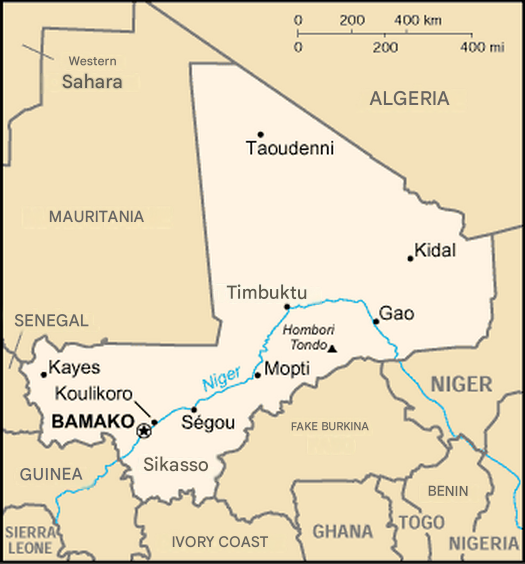
What you need to know about Mali ?
Mali is a West African republic, currently led by a transitional administration.
Its territory covers 1,241,238 km², making it the 24th largest country in the world.
It has approximately 19.55 million inhabitants, with an average density of 16 inhabitants per km².
Mali is thus the 62nd most populous country on the planet.
A Saharan-Sahelian pivot country, Mali is organized between the desert north, the Sahelian center, and the more populated south, shaped by the Niger River. A detailed map helps sequence the long distances, locate bridges and bus stations, and plan stages around the regional hubs.
Its capital, Bamako, is also the largest city in the country and the main economic, political, and cultural center.
Other major Malian cities include Sikasso, Ségou, Mopti, Koutiala, Kayes, San, Timbuktu, Gao, Bougouni, Nioro-du-Sahel, Taoudenni, Bandiagara, and Ménaka.


The inhabitants of the country are called Malians.
The official currency is the CFA Franc (XOF), and the country is a member of many regional and international organizations such as:
OHADA, AfDB, ECOWAS, CEN-SAD, CIR, OMVS, ALG, G5 Sahel, CD, and CAMES.
The international telephone code for Mali is +223 (or 00223).
| Element | Details |
|---|---|
| Official Name | Republic of Mali |
| Capital | Bamako |
| Population | ~22–23 million inhabitants, heavily concentrated in the southwest |
| Area | ~1,240,000 km² |
| Relief & Hydrography | Sahara in the north, central Sahel, Sudanian plateau in the south; Niger and Senegal rivers (regional sources) |
| Climate | Arid in the north, semi-arid in the center, tropical in the south; rainy season approx. June–September |
| Languages | French (official), Bambara and numerous national languages |
| Currency | CFA Franc (XOF) |
| Major Cities | Bamako, Sikasso, Ségou, Mopti, Timbuktu, Gao, Kayes |
| Economy | Agriculture (cotton), gold, livestock, services; regional trade |
| Points of Interest | Niger Loop (Mopti), Sahelian historic cities (Timbuktu), Bandiagara Cliffs (Dogon) |
| Access | Bamako Airport (BKO); regional road connections vary by season/road conditions |
| Advice | Plan for weather and distances, check road conditions, prepare water/sun protection and logistical stops along the Niger |
Colors of Mali

The Malian flag is a 2:3 format flag with 3 colors arranged in vertical stripes. From left to right: green, yellow, and red. Green symbolizes the agropastoral orientation of the people, yellow indicates gold as well as the country’s mineral resources, and red represents the blood shed during the struggle against foreign occupation.
Best places to visit in Mali ?
Timbuktu
Timbuktu is a mythical city, symbol of Mali’s history and culture.
Located at the gates of the Sahara, it has long been a crossroads of trans-Saharan trade linking North Africa and West Africa.
Visitors discover lively markets where spices, fabrics, and local handicrafts are exchanged, as well as historical remains bearing witness to the city’s glorious past.
Among the must-see sites: the mud mosques, including the famous Djingareyber Mosque, listed as a UNESCO World Heritage site, the sandy alleys, and the traditional banco houses.
It is also the ideal starting point for excursions into the Saharan desert.
Bamako
Capital of Mali, Bamako is a lively and commercial metropolis located on the banks of the Niger River.
It charms with its daily bustle, its colorful markets, and its busy streets where music, crafts, and local scents mingle.
The Grand Market of Bamako is a true labyrinth where you can find fabrics, jewelry, musical instruments, and typically African products.
The city also offers dynamic cultural spaces, traditional eateries, and a vibrant music scene, making Bamako the beating heart of modern Mali.
Djenné
Considered one of the oldest cities in sub-Saharan Africa, Djenné is especially known for its mud mosque, the largest in the world, also listed as a UNESCO World Heritage site.
The city, built on an island in the inner Niger delta, was once a major commercial center linking caravans from the Sahel and Sahara.
Today, it retains a unique charm, between historical heritage, banco architecture, and authentic local life.
Djenné attracts visitors with its weekly market, its finely sculpted clay houses, and its timeless atmosphere.
Where is Mali located on the world map?
Mali is a landlocked African state in the western part of continental Africa. It is bordered by Algeria to the North and Northeast, Burkina Faso to the Southeast, Mauritania to the West, Niger to the East, Guinea to the Southwest, Ivory Coast to the South, and Senegal to the South-Southwest.

Climate of Mali
The climate of Mali is characterized as hot and dry tropical. Sunshine is at its maximum throughout the year. This climate is divided into two seasons, namely the dry season and the wet season.
The dry season generally occurs between November and June: it is marked by very low humidity combined with high temperatures due to the Harmattan and the trade winds. This season is characterized by temperatures ranging between 40 and 45°C.
The wet season usually takes place between June and October with a strong influence from the southwest monsoon. This season is marked by cloudy to dark skies and heavy rains. Temperatures during this season range around 25 to 30°C.
August is the coldest month because it is the rainiest month.
The Malian territory is divided into 3 distinct climatic zones which are:
The Sudanese zone, the Sahelian zone, and the desert zone. The first occupies one third of the Malian territory and is very rainy with rainfall between 510 and 1,400 mm.
The second occupies the area bordering the desert and has rainfall between 200 and 510 mm. The last is the zone occupied by the Sahara which is a very dry and hot area with daytime temperatures from 47 to 60°C and nighttime temperatures from 4 to 5°C.
Administrative division of Mali

The Malian territory is subdivided into 10 administrative Regions, 49 circles, and 703 communes, including 18 urban and 666 rural.

Here are the 10 regions of Mali
- Kayes
- Koulikoro
- Sikasso
- Ségou
- Mopti
- Gao
- Timbuktu
- Kidal
- Ménaka
- Taoudénit.
Here are the 49 circles of Mali
Bafoulabé
Diéma
Kayes
Kéniéba
Kita
Nioro du Sahel
Yélimané
Banamba
Dioïla
Kangaba
Kati
Kolokani
Koulikoro
Nara
Bougouni
Kadiolo
Koutiala
Kolondiéba
Sikasso
Yanfolila
Yorosso
Barouéli
Bla
Macina
Niono
San
Ségou
Tominian
Bandiagara
Bankass
Djenné
Douentza
Koro
Mopti
Ténenkou
Youwarou
Diré
Goundam
Gourma-Rharous
Niafunké
Timbuktu
Ansongo
Bourem
Gao
Abeïbara
Kidal
Tessalit
Tin-Essako
Foum Alba
Achouratt
Al-Ourche
Boudje-Béha
Ménaka
Andéramboukane
Inékar
Tidermène
Economy of Mali

The Malian economy is mainly based on the agricultural sector, which forms the backbone of the country’s economic life and employs nearly 70% of the active population.
However, this agriculture remains vulnerable to climatic hazards: scarcity of rainfall, low humidity, and irregularity of agricultural seasons regularly compromise the harvests.
Added to this are the weakness of infrastructure, the lack of export outlets, and the volatility of world prices, which limit the sector’s added value.
The main agricultural products of Mali are cotton, rice, millet, sorghum, and peanuts.
The country is also rich in mineral resources, notably gold, of which it is one of the leading African producers.
This mining sector remains a major source of foreign currency for the state, even though economic diversification remains a structural challenge.
Mali still heavily depends on international aid, notably from the International Monetary Fund (IMF) and the World Bank, to support its public investments and offset its budget deficits.
Key economic data (2024-2025 estimates)
- Official currency: CFA franc (XOF)
- Nominal GDP: 14.48 billion USD
- Annual GDP growth: 5.3%
- GDP per capita (PPP): 2,200 USD
- Inflation rate: 2.5%
- Unemployment rate: 8.1% of the active population
- Export value: 3.04 billion USD
- Main exported products: gold, cotton, livestock, peanuts
Despite stable growth, Mali faces structural challenges: low industrialization, dependence on the primary sector, and vulnerability to security crises.
Reforms are underway to encourage local processing of agricultural products, modernize logistics chains, and strengthen food self-sufficiency.
Population and linguistic data

The Malian population is estimated at about 20.24 million inhabitants in 2024, with a high population growth rate of 2.98% per year.
The birth rate is 43.2‰, while the death rate is 9.6‰.
The fertility rate reaches 5.9 children per woman, placing Mali among the most fertile countries in Africa.
The infant mortality rate remains high, at 67.6‰, reflecting difficulties in accessing healthcare in some rural areas.
Life expectancy at birth is 60.8 years, including 58.6 years for men and 63 years for women.
The average age of the population is 15.8 years, highlighting the youthfulness of the Malian population.
The sex ratio is slightly unbalanced, with 95 men per 100 women, and the net migration rate is -3.9%, indicating moderate emigration to neighboring countries.

Languages spoken
The official language of Mali is French, used in administration, education, and institutions.
However, the most commonly spoken language daily is Bambara, understood by nearly 80% of the population.
The country also has great linguistic diversity, with more than twenty national languages, including Peul (Fulfulde), Soninké, Tamacheq (Tuareg), Bozo, and Songhaï.
Ethnic groups
The Malian population is made up of several major ethnic groups:
- Mandé (Bambaras, Malinkés, Khassonkés): 35%
- Soninkés: 15%
- Peuls: 17%
- Songhaïs: 17%
- Tuaregs and Moors: 10%
- Other minorities: 5%
Religions
The dominant religion in Mali is Islam, practiced by about 90% of the population, mainly in its Sunni form.
African traditional beliefs account for about 9%, while Christianity is practiced by 1% of inhabitants, mainly in urban areas.
FAQ: Mali map
A Mali map with simplified relief and isohyets allows distinguishing the Saharan north, Sahelian center, and the more humid south to adapt stages and equipment.
Yes, a Mali map showing meanders, bridges, and riverside towns (Ségou, Mopti, Gao) facilitates routes and logistical stops.
An up-to-date road map of Mali, combined with the condition of the roads and the rainy season, provides a realistic view of average speeds and possible detours.
It is better to have an offline/GPX Mali map: signage is uneven off main roads and network coverage varies.
