
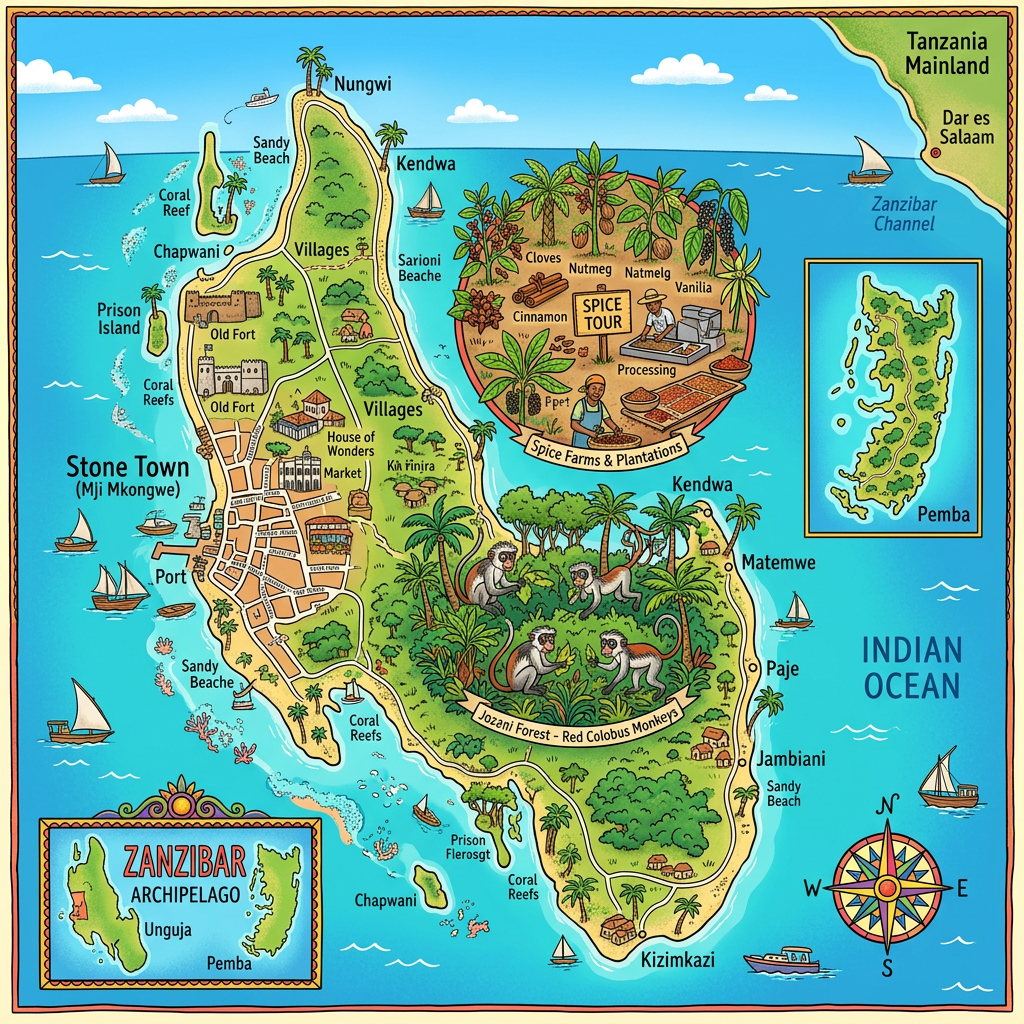
Zanzibar is a Tanzanian archipelago located in the Indian Ocean, off the east coast of Tanzania. It is mainly composed of two major islands: Unguja (often called Zanzibar) and Pemba. The archipelago has a total of about 75 islands, most of which are uninhabited.
Contrary to popular belief, Mafia Island is not administratively part of Zanzibar: it belongs to the mainland region of Pwani in Tanzania.
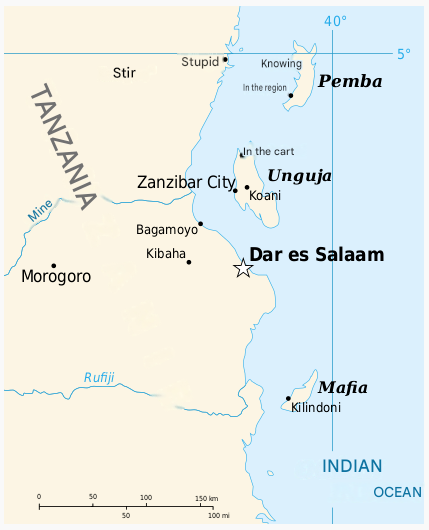
Zanzibar is a semi-autonomous region of the United Republic of Tanzania. The archipelago has its own government, called the Revolutionary Government of Zanzibar, while remaining under the authority of the Tanzanian central government.
The total population of Zanzibar is estimated at about 1.89 million inhabitants (2022 census), over an area of approximately 2,643 km². The administrative, historical, and cultural capital of the archipelago is Stone Town, located on the island of Unguja.
| Mapping Indicator | Exact Data | Concrete Reading on the Map |
|---|---|---|
| Area (Unguja) | 1,666 km² | Island larger than Madeira |
| North–South Length | ≈ 85 km | Crossing in 1h30–2h |
| East–West Width | ≈ 39 km | Very extensive coast |
| Total Population | ≈ 1.9 million | High local pressure |
| Average Density | ≈ 1,140 inhabitants/km² | Highly populated areas |
| Historical Capital | Stone Town | West, cultural heart |
| Maximum Altitude | ≈ 120 m | Very flat island |
| Total Coastline | ≈ 340 km | Ubiquitous beaches |
| Distance Stone Town ↔ Nungwi | ≈ 58 km | Touristic North |
| Distance Stone Town ↔ Paje | ≈ 50 km | Seaside East |
| Distance Stone Town ↔ Jambiani | ≈ 56 km | Quiet area |
| Most Touristic Zone | North & East | Resorts + beaches |
| Most Authentic Zone | Center & South | Villages, agriculture |
| Tides (East Coast) | Amplitude up to 3 m | Beaches vary depending on the time |
| Zone without visible tides | North & West | Stable swimming |
| Annual Temperature | 25–30 °C | Constant tropical climate |
| Dry Season | June to October | Ideal conditions |
| Rainy Season | March–May | Sometimes difficult roads |
| Main Airport | ZNZ – West | Only entry point |
Countries bordering Zanzibar
Since Zanzibar is an archipelago in the Indian Ocean off the Tanzanian coast, its direct neighbor is Tanzania. To precisely locate the archipelago, see where Zanzibar is located and the map of Zanzibar. At the regional level, the closest shores are those of Kenya and Mozambique, as well as the archipelagos of the Comoros and the Seychelles.
The colors of Zanzibar

Since it is a governorate associated with that of Tanzania, the flag of Zanzibar is the same as the flag of Tanzania. It is, of course, the Tanzanian flag which was born in 1964 and whose colors are green and blue crossed by a thickened black band of yellow color. In fact, the blue color represents the inland waters of Zanzibar and the Indian Ocean. The black color, on the other hand, is meant to represent the people and finally, the green color represents the country’s agriculture.
The best cities and places in Zanzibar
Stone Town
Stone Town, locally called Mji Mkongwe (“old town”), is the historical and cultural heart of Zanzibar. Listed as a UNESCO World Heritage Site, it stands out for its network of narrow and labyrinthine alleys, its ancient mosques, its buildings influenced by Arab, Persian, Indian, and colonial styles, as well as its famous carved doors. It is the administrative, historical, and logistical center of the archipelago.
Jambiani
Jambiani is a village located in the southeast of Unguja Island, the main island of Zanzibar (and not in the southwest). A former fishing and seaweed farming village, it has managed to preserve a local atmosphere while developing a balanced tourist offer. There are many lodges and guesthouses. The lagoon, protected by the coral reef, offers turquoise waters ideal for swimming, kitesurfing, and windsurfing, with a strong influence of the tides.
Nungwi
Located at the extreme north of Unguja, Nungwi is one of the most touristic areas of Zanzibar. It is known for its beaches without marked tides, its calm waters all day long, and its high-end hotel infrastructure. It is one of the best areas for swimming and sunsets.
Paje
Paje is a world reference for kitesurfing, thanks to its constant winds and its wide shallow lagoon. The village attracts a young, international, and sporty population. The tides are very visible there, which strongly structures water activities and local life.
Economic map of Zanzibar
Tanzania has experienced sustained economic growth for more than a decade, driven by infrastructure, agriculture, and tourism.
- Tanzania’s GDP (2023): ≈ 75 billion USD
- Average annual growth: 5 to 6%
- Weight of tourism in Zanzibar: ≈ 25 to 30% of the local economy
- Specificities of Zanzibar: beach and cultural tourism, export of clove (Zanzibar remains one of the world symbols of this spice)
Zanzibar benefits from a positioning of premium tourism + culture, distinct from the Tanzanian mainland.
Climatic map of Zanzibar
Zanzibar has a hot tropical climate all year round:
- Average temperatures: between 21 °C and 32 °C
- Temperatures rarely drop below 19 °C and rarely exceed 34 °C
- Main dry season: June to October
- Short rainy season: November
- Main rainy season: March to May
The east coast is more exposed to wind and tides, while the north and west offer more stable conditions.
Demographic and administrative map of Zanzibar
Demographics
- Total population of Zanzibar (2022 census): ≈ 1.89 million inhabitants
- Population growth rate: ≈ 3.1% per year
- Distribution:
- Unguja Island: ≈ 60% of the population
- Pemba Island: ≈ 40%
- Most densely populated area: West of Unguja (Stone Town and surroundings)
- Median age: ≈ 27 years
- Male/female ratio: ≈ 101 men per 100 women
Administrative organization
Zanzibar is a semi-autonomous region of the United Republic of Tanzania, administered by the Revolutionary Government of Zanzibar, with its own institutions while remaining attached to the Tanzanian state.
Administrative map
After the presidential and legislative elections of 2010, the autonomous region of Zanzibar is subdivided into 19 constituencies including:
- Mtoni Constituency (West)
- Mpendae Constituency (Urban)
- Mji Mkongwe Constituency (urban)
- Magomeni Constituency (urban)
- Dimani Constituency (West)
- Chumbuni Constituency (urban)
- Bububu Constituency (West)
- Amani Constituency (urban)
- Magogoni Constituency (West)
- Kwahani Constituency (urban)
- Kikwajuni Constituency (urban)
- Kiembesamaki Constituency (West)
- Jang’ombe Constituency (urban)
- Fuoni Constituency (West)
- Mwanakwerekwe Constituency (West)
- Mfenesini Constituency (West)
- Kwamtipura Constituency (urban)
- Dole Constituency (West)
- Raha Leo Constituency (Urban)
Zanzibar map

Zanzibar demolinguistic data
The population of Zanzibar is mainly composed of the Washirazi who reside in the north of the main island called Ugunja. And on the island of Pemba, the center and south of the island are inhabited by the Wahadimu. Thus, the majority of Zanzibaris are Muslim or Sunni and speak their mother tongue, Swahili, but the islanders call it Kiunguja. The Arabic language is also spoken, but only in Quranic schools called madrasa, and in Zanzibar, Arabic is used only during services in mosques.
Map of Zanzibar

Zanzibar is located off the east coast of Tanzania, in the Indian Ocean, about 35 km from Dar es Salaam. The archipelago includes two main islands – Unguja (often called Zanzibar) and Pemba – as well as many small islands. On a map, Zanzibar is visible opposite Bagamoyo, at the equator, which explains its tropical climate.
Zanzibar has about 1.8 million inhabitants, with a high concentration around the capital, Zanzibar City, especially in the historic Stone Town district. Some rural areas of the island are much less populated, offering preserved landscapes. The average density exceeds 500 inhabitants/km², making it a much more densely populated area than the Tanzanian average.
A detailed map highlights the coral reefs surrounding the island, the shallow lagoons to the east, protected forests such as Jozani in the south, and the long white sandy beaches. Contrary to some common beliefs, the island’s terrain is relatively flat, with some gentle hills not exceeding 120 meters in altitude.
