
What you need to know about Chile ?
The Republic of Chile is a Latin American country located between the Andes mountain range and the Pacific Ocean. It is a constitutional republic with a unitary presidential system.
The total area of its territory is 756,096 km², making it a very elongated country from north to south. Its population is estimated at about 19.6 million inhabitants in 2025, making it one of the most stable and urbanized countries in South America.
The capital and largest city is Santiago de Chile, the political, economic, and cultural center of the country.
Its largest city as well as its metropolis is called Santiago. The Chilean people mainly speak Spanish, which is also considered the official language. Chile is called the “southernmost country” due to its geographical location. Driving in Chile is on the right, and the telephone code is 56.
Table – Chile: Geographical and demographic information
| Item | Key Information |
|---|---|
| Total area | 756,102 km² |
| Capital | Santiago |
| Neighboring countries | Peru, Bolivia, Argentina |
| Coastline | ~6,435 km on the Pacific Ocean |
| Estimated population | ~20 million inhabitants (2025) |
| Population density | ~26 inhabitants/km² |
| Relief | Andes Mountains to the east, narrow coastal plains, deserts in the north, icy zones in the south |
| Climate | Arid in the north (Atacama Desert), Mediterranean in the center, cold and humid in the south |
| Official language | Spanish |
| Economic resources | Copper (world’s largest producer), wine, fruit, fishing |
| Special feature | Longest country in the world from north to south (4,300 km) but very narrow |
Additional points on the map of Chile
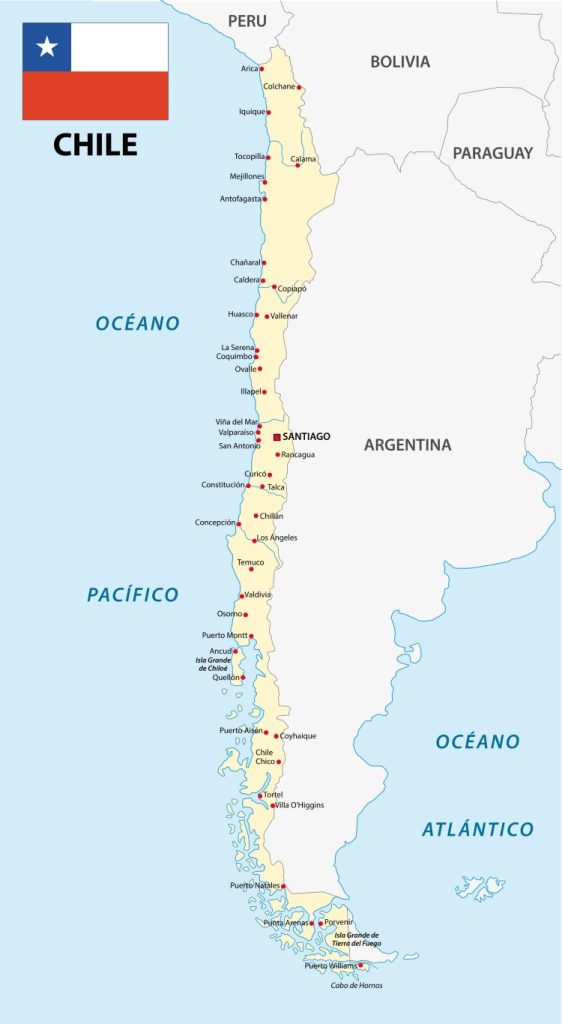
- Chile stretches along the Pacific coast of South America, from the Atacama Desert in the north to Patagonia in the south.
- Its physical map reveals a narrow strip of land squeezed between the Pacific Ocean and the Andes Mountains.
- The country borders three states: Peru, Bolivia, and Argentina.
- The capital, Santiago, is located in a valley in the center of the country.
- Chile has island territories, including Easter Island in the Pacific.
Where is Chile on the world map?
On the world map, Chile is located on the American continent. Indeed, the country occupies the southern part of America and in this part, it is on the western side. The west coast of Chile faces the Pacific Ocean. Its territory is quite long and thin on the map and it shares borders with Peru, Bolivia, and Argentina.

Colors of Chile and their meanings
The Chilean Flag is a rectangular flag composed of 3 colors: it consists of two superimposed bands, white (on top) and red (on the bottom). On the white band and towards the hoist side is a blue square with a white five-pointed star inside.
According to information, the blue square represents the blue of the sky and the star represents the executive power. The white color, on the other hand, represents the snow on the Andes and the red color symbolizes the blood shed during the battle for independence.

What are the best cities in Chile?
Santiago de Chile
Santiago is the capital and concentrates nearly 40% of the Chilean population. Lively by day and night, the city offers a dynamic cultural scene with museums, theaters, and art galleries. You can taste local specialties in its renowned restaurants, stroll through the chic neighborhoods, then head to the surrounding hills and natural parks. The nearby Andes allow for hiking and even skiing in winter.
Valparaíso
A port city listed as a UNESCO World Heritage site, Valparaíso charms with its bohemian character. Its colorful alleys, steep staircases, and mural paintings make it a unique destination. You will discover a mix of colonial architecture and modern creativity, all facing the Pacific Ocean.
La Serena
The second oldest city in the country, La Serena is known for its long beaches and colonial and neocolonial architecture. It also has an archaeological museum tracing pre-Columbian history. It is an ideal destination to combine beach relaxation and culture.
Viña del Mar
Nicknamed the “garden city,” Viña del Mar is one of Chile’s most famous seaside resorts. Renowned for its beaches, casinos, and music festivals, it attracts both Chileans and foreign visitors.
Puerto Varas
Located on the shore of Lake Llanquihue, this city with German-influenced charm offers a breathtaking view of the Osorno and Calbuco volcanoes. It is a gateway to the lake district and an ideal place for hiking, water sports, and discovering exceptional landscapes.
Population of Chile
The population of Chile is estimated at 19.6 million inhabitants (2025) with an annual growth rate of 0.6%.
- Fertility rate: 1.6 children per woman
- Birth rate: 12.7 ‰
- Death rate: 6.3 ‰
- Life expectancy: 80 years (77 years for men, 83 years for women)
- Median age: 36 years
- Sex ratio: 97 men per 100 women
Economic information about Chile
The Chilean economy is one of the most stable and prosperous in Latin America, based on a market economy and heavily oriented towards exports (notably copper, of which Chile is the world’s leading producer).
- Official currency: Chilean Peso (CLP)
- Nominal GDP: 375 billion USD
- GDP (PPP): 640 billion USD
- Annual GDP growth: 2.5%
- GDP per capita: 19,300 USD (nominal), 33,000 USD (PPP)
- Inflation: 4.1%
- HDI: 0.855 (high human development)
- Exports: 95 billion USD (copper, fruits, wine, wood, salmon)
- Imports: 100 billion USD (oil, machinery, vehicles, chemicals)
Climate information on Chile
From north to south, Chilean territory stretches over at least 4000 km in length, which explains its extremely varied climate. The mountain ranges and islands off the Chilean coasts also influence the climate.
Indeed, Chile experiences a moderate climate along the coasts and a cold climate in the mountains. The mountainous areas are colder and often see snowfall. The southern regions of Chile, on the other hand, experience frequent precipitation that turns into snow in high-altitude areas.
The coastal regions have mild winters and pleasantly warm summers. Year-round temperatures hover around 28°C across most of the territory except in mountainous areas which remain cold year-round, around 0°C. Coastal and central zones show summer temperatures around 38°C and can even reach 84.2°C in Santiago during July.
Administrative subdivisions of Chile

The Chilean territory is currently divided into 16 administrative regions, which are further divided into 56 provinces and 346 communes.
Here are the 16 regions of Chile:
- Arica and Parinacota
- Tarapacá
- Antofagasta
- Atacama
- Coquimbo
- Valparaíso
- Metropolitan
- O’Higgins
- Maule
- Ñuble
- Biobío
- Araucanía
- Los Ríos
- Los Lagos
- Aysén
- Magallanes
Demolinguistic data of Chile
The Chilean population is primarily composed of:
- Mestizos (66%)
- Europeans (25%)
- Amerindians (6%)
- Others (3%) (Asians, Middle Eastern)
There are also indigenous peoples who are:
- Aymara
- Quechua
- Mapuches
- Araucans
- Alakufs
The important indigenous languages are:
- Mapuche (300,000 speakers)
- Aymara (1,000 speakers) spoken mainly in Tarapacá
- Quechua (1,000 speakers) spoken in Antofagasta
- Huiliches (several thousand speakers) in Los Lagos
- there is also the Polynesian language which is Rapanui, derived from Austronesian languages.
FAQ – Chile map
Chile stretches along the Pacific coast, between Peru, Bolivia, and Argentina.
The capital is Santiago, located in the central part of the country.
A very elongated country, it includes the Atacama Desert, fertile valleys, the Andes mountain range, and the fjords of Patagonia.
