
What you need to know about Bolivia ?
The Plurinational State of Bolivia is a landlocked country located in west-central South America. It has two capitals: Sucre, the constitutional capital and seat of the judiciary, and La Paz, the seat of government and administrative capital. The country’s largest city is Santa Cruz de la Sierra. Bolivia covers an area of 1,098,581 km², and its population is estimated at 12,588,000 inhabitants in 2025.
Bolivia is the 27th-largest country in the world by area and ranks around 80th worldwide by population. Its population density is approximately 11.5 inhabitants per square kilometre. The country officially recognizes 37 official languages, including Spanish, Quechua, Aymara, Guaraní, and 33 other Indigenous languages. Finally, Bolivia’s international calling code is +591.
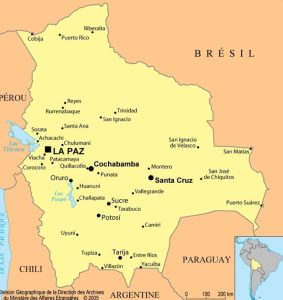
Where is Bolivia on the world map?
On the world map, Bolivia is located in America, precisely in the southern hemisphere of the American continent and in the central-western part of it. Bolivia is landlocked among several neighbors which are: Peru (west), Brazil (northeast), Paraguay (southeast), Argentina (south), and Chile (southwest).
Colors of Bolivia
The Bolivian flag is a rectangular flag composed of 3 stripes of equal size. From top to bottom, we have: red, yellow, and green. In the center of the yellow stripe are the national coat of arms. The red represents the blood shed during the struggle for independence, the yellow symbolizes mineral wealth, and the green represents green spaces and agriculture.

What Are the Best Cities to Visit in Bolivia?
Salar de Uyuni
As its name indicates, Salar de Uyuni is a flat city with minimal altitude variations (<1m). The name “Salar” also comes from the salt flat in the area during the dry seasons, and during the wet seasons, it is covered with water. It is a breathtaking natural spectacle to see the sun and the blue sky reflected in what looks like a saltwater mirror.
La Paz
La Paz is the administrative capital of Bolivia, nestled on rugged hills reaching up to 3,650 m. It is the highest capital in the world, and if you have the chance to fly over the area, the view will be stunning. First, you will see the slums of El Alto, then you will see La Paz clinging to the sides like a large cut in the earth.
Tiwanaku
Tiwanaku is located in the southern section of Lake Titicaca. It was the capital of several ancient civilizations including the Incas. Archaeologists later discovered separate ancient neighborhoods surrounded by large adobe walls. There are also other remains such as temples, a pyramid, gates, and sculptures of extraterrestrial faces.
Population of Bolivia
Bolivia’s population is estimated at 12,588,000 inhabitants in 2025, with a population density of approximately 11.5 inhabitants per square kilometre. The annual population growth rate is about 1.2%, while the birth rate is 20 per 1,000 inhabitants and the death rate is 7 per 1,000 inhabitants.
Life expectancy at birth is approximately 69.8 years, including 67.0 years for men and 72.7 years for women. The fertility rate is about 2.4 children per woman. Finally, the population sex ratio is approximately 99 men for every 100 women.
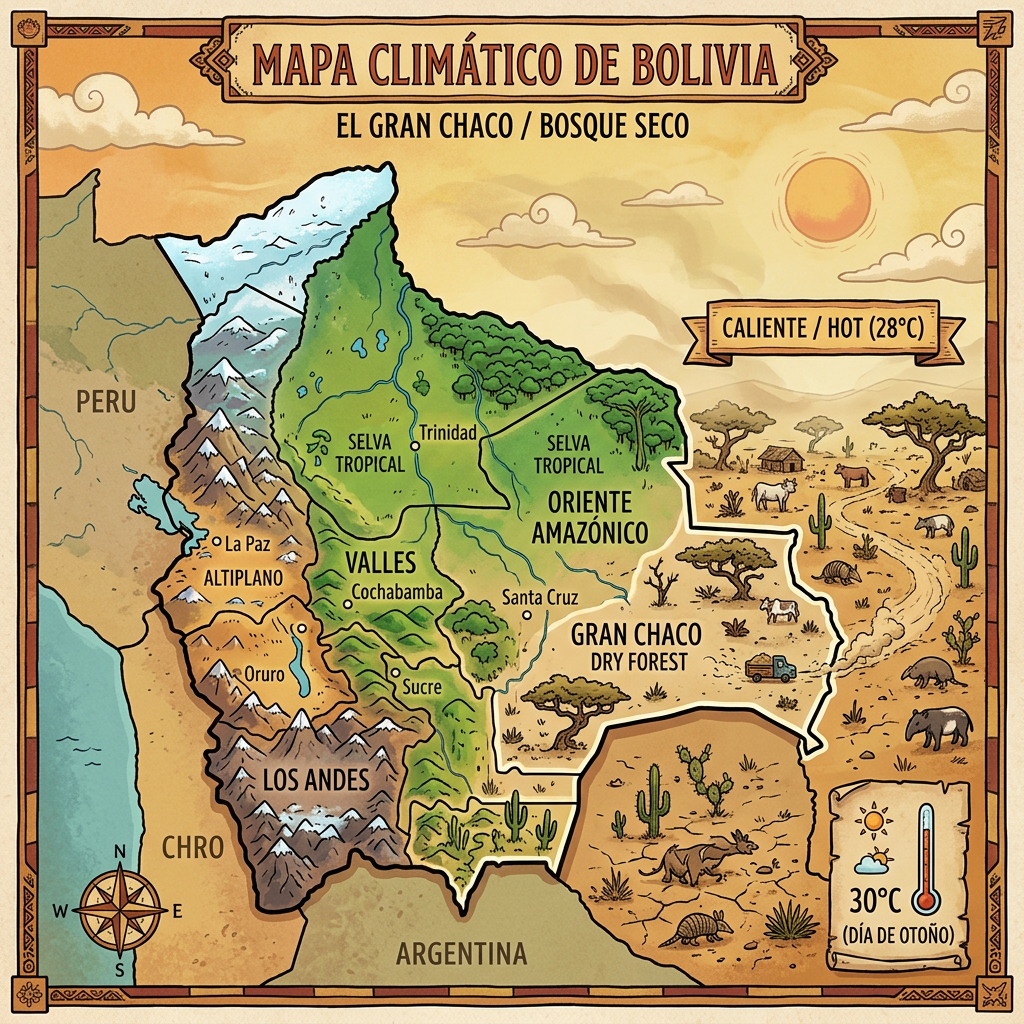
Bolivia climate map
The climate of Bolivia varies depending on the regions. For example, the Llanos experience a tropical climate while in the western Andes, the climate is polar. Generally, throughout the territory, summers are hot: in the east, summers are hot and in the west, summers are hot and humid. However, rains often disrupt temperatures by increasing atmospheric pressure.
Under the influence of El Nino, weather conditions are altered and winters are harsh in the west and in the mountain ranges, it often snows. Average annual temperatures in tropical zones hover around 25°C during the day and around 15 to 20°C at night in summer. In winter, nighttime temperatures can reach 0°C but during the day, it is mild with average sunshine. Snow only occurs in the country in high altitude areas exceeding 2000m.
Bolivia Economic Map
According to the latest estimates from the International Monetary Fund (IMF) and the World Bank, Bolivia has a medium-sized economy. In 2025, Bolivia ranks around 95th in the world in terms of nominal GDP and around 87th worldwide in terms of Gross Domestic Product based on Purchasing Power Parity (PPP).
Here are some economic data:
- Current currency: Bolivian Boliviano
- Nominal GDP: approximately USD 48.0 billion
- Gross Domestic Product (PPP): approximately USD 121 billion
- GDP per capita (nominal): approximately USD 3,800
- GDP per capita (PPP): approximately USD 9,600
- Annual GDP growth: approximately 1.7%
- Inflation rate: approximately 9.9% (2025)
- Population living below the poverty line: approximately 36%
- Unemployment rate: approximately 3.5%
- Human Development Index (HDI): 0.698
- Exports of goods: approximately USD 8.7 billion
- Imports of goods: approximately USD 11.6 billion
- Main industries: mining (zinc, silver, tin, and lithium), hydrocarbons (natural gas and oil), food processing, textiles and clothing, cement production, petroleum refining, jewelry, and metal processing.
Administrative and demolinguistic data
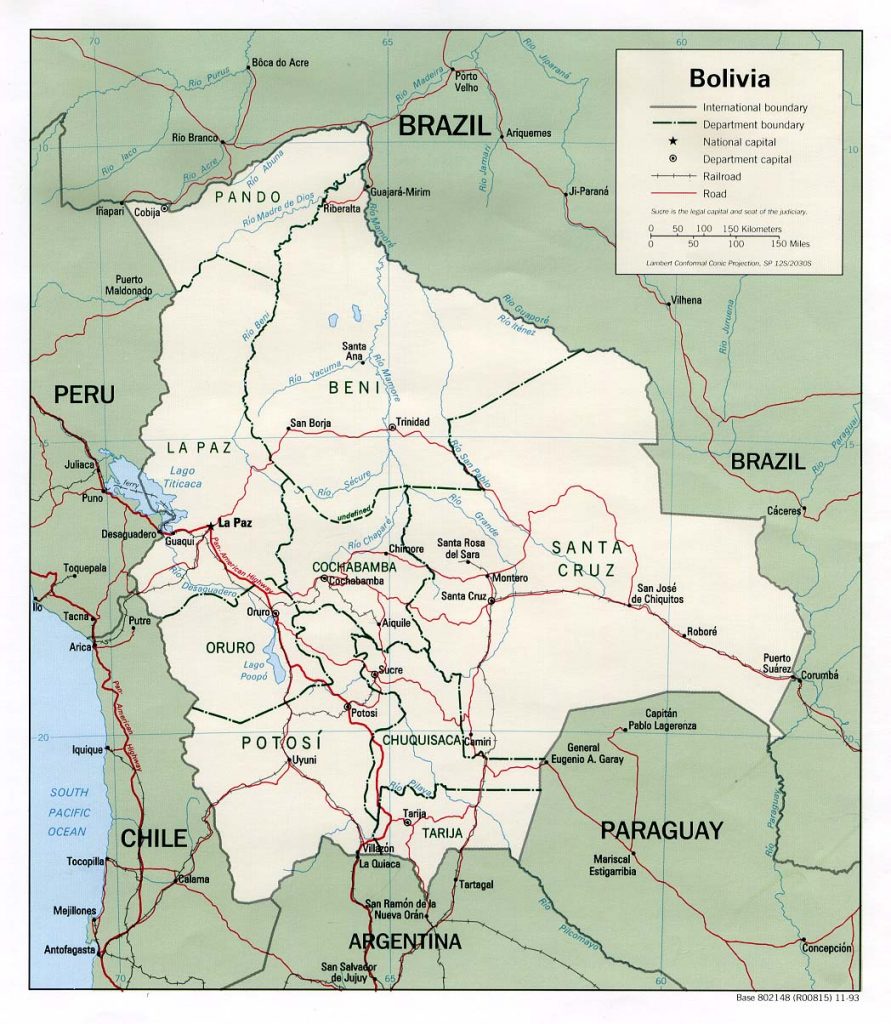
Administrative subdivisions
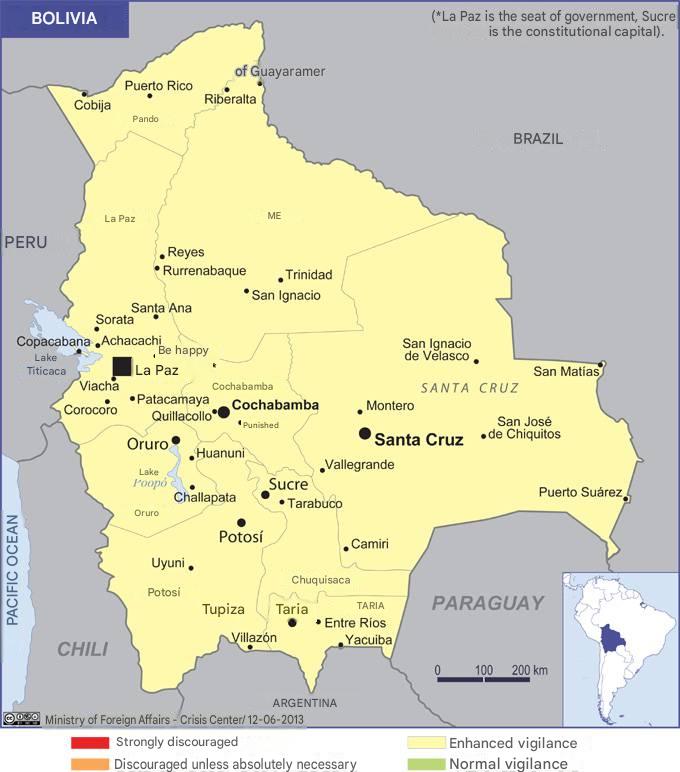
The Bolivian territory is divided into 9 departments which are in turn divided into 112 provinces. These provinces are further divided into 337 communes or municipalities.
Here are the departments of Bolivia:
- Beni
- Chuquisaca
- Cochabamba
- Santa Cruz
- Tarija
- La Paz
- Oruro
- Pando
- Potosí
Demolinguistic data
Bolivians are considered a multiethnic people. Indeed, indigenous peoples who identify as such represent 60% of the population and others who do not identify represent 40%.
Here is the ethnic composition of the Bolivian people
Mestizo (68%), Indigenous (21%), White Bolivians (4%), Cholo (2%), Afro-Bolivians (1%), Others (1%), undefined (3%). The most dominant native groups in the population are the Quechuas (2.5 million inhabitants), Aymaras (2 million inhabitants), Chiquitano (180,000 inhabitants), and Guarani (125,000 inhabitants). Bolivian ethnicities are estimated at 30% speaking the Quechua language and 25% speaking the Aymara language.
The other ethnicities represented in the 1% are Asians (Japanese and Lebanese), there are also European immigrants (French, Italians, Germans, Portuguese). There are also American emigrants, Brazilians, Chileans, Colombians, Ecuadorians, Venezuelans, Peruvians.
Bolivia Map FAQ
Bolivia is located in the heart of South America. It shares borders with Brazil, Paraguay, Argentina, Chile, and Peru.
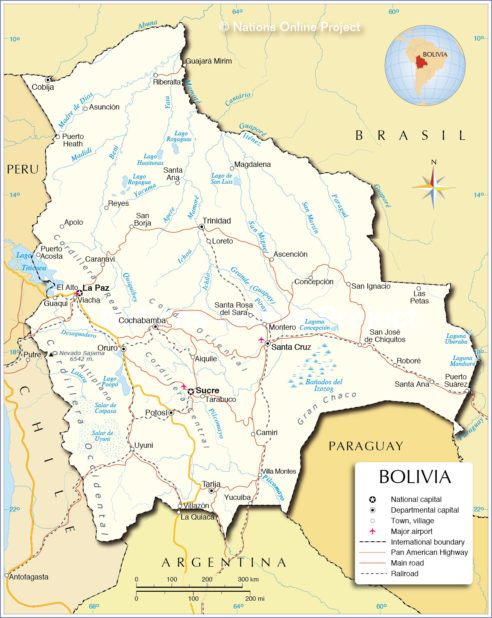
A map of Bolivia helps locate the country’s major cities, departments, mountain ranges, and large lakes. It also highlights the diversity of its landscapes, from the Andes Mountains to the Amazon rainforest.
A map is useful for understanding Bolivia’s geography and territorial organization. It also helps when planning a trip or studying the country’s demographic and natural features.
