
What you need to know about Argentina ?
The Argentine Republic is a South American country with a federal constitutional presidential system. It covers an area of 2,780,400 km², making it the eighth-largest country in the world. Its population is estimated at 45,851,378 inhabitants in 2025, ranking it 35th in the world by population.
According to geographical information, it is the second largest country in South America and the largest with the most Spanish speakers. The capital of Argentina is Buenos Aires, which is also its largest city; the national language is Spanish, and the country calling code is 54.
Where is Argentina located on the world map ?
On the world map, Argentina is located on the American continent. Specifically, the country lies in the southern hemisphere of Latin America. Chile shares its borders and the southern cone of Latin America with Argentina to the east. Other neighbors are : Bolivia, Paraguay, Brazil, and Uruguay, which border it respectively to the north, north, northeast, and east. The country also faces the South Atlantic to the east.

Colors of Argentina
The flag of Argentina is a blue and white triband flag with white in the center. At the center of the flag is the symbol of the “Sun of May.” The flag’s length is twice its width, and the design is very old as it was adopted at the end of 1818. The colors were chosen by Manuel Belgrano, who was the leader of the Argentine revolution against Spain. Here are the meanings of the colors : blue represents the blue of the sky revealing the white (the clouds) and the Sun of May.

Population of Argentina
Argentina’s population is estimated at 45,851,378 inhabitants in 2025. Its annual population growth rate is approximately 0.35%. The fertility rate is about 1.5 children per woman, while the birth rate is 13 per 1,000 inhabitants and the death rate is 8 per 1,000 inhabitants.
Life expectancy at birth is approximately 78.3 years, including 75.2 years for men and 81.5 years for women. The median age of the population is about 32.8 years. Finally, the sex ratio is approximately 97 men for every 100 women.
What are the best cities to visit in Argentina ?

Buenos Aires
Buenos Aires is the capital of the country, it is also the birthplace of several European influences mixed with Latin culture. It is also the main destination for those who want to travel to Argentina. That is why you will see many decaying buildings lining boulevards and alleys there.
Here, there are also several museums, galleries as well as world-class theaters, which makes Buenos Aires a cultural capital, very active and vibrant. It is also listed as a UNESCO World Heritage site. You will enjoy it if you are a fan of cultures, shows, dining, and hostels for your stay in the high season.
Mendoza
Mendoza is especially famous for being a green city and also for its production of world-class wine. The streets lined with greenery will give you the pleasure of strolling. This city was rebuilt in Argentina during the 19th century following an earthquake.
It was after this that the city streets became alleys added to several spaces. You will still see many historic buildings worth visiting. It is also a lively city and above all, there are many classy bars, restaurants, and nightclubs to let loose at night.
You can also enjoy the Andes and their snow-capped mountains which are ideal for spectacular adventures and excursions.
Cordoba
Cordoba is a magnificent city to visit various traditional and contemporary attractions. Among them, you will see the colonial architecture of Córdoba which is an attractive setting for students of the Argentine republic who frequent the lively restaurants and bars.
It is the birthplace of the country’s artistic scene, as you will see four galleries dedicated to the arts, but also several theaters, cinemas, and breathtaking history museums. On the horizon, you will see several hills surrounding the city and it feels like they are the continuation of the spacious streets of the city.
Ushuaia
The city of Ushuaia is an interesting city for a trip to Argentina, it is the capital of Tierra del Fuego and is located at the End of the World, in the Ushuaia department.
It is also known for being the southernmost city in the world. In Ushuaia, there is the Tierra del Fuego National Park allowing you to see Lapatala Bay to the west of Chile. You will also see Magellan penguins and the lighthouse at the end of the world. During winter, it is even possible to see ice fields and icebergs.
Argentina climate map
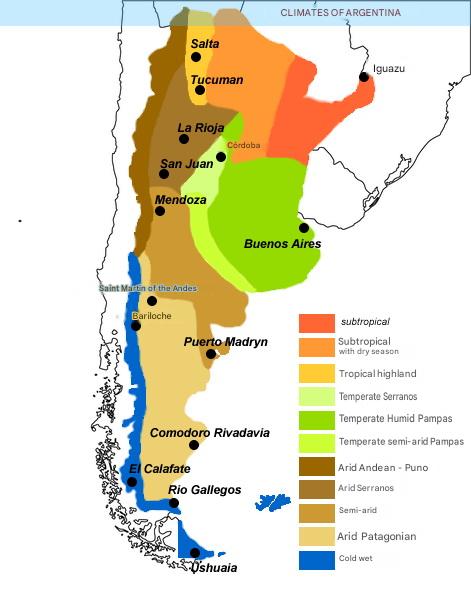
Generally, the Argentine climate is divided into four types. There is the hot climate, the moderate climate, the arid climate, and the cold climate. They vary according to geographical location, topography (relief) and the types of existing terrain. Most of the inhabited territory has a temperate climate.
The country’s climate varies from north to south; the northern climate is subtropical type and in the extreme south, the climate is polar glacial. The average annual rainfall is 150 mm in the driest areas and 2000 mm per year in the western or northwestern parts, that is in Patagonia.
On average, temperatures hover around 5°C annually (glacial southern section) and around 25°C in the northern sections.
Argentina economic map
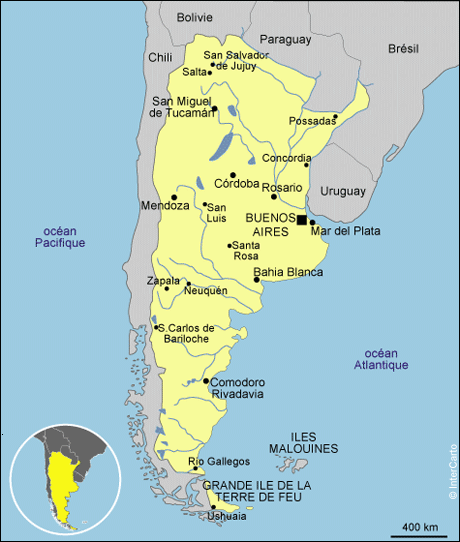

The IMF and the World Bank consider Argentina to be a developing country. It is the second most performing economy in Latin America after Brazil. The strengths of this economy are the country’s wealth in natural resources, the high literacy rate, as well as the highly linked agricultural exploitation and industry which increases the influx of Argentine peso.
Here are some economic data of Argentina
- Current currency: Argentine Peso
- Nominal GDP: approximately USD 684 billion
- Gross Domestic Product (PPP): approximately USD 1.55 trillion
- Annual GDP growth: approximately 5.5% (2025, following the contraction recorded in 2024)
- GDP per capita (nominal): approximately USD 14,900
- GDP per capita (PPP): approximately USD 33,800
- Annual inflation rate: approximately 43.5% (a sharp decline from 2024, though still high)
- Population living below the poverty line: approximately 31.6%
- Human Development Index (HDI): 0.865 (very high)
- Unemployment rate: approximately 7.9%
- Exports of goods: approximately USD 79 billion
- Imports of goods: approximately USD 60 billion
Administrative and demolinguistic data
Administrative subdivisions
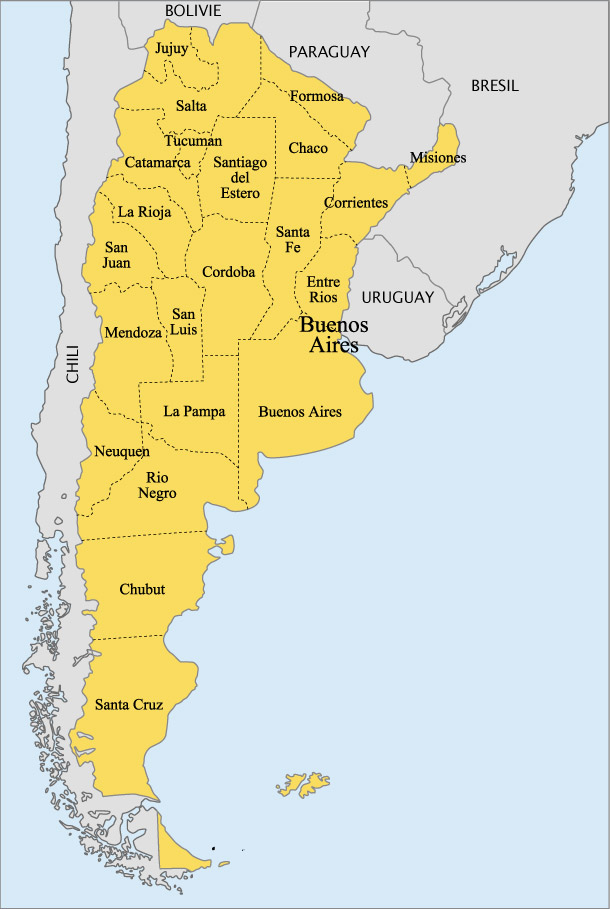
The Argentine territory is currently divided into 4 distinct regions which are then composed of 23 provinces (or provincias in Spanish), in addition to an autonomous city (cité or ciudad autonoma)
Here are the 4 regions of Argentina:
- Norte Grande Argentino
- Centro
- Nuevo Cuyo
- Patagonia
Here are the 23 provinces and the autonomous city:
- Chubut
- Cordoba
- Entre Ríos
- Santiago del Estero
- Tierra del Fuego, Antártida e Islas del Atlántico Sur
- Tucumán
- Corrientes
- Misiones
- Neuquén
- Formosa
- Jujuy
- La Pampa
- La Rioja
- Mendoza
- Santa Fe
- Autonomous City of Buenos Aires
- Buenos Aires
- Catamarca
- Chaco
- Río Negro
- Salta
- San Juan
- San Luis
- Santa Cruz
The provinces are then divided into 376 departments which even include those of Argentine Antarctica and the oceanic archipelagos in the South Atlantic. The number 326 must then be added to 134 “partidos” which constitute the departments of the Buenos Aires province (the autonomous city)
Demolinguistic data
Of the 44.6 million Argentines, just under 50% live in the federal metropolis or in Buenos Aires. The Argentine people derive from 3 original ethnic groups:
- Indigenous peoples called Indians or Amerindians (1.49%)
- Europeans: Hispanics and Italians (97%)
- Africans (0.37%)
There is also a small proportion of nationals (1.5%) in the country who are:
- Poles
- Armenians
- Chinese
- Peruvians
- Germans
- Japanese
- Greeks
The majority of Argentina’s population (91%) speaks Spanish but in truth the Spanish language used in the country is called “Argentinian language” by the Argentine people. It is a South American variation of Castilian Spanish; it is influenced by Andalusian, Catalan, Galician and European languages (French, German, Portuguese). This Spanish language specific to Argentina is divided into 5 dialects and 5 different accents
Spanish accents:
- Northern accent
- Guaranitic accent
- Cuyo accent
- Cordovan accent
- Rio de la Plata accent
Spanish dialects:
- Northern dialect
- Guaranitic dialect
- Cuyano (Cuyo) dialect
- Cordoban (central Cordovan) dialect
- Rioplatense (Rio de la Plata) dialect
Argentina Map FAQ
Argentina is located in the southern part of South America. It shares borders with Chile, Bolivia, Paraguay, Brazil, and Uruguay.
A map of Argentina helps identify the country’s major cities, provinces, mountain ranges, and major rivers. It also highlights the diversity of its landscapes, from the Andes Mountains to Patagonia.
A map is useful for understanding the country’s territorial organization and the distribution of its main geographical regions. It also helps when planning a trip or studying Argentina’s geography and demographics.
