
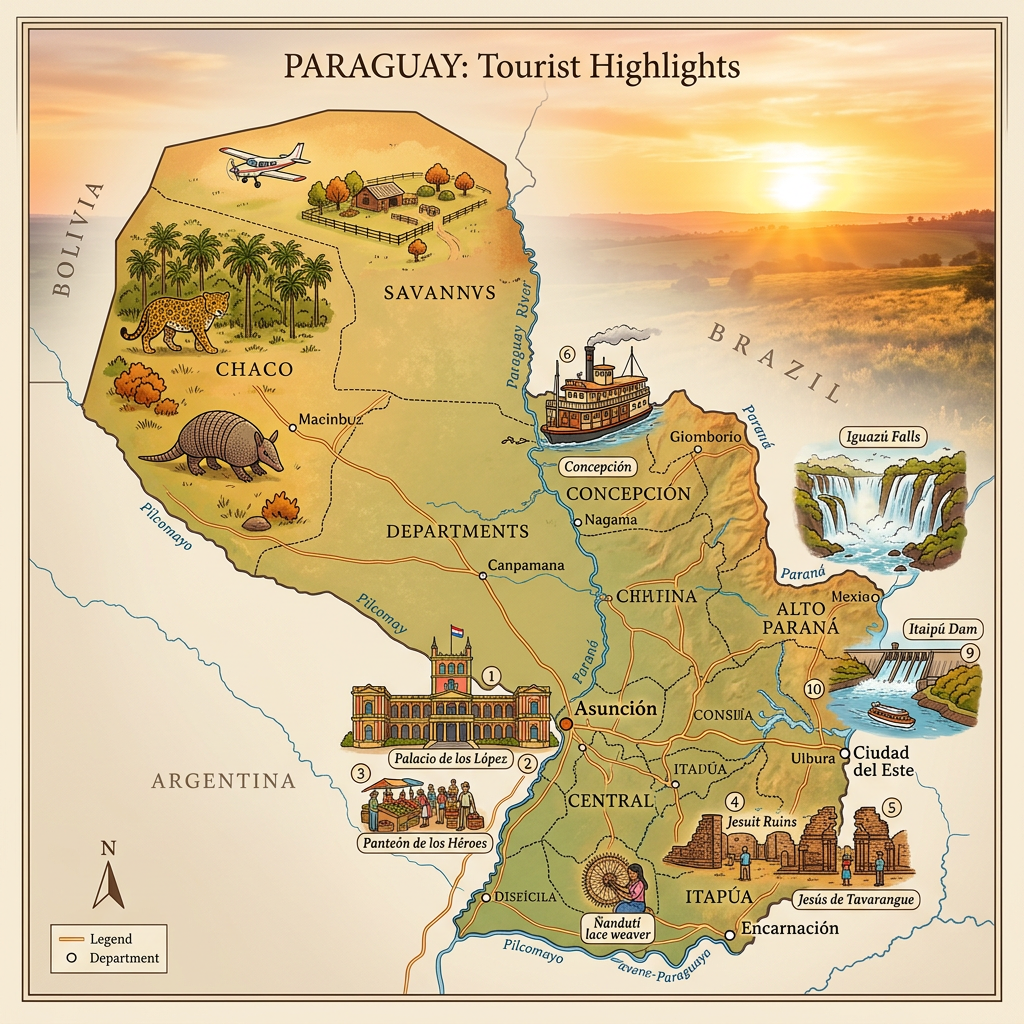
Essential information about Paraguay
The State of Paraguay is a constitutional republic located in South America. A landlocked country, it shares its borders with Brazil, Argentina, and Bolivia.
- Area: 406,752 km²
- Population: approximately 7.19 million inhabitants
- Density: ~18 inhabitants/km²
The capital and largest city is Asunción.
The official languages are Spanish (Castilian) and Guarani.
Paraguay is a member of the OEI, the CIR, the GGGI, and the Cairns Group.
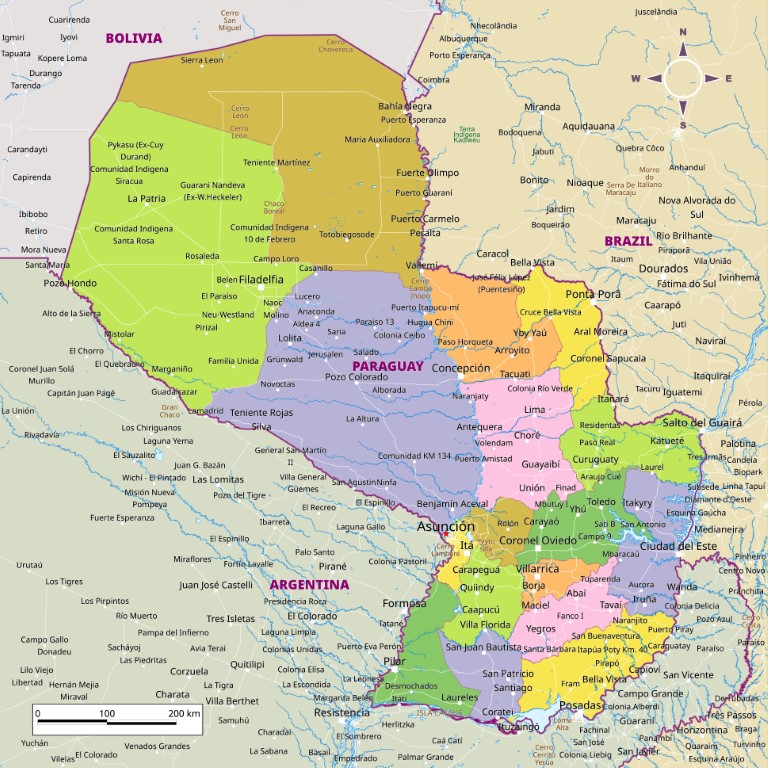
Linguistic data
Other minority Amerindian languages persist in certain communities.
Guarani: spoken by ~88% of the population
39.2% use it exclusively
48.9% are bilingual (Guarani and Spanish)
Spanish: administrative and vehicular language

The map of Paraguay highlights a landlocked country in South America, bordered by Brazil to the east and northeast, Argentina to the south and west, and Bolivia to the northwest. The Paraguay River, the true backbone of the country, connects the capital Asunción to other regions.
Table – Paraguay: Geographic and demographic information
| Element | Key Information |
|---|---|
| Total Area | 406,752 km² |
| Capital | Asunción |
| Neighboring Countries | Brazil, Argentina, Bolivia |
| Coastline | None (landlocked country), but crossed by the Paraguay River |
| Estimated Population | ~7.6 million inhabitants (2025) |
| Population Density | ~19 inhabitants/km² |
| Relief | Plains, plateaus, Chaco in the northwest |
| Climate | Subtropical in the south, tropical in the north |
| Official Languages | Spanish, Guarani |
| Economic Resources | Agriculture (soybean, corn), hydroelectricity (Itaipu), livestock |
| Particularity | Landlocked country in the heart of South America, strong hydroelectric potential |
Additional points on the map of Paraguay
- Paraguay is a landlocked country, without direct access to the sea.
- The Paraguay River runs through the country from north to south and serves as a major communication route.
- In the east, the lands are fertile and densely populated, while to the west stretches the Gran Chaco, a more arid and sparsely populated area.
- The country shares its borders with Brazil, Argentina, and Bolivia.
- The capital Asuncion is located on the banks of the Paraguay River.
Population of Paraguay
The Paraguayan population is estimated at 7,025,763 inhabitants, with a natural growth rate of 1.17%. The fertility rate is 1.9 births per woman. The birth and death rates are respectively 1.66% and 0.48%, and the life expectancy of a Paraguayan at birth is 77.6 years. The male/female population ratio is 101%. The Mestizos make up almost the entire Paraguayan population (95%), the rest is undefined. The dominant religions are Catholicism (90%) and Protestantism (10%).
Climate of Paraguay
The Paraguayan climate is categorized as subtropical type. This translates to a mild winter season (May-August) and a hot, stormy summer season (November-March). The northwest section is the driest with annual precipitation <1000 mm.
The rainiest section is the southeast part, with >2000 mm. The entire Paraguayan territory is subject to intense heat waves temporarily raising temperatures to over 40°C in the western and southern sections, while the northwest reaches just over 30°C.
Colors of Paraguay
The flag of Paraguay is rare because it is composed of 3 horizontal color bands (red-white-blue) but displays two different designs on the front and back sides. Front: national coat of arms, back: treasury coat of arms. The red color symbolizes courage and patriotism, the white color represents kindness, unity, peace, and the blue color represents reality and freedom.

Which cities to visit in Paraguay?
Asunción
Capital and largest city of the country, Asunción is known for being one of the hottest capitals in the Americas. A flat and lively city, it attracts many visitors.
To discover:
- the Palacio de los López, seat of government,
- the waterfront on the Paraguay River,
- the botanical and zoological garden, a true oasis in the urban heart.
Encarnación
Nicknamed the “Pearl of the South,” Encarnación is renowned for its annual carnival, considered one of the most important in the region.
It is also an affordable and welcoming city, where many restaurants, hotels, and developed river beaches can be found.
Ciudad del Este
Bordering Brazil and close to the famous Iguaçu Falls, Ciudad del Este is a major international commercial center.
The city attracts visitors for its markets, duty-free shopping centers, and surrounding landscapes.
Concepción
Located in the north of the country, on the Paraguay River, Concepción is an important river port.
The city retains a colonial atmosphere with its old churches and traditional streets, while serving as a gateway to the Chaco region.
Villarrica
Capital of the Guairá department, Villarrica is a cultural and university city.
It is known for its colonial architecture, its museums, and its strong Guarani identity. It is an important artistic and intellectual center of Paraguay.
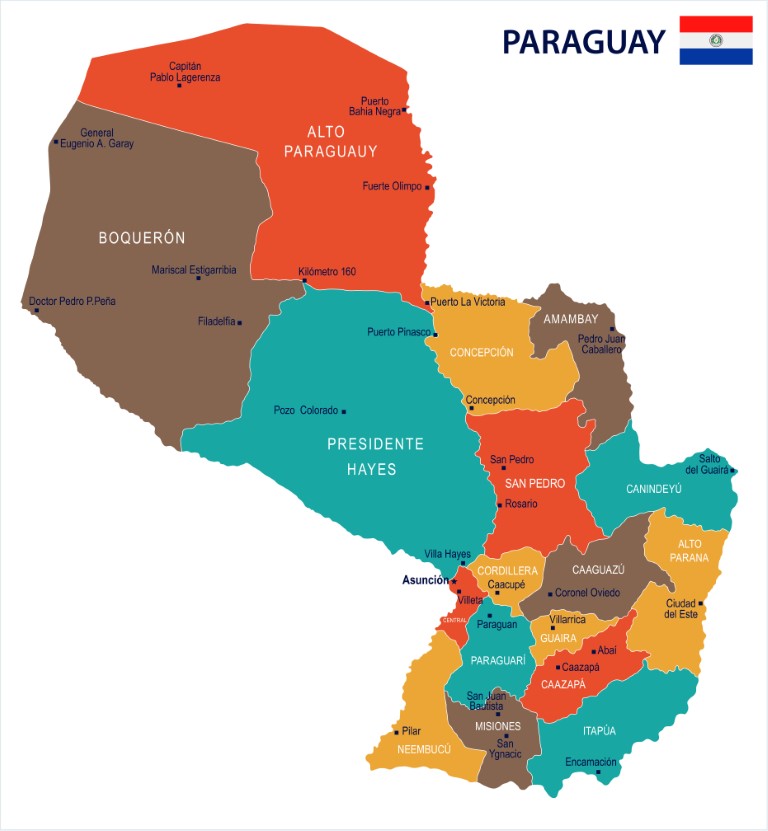
Economy of Paraguay
The economy of Paraguay is essentially agricultural and dominated by soybean production. The industrial sector is taken up by SMEs and the country’s GDP is low. The only large industries in the country are sugar industries, cement plants, clothing, textiles, and steelworks. Here are some economic data of Paraguay:
- GDP in nominal terms: 28.78 billion USD
- GDP in purchasing power parity: 68.05 billion USD
- Annual GDP growth rate: 3.9% PPP
- GDP per capita 9,800 USD PPP
- Inflation rate: 3.6%
- Unemployment: 6.5%
- Imports: 10.37 billion USD
- Exports: 11.53 billion USD
FAQ – Paraguay map: 3 questions
Paraguay is located in the center of South America, between Brazil, Argentina, and Bolivia.
The capital is Asuncion, located on the Paraguay River.
The country is divided between the fertile plains of the east and the Gran Chaco in the west, which is drier and sparsely populated.
