
Burma, also called Myanmar, is a country located in Southeast Asia. Its official name is the Republic of the Union of Myanmar.
The capital of the country is named Naypyidaw, but its largest urban area is Yangon. The official language spoken in Myanmar is Burmese, and the Burmese population is mainly composed of Bamar (68%).
Practical information about Burma and its map
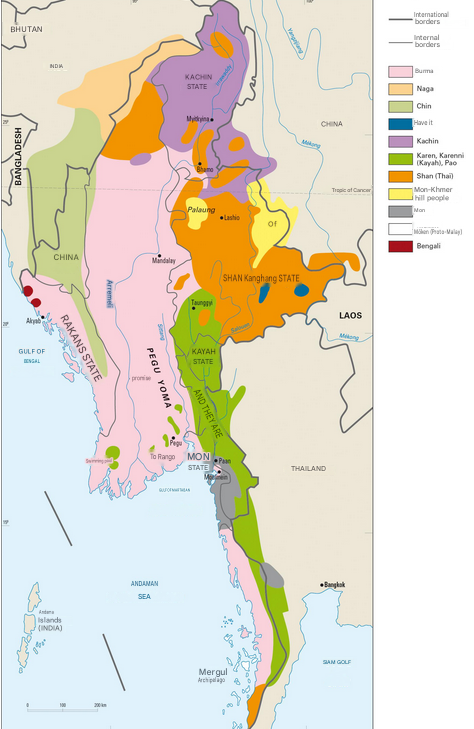
Burma (Myanmar) includes many ethnic minorities such as the Shan, Karen, Rakhine, as well as Chinese, Indian, and Lisu/Lahu (Monday) communities.
The main religion is Buddhism, practiced by about 87.9% of the population. There are also:
- Christians (~6.2%),
- Muslims (~4.3%),
- and small animist and Hindu minorities.
The current population of the country is estimated at about 53.6 million inhabitants for a surface area of 676,578 km², which corresponds to an average density of 79 inhabitants per km².
The international telephone code of Myanmar is +95 (0095).

Table – Burma: Geographical and demographic information
| Element | Key information |
|---|---|
| Total area | 676,578 km² |
| Capital | Naypyidaw |
| Former capital | Rangoon (Yangon) |
| Neighboring countries | Bangladesh, India, China, Laos, Thailand |
| Coastline | ~1,930 km on the Andaman Sea and the Bay of Bengal |
| Estimated population | ~56 million inhabitants (2025) |
| Population density | ~83 inhabitants/km² |
| Relief | Mountain ranges in the west and north, Irrawaddy plain in the center |
| Climate | Monsoon tropical, hot and humid |
| Official language | Burmese |
| Economic resources | Gas, oil, jade, teak, agriculture |
| Particularity | Key country between South Asia and Southeast Asia |
Additional points on the map of Burma
- Located at the junction of South and Southeast Asia, Burma occupies a strategic position.
- Its physical map highlights the Irrawaddy valley, a vital axis for agriculture and population.
- It shares its borders with five countries: India, Bangladesh, China, Laos, and Thailand.
- The country has a vast coastline on the Bay of Bengal and the Andaman Sea.
- Naypyidaw is the political capital, but Yangon remains the economic capital.
Which countries border Burma?

The neighboring countries of Burma are Bangladesh, India, China, Laos and Thailand. The country is also very close to the Andaman Sea as well as the Bay of Bengal.
Population of Burma
Currently, the Burmese population is estimated at 54,613,542 inhabitants according to the latest United Nations estimates.
This population represents about 0.7% of the global population and based on an area of 653,290 km2 and a density of 83 inhabitants per km2, Myanmar ranks 26th in terms of population dependency.
About 17,068,066 inhabitants live in the country’s major cities, representing 31.4%, and the expected average age is 29 years, indicating a very young population.
What are the colors of the country Burma?

The Burmese flag was adopted in 2010 and the colors are arranged in stripes of equal size with yellow on top, green in the middle, and red at the bottom. In the center of the flag is a white five-pointed star. Here are the meanings of the colors:
- Yellow: characteristic of brotherhood
- Green: characteristic of peace, greenery, and well-being
- Red: symbolizes bravery and determination
- The star: symbolizes the community.
What are the best cities to visit in Burma

Naypyidaw
Also called Nay Pyi Taw, it is the administrative capital of Burma. It is a modern and sprawling city, housing all government buildings, embassies, and ministries.
To visit:
- the national herb garden,
- the Naypyidaw Zoological Park,
- the Jade Emporium and the Myanmar Gems Museum,
- the Myoma Market and the Junction shopping center,
- the Fountain Garden with its 13 water jets and tree-lined paths.
Rangoon (Yangon)
Former capital and largest city of the country, Rangoon blends Victorian colonial architecture and Buddhist traditions.
Among its must-sees:
- the Shwedagon Pagoda, national symbol,
- the Bogyoke Market (Scott’s Market), ideal for crafts and souvenirs,
- its tree-lined avenues and gardens.
It is also a major starting point for travelers to other destinations in the country.
Mandalay
Former royal capital located 700 km north of Naypyidaw, Mandalay is the spiritual and artisanal heart of the country.
To discover:
- the royal palace,
- numerous monasteries and pagodas,
- the Mandalay Hill offering a panoramic view,
- the nearby sites of Amarapura, Inwa, Sagaing, and Mingun.
Bagan
Former capital founded in the 11th century, Bagan is a must-see UNESCO World Heritage site. It features more than 2,300 temples and pagodas scattered across a vast plain.
The sunsets over the temple valley offer a unique spectacle in the world.
Inle Lake (Nyaung Shwe)
Located in Shan State, the Inle Lake region attracts visitors for its floating villages, water gardens, and Intha fishermen with traditional techniques. The town of Nyaung Shwe is the main gateway to this iconic natural site.
Hpa-An
Capital of Karen State, Hpa-An is surrounded by spectacular landscapes. Visitors can explore:
the Zwegabin Mountain, a sacred mountain offering a panoramic view after a 700 m ascent.
the Buddhist caves of Saddar and Kawgun,
the lush rice fields,
Where the cities are located on the map of Burma ?
Naypyidaw
On the map of Burma, the city of Naypyidaw is located in the Mandalay region in the very center of the country. Geographic coordinates: 19° 45′ 41″ north, 96° 05′ 11″ east.
Rangoon
On the map of Burma, the city of Rangoon is located in the southern section of the country, in the Gulf of Martaban overlooking the Andaman Sea. Geographic coordinates: 16° 48′ north, 96° 09′ east.
Mandalay
On the map of Myanmar, the city of Mandalay is located in the central part of the country. This region is dominated by the dry plains of central Burma. Geographic coordinates: 21° 58′ north, 96° 05′ east
Bagan
On the map of Burma, the city of Pagan or Bagan is located in the central plain section of the country. Geographic coordinates: 21° 10′ 21″ N, 94° 51′ 36″ E.
Climate map of Burma
The Burmese climate depends greatly on the geographical location of the territory. In general, all Burmese regions display a tropical or subtropical climate depending on their orientation relative to the sea. This means that Myanmar’s climate can be subdivided into 3 well-defined seasons:
–Winter: it is the cool but cold season and takes place between November and February
–Summer: it is the hot and dry season and takes place between March and April
-The rainy season: takes place between May and October but is strongly influenced by the monsoon.
Most Burmese territories are located around the equator and are therefore strongly influenced by the monsoon coming from the Asian territory. On the Burmese coast, precipitation is around 5000mm per year. Inland areas are less rainy, with about 2500mm of rainfall per year.
In the highland areas, winter temperatures are freezing and frequent snowfall is observed especially in the northern section. In these same regions, summer is hot and temperatures hover around 21°C and can reach 32°C depending on maximum sunlight.
Economic map of Burma


Burma (Myanmar) remains a developing country whose economy is one of the least performing in Asia, heavily affected by political instability and international sanctions.
- Agriculture still occupies a central place, representing nearly 40% of GDP and employing the majority of the active population.
- The main crops are rice (the basis of the diet) and, in some areas, opium, despite reduction efforts.
- The country also has significant forest (notably teak) and mining resources.
Natural resources and industries
- Myanmar is one of the world’s largest producers of jade, rubies, and sapphires, covering about 90% of the global demand for rubies.
- It has significant reserves of natural gas (Yadana and Shwe fields) and oil.
- Its main industries are: textiles, gas/oil, wood, agri-food, and mining.
- Industrial development is hampered by the lack of infrastructure (roads, ports, modern airports) and constraints related to the political climate.
Economic data (2025, estimates)
- Official currency: Kyat (MMK)
- Nominal GDP: ~65 billion USD
- GDP (PPP): ~278 billion USD
- GDP per capita (nominal): ~1,200 USD
- GDP per capita (PPP): ~5,100 USD
- Annual GDP growth: ~2% (unstable depending on the year)
- Inflation: ~15% (heavily impacted by the political crisis)
- Population below poverty line: ~32%
- Active population: ~31 million people
- Official unemployment rate: ~5% (but high underemployment)
Administrative and demolinguistic data

Administrative subdivisions
The Republic of Myanmar has 21 regulatory districts. These districts are:
- Regions numbering 7
- States numbering 7
- One Union territory of Myanmar
- Administrative zones numbering 5
- One self-administered division.
The regions and states are divided into districts which in turn encompass cities, townships, or villages. Here are the regions and states of the Republic of the Union of Myanmar
Regions of Burma
- Ayeyarwady
- Bago
- Magway
- Mandalay
- Sagaing
- Tanintharyi
- Yangon
States of Burma
- Chin
- Kachin
- Kayah
- Kayin
- Mon
- Rakhine
- Shan
Demolinguistic data
Burma, as a united federation of several Burmese states, includes several hundred ethnic groups. The majority population is composed of Bamar also called Bama at 57%, the rest is made up of Shan, Rakhine (Arakanese), Karen, Mon, Kachin, Chin, Karenni, Lahu, Rohingya, Gurka, Palaung, Meo, Naga, Akha, Lisaw, Kadu, Wa, Moken and many more.
The official language of the country is Burmese, which is part of the Sino-Tibetan family. It is a language subdivided into several variants including: Myeik, Beik, Yaw, Dawei, Palaw.
There are also other dialects such as that of the Rakhine or Arakanese state or Marma from Bangladesh. The linguistic families of the country are grouped into 3: the Sino-Tibetan family, the Austroasiatic family, and the Tai-Kadai family.
FAQ – Burma map: 3 questions
Burma is located between India, China, Laos, and Thailand, with access to the Bay of Bengal and the Andaman Sea.
The capital is Naypyidaw, while Yangon remains the main economic city.
The country is dominated by the Irrawaddy valley, surrounded by mountain ranges and bordered by a long maritime coastline.
