
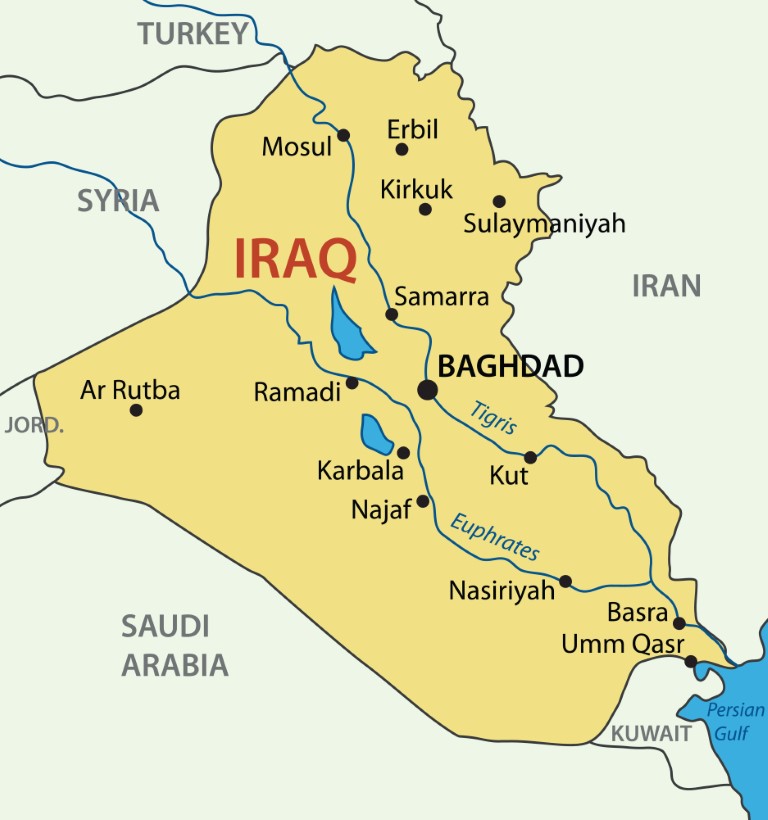
Iraq, also named Iraq, is an eastern country located on the Arabian Peninsula. The country is officially called the Republic of Iraq due to its status as a Federal republic. Etymologically, the term Iraq comes from Persian and relates to two rivers that actually exist: the Tigris and the Euphrates.
The capital and largest city of Iraq is Baghdad. The country covers an area of about 438,000 km² and has an estimated population of around 46 million people in 2025. It is one of the most populous countries in the Middle East.
Iraq has some of the largest oil reserves in the world and is a member of OPEC. The national economy remains heavily dependent on hydrocarbons, which account for a major share of exports and government revenue.
The Iraqi territory occupies an important part of the Mesopotamian land, which is one of the territories formerly occupied by several civilizations. It is indeed in this region that writing was created. The telephone code in Iraq is 964, that is 00964 or +964.
Which countries border Iraq?
The neighboring countries of Iraq are Turkey, Iran, Kuwait, Saudi Arabia, Jordan, and Syria. These countries border it respectively to the north, east, southeast, south-southwest, extreme west, and northwest.
Population of Iraq
Iraq’s population is estimated at around 46 million people in 2025, with an annual growth rate of about 2% and a fertility rate close to 3 children per woman, gradually declining.
The birth rate remains higher than the death rate, reflecting continued population growth. Life expectancy is around 75 years, higher for women than for men. The population is very young, with a median age of about 21 years.
The sex ratio is generally balanced, with a slight male majority in younger age groups and a gradual shift in older populations. The country also experiences a slightly negative net migration rate, mainly due to emigration linked to economic and security conditions.
What are the colors of the country?

The Iraqi flag is a rectangular flag with three stripes of equal size. From top to bottom, we have red, white, and black. On the middle white stripe, there is an inscription in green Arabic which means “God is great.” The black symbolizes the oppression the country has suffered for several centuries, the red symbolizes the struggle for the liberation of the people, and the white symbolizes a bright future.
The best places to visit in Iraq

Baghdad
The largest urban area in the country is its capital; it is a very ancient city located on the banks of the Tigris and Euphrates. Moreover, it is both the administrative, economic, and commercial metropolis of the country.
The first river divides the old city into two sections: Risafa to the east and Karkh to the west. The capital’s topography is flat. Moreover, if you visit the city, you will see several neighborhoods as well as various administrative and institutional buildings. It is also the birthplace of Iraqi Airways and an imposing city in Iraq that represents 40% of the country’s GDP.
Basra
Located between Iraq and its neighbor Kuwait, the city of Basra is crossed in its center by the Shatt al-Arab river. It is the second most populous urban area in Iraq. It is a port city with beautiful beaches. It was once an Arab territory and a former territory of Caliph Rashid Umar.
In the city, you will see the remains of surveillance grounds as well as several canals that once served as water sources. This city also hosts several oil fields, with the largest number concentrated in the western district. You will also see many cornfields, rice paddies, and fields of wheat and millet spread throughout the territory of the old city.
Hillah
The city of Hillah is located on the branch of the Euphrates that bears the same name. Situated in the heart of the country, this city still displays the ruins of the ancient Babylonian empire. It is an extremely fertile city, both horticultural and agricultural. You will see numerous fruit trees, cultivated lands, and many street vendors. It is also an industrial city dominated by oil refineries and textile industries.
Culturally, the city of Hillah is rich in culture but is also very populous; in fact, it is the third largest in Iraq. You can visit the shopping galleries that showcase many local artists and cultural gatherings that take place periodically in the city. You can also admire the remains of Babylon, notably the ruins of Kish and the Albères.
Where the cities are located on the map of Iraq ?
Baghdad
On the map of Iraq, the city of Baghdad is located in the central section slightly shifted towards the east of the territory. Geographic coordinates: 33° 20′ 00″ north, 44° 26′ 00″ east
Basra
The city of Basra is located in the southeast section of the country, at the confluence of the Euphrates. Geographic coordinates: 30° 30′ north, 47° 48′ east.
Hillah
The city of Hillah is located in the center of the country, just a few kilometers from the capital. Near the city are the remains of the Babylonian empire. Geographic coordinates: 32° 29′ 00″ north, 44° 26′ 00″ east.
Economic map of Iraq
Iraq has a weak but self-sufficient economy; the reason for its weakness is its struggles against various crises affecting the country, including financial and social problems compounded by Covid-19.

Iraq has some of the largest oil reserves in the world and remains heavily dependent on this resource, which accounts for a major share of its revenues and exports. As a result, the Iraqi economy is highly sensitive to fluctuations in global oil prices.
Following economic shocks, including the pandemic period, lower oil revenues weakened public finances. The government implemented production management and fiscal stabilization policies to reduce the impact of these fluctuations. Despite a partial recovery in oil prices, the economy remains strongly dependent on the energy sector.
- Current currency: Iraqi Dinar
- International organization of which the country is a member: OPEC
- GDP in nominal parity: approximately US$250 billion
- Annual GDP growth rate: around 3–5%
- Population below the poverty line:about 17–20%
Iraq climate map
The Iraqi climate is considered arid; however, it experiences mild winters and long, very hot summers. These characteristics are observable in the central southern part of the country, whereas the northern section is relatively cold in winter and summers are hot and rainy. In the mountainous areas, the climate is hot in summer with maximum sunshine, but nighttime temperatures are cooler due to the elevation.
Climate in the mountainous areas
This part is the northeastern section. In this section, winter is cold and shows consistent precipitation. However, summer is very hot despite the high altitudes. In this part of Iraq, annual rainfall ranges between 700 and 1000mm. Rainy periods occur between April and October.
Climate in the southwestern section of Iraq
This area truly exhibits an arid climate; it is the driest part of the country due to its annual rainfall of 50mm. This zone is the least densely populated because inhabitants are mostly concentrated around the confluences and banks of the two rivers, the Tigris and Euphrates.
This area is the most prone to winds coming from the south; moreover, these can bring dust and wind. Both the autumn and winter seasons can be influenced by this warm southern wind. That is why the climate is dry and scorching.
Climate in Baghdad, the capital
In the capital, summers are very hot; temperatures in July can reach 35°C in the shade and up to 44°C at maximum. Winter, on the other hand, is milder, with temperatures around 9.5 to 10°C. However, this season can display very cold temperatures with occasional frost and snowfall in some areas of the capital.
Rainfall is low, amounting to about 150 mm annually. The rainy seasons occur between November and March. Sunshine is excellent even during rainy periods; however, summer is a season when dull clouds alternate with sunshine.
Climate in the rest of Iraq
The rest of the Iraqi territory is relatively flat; the climate in these areas is characterized by cold dryness in winter but very hot and dry in summer. This season occurs between June and September, but sometimes temperatures also rise between May and October.
Within this territory lies Mesopotamia, which has an arid climate. As a result, the site’s geography changes from time to time because rivers can dry up and become marshy areas.
There is also the northern section, which exhibits roughly the same climate, that is, a cold and arid period and a hot and rainy period. The difference in this zone compared to others is that its rainfall is moderate.
Administrative and demolinguistic data
Administrative subdivisions
The Iraqi territory is today subdivided into 18 governorates, also called administrative provinces. In addition, there is an autonomous region which is the Iraqi Kurdistan.
Here are the 18 provinces of Iraq:
- Basrah (Shiite/Sunni)
- Dhi Qar (Shiite)
- Muthanna (Sunni/Shiite)
- Qadisiyah (Shiite)
- Najaf (Shiite/Sunni)
- Babil (Shiite)
- Karbala (Shiite)
- Maysan (Shiite)
- Wassit (Shiite)
- Baghdad (Shiite/Sunni)
- Anbar (Sunni/Shiite)
- Ninawa or Nineveh (Sunni/Kurdish)
- Salah ad-Din or Saladin (Sunni/Kurdish)
- Kirkuk (Sunni/Kurdish)
- Diyala (Sunni/Shiite/Kurdish)
- Erbil (Kurdish)
- Souleimaniyeh (Kurdish)
- Dohouk (Kurdish)
The Iraqi Kurdistan is located in the northeast of the territory and includes the governorates of Dohouk.
Demolinguistic data
Here is the ethnic subdivision of the Iraqi population
Arabs (68%)
- Iraqi Arabs (39.1%)
- South Arabs + North Arabs (22.1%)
- Saudi Arabs (4.3%)
- Egyptian Arabs (1.1%)
- Marsh Arabs (0.6%)
- Gulf Arabs (0.1%)
Kurds (21.2%)
- Central Kurds (11.7%)
- Kurmanji Kurds (8.6%)
- Yazidis (1.4%)
Ethnic Minorities (14%)
- Azeris (5.9%)
- Iranians (1.1%)
- Turkmens (1.1%)
- Assyrians, Luri, Chaldeans, Armenians, Bajelani, Herki, Adyghe, Gypsies, Hawrami, Chechens, Mandaeans
Here is the Linguistic subdivision of the Iraqi population
- Mesopotamian or Iraqi Arabic (61.2%): north and south of Baghdad
- Najdi or Saudi Arabic (4.3%): Southwest
- Egyptian Arabic (1.1%): Baghdad
- Marsh Arabic (0.6%)
- Gulf Arabic (0.1%): Basrah region
- Palestinian Arabic
- Syrian Arabic.
However, 21.7% of the population does not speak Arabic but Kurdish, with speakers of this language numbering about 4 million inhabitants.
FAQ- Iraq map: Geographical and demographic information
Iraq is located in Western Asia, bordered by Turkey to the north, Iran to the east, Kuwait to the southeast, Saudi Arabia to the south, Jordan to the west, and Syria to the northwest.
Iraq shares its borders with six countries: Turkey, Iran, Kuwait, Saudi Arabia, Jordan, and Syria.
Iraq is located in Asia.
