
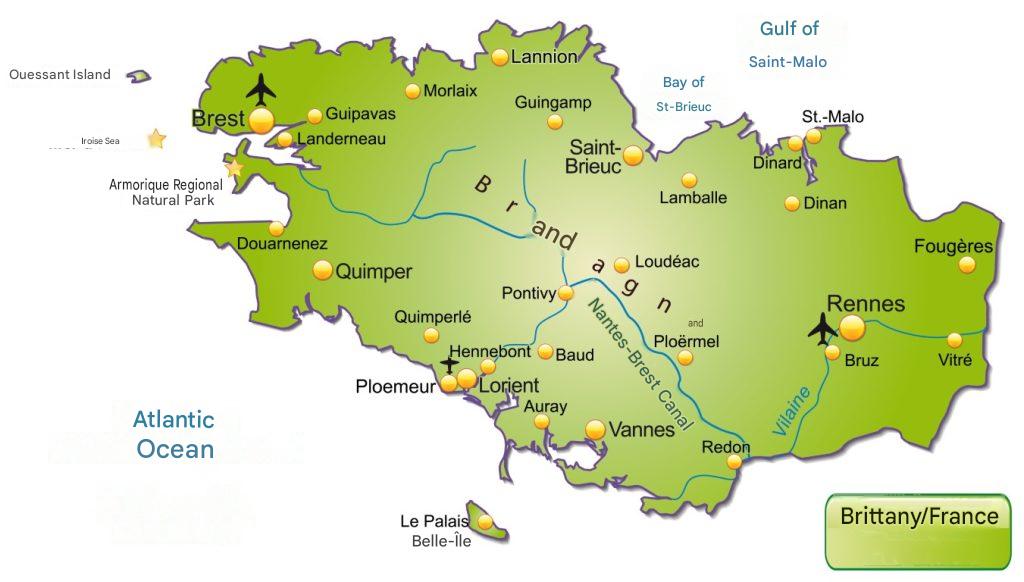
Brittany, an emblematic region located at the far west of France, stands out for its varied landscapes, charming towns, and fascinating historical sites. To understand this region in all its diversity, it is essential to pay close attention to its geographical map.
In this article, we will explore the different aspects of the Brittany map, including its main cities, its road networks, its major national parks, as well as its rivers and waterways.
The major cities of Brittany
Rennes: capital of the region
Rennes, the administrative capital of Brittany, is located at the heart of the region. On a map, it appears as a central hub connected by main road and rail routes facilitating its accessibility. The city is known for its medieval architecture, its renowned universities, and its dynamic cultural life. It also plays a central role in the regional economy by hosting numerous businesses and public institutions.
Brest: strategic port
Brest, located on the northwest coast of Brittany, is a maritime port of national importance. Its strategic position is illustrated on the map by its proximity to the Iroise Sea and the Brest harbor. The military port, shipyards, and oceanographic research centers make this city a key hub of the French maritime industry.
Quimper: heart of Cornouaille
Quimper, in southern Finistère, is famous for its half-timbered houses, its faience pottery, and its Gothic cathedral. Situated near the mouths of the Steir and Odet rivers, Quimper is well represented on any tourist map. This city combines Breton traditions and modern dynamism. Its location offers an ideal gateway to the surrounding beaches and coves.
Vannes: historic beauty
Located in Morbihan, Vannes is a historic city surrounded by ramparts and featuring a picturesque port. On geographical maps, it stands out due to its proximity to the Gulf of Morbihan, renowned for its islands and winding curves. The old town is particularly attractive for visitors wishing to discover Breton history through its cobbled streets and ancient monuments.
Transport routes in Brittany
The main road network
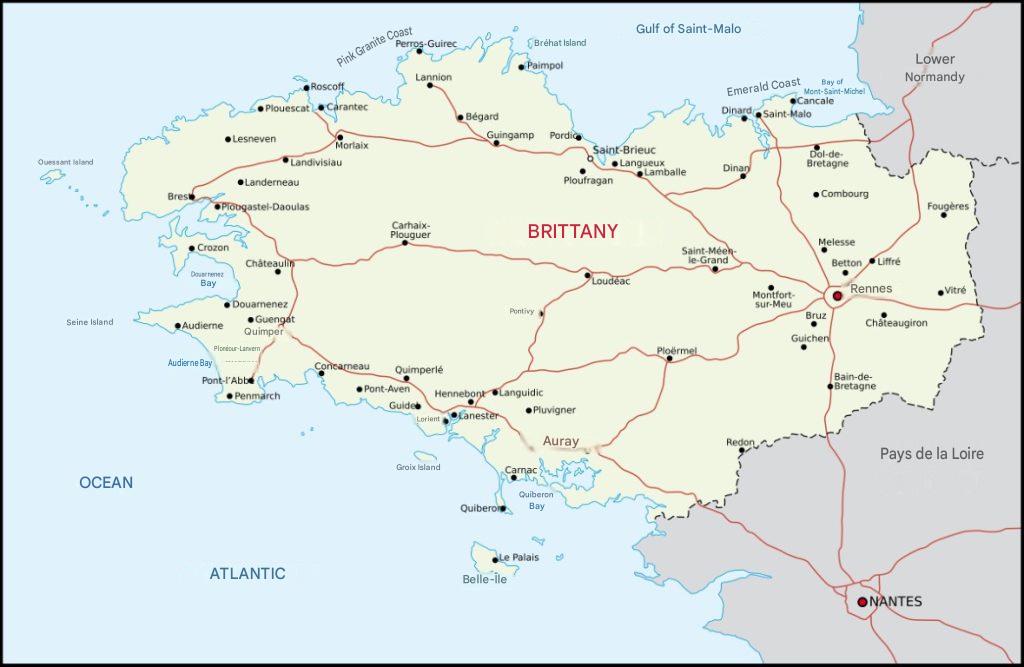
The road networks in Brittany are well developed to facilitate internal travel and connections to other regions. Among the main roads, there are:
- The A84 motorway connecting Rennes to Caen, allowing quick access to Normandy and Hauts-de-France.
- The N165 which crosses the region from east to west from Nantes to Brest, serving important cities such as Lorient and Vannes.
- The N12 connecting Rennes to Brest via Saint-Brieuc, offering an essential link between Upper and Lower Brittany.
The railway network
Brittany also benefits from a dense railway network, with several TGV lines connecting the region to other major French cities. The main stations include those of Rennes, Brest, and Quimper. These connections not only allow efficient transport but also contribute to the economic attractiveness of the region.
Regional airports
Although fewer in number compared to the road and rail networks, airports play a crucial role for tourism and business:
- Rennes-Saint-Jacques Airport, an essential hub for domestic and international flights.
- Brest-Bretagne Airport, facilitating exchanges with the United Kingdom and other European destinations.
- Lorient Bretagne Sud Airport, mainly dedicated to domestic flights.
National parks and nature reserves

Armorique Regional Natural Park
The Armorique Regional Natural Park covers a vast area stretching from the Black Mountains to the Crozon peninsula. The main features of the park include spectacular cliffs, wild moorlands, and dense forests such as the Cranou state forest. Looking at a map, it is easy to spot this park thanks to the biodiversity it protects and the well-marked hiking trails attracting thousands of visitors each year.
Séné nature reserve
The Séné Nature Reserve, located in the Gulf of Morbihan, hosts a lush ornithological wealth. It is a privileged place for nature lovers and bird watchers. Being by the sea, this reserve is clearly identifiable on a map, notably thanks to its salt marshes and wetlands which offer a unique ecosystem.
Rivers and streams in Brittany
The breton rhône: the vilaine
The Vilaine crosses a large part of Brittany, from Juvigné in Mayenne to its mouth at Pénestin in Morbihan. This major watercourse is represented in detail on river navigation maps and is often used for water activities such as canoeing and kayaking. It also plays a vital role in irrigating the surrounding agricultural lands.
The Odet: pearl of Finistère
The Odet originates in the Black Mountains and flows into the Atlantic Ocean at Bénodet. Considered one of the most beautiful rivers in France, it winds gracefully through lush valleys and charming villages. A cruise on the Odet allows admiring the splendor of these natural landscapes directly from the water.
Artificial canals
Besides natural rivers, Brittany has several artificial canals such as the Nantes to Brest canal. Stretching over 360 km, it connects two of the main regional cities and has historically played a major role in the transportation of goods. On a map, this canal is easy to follow, marked by numerous locks and developed waterways.
Using the map to discover Brittany
Trip planning
A map of Brittany is an essential tool for planning any excursion in the region. Whether it is to establish a detailed road itinerary, locate hotels and restaurants, or anticipate distances between different attractions, having an accurate map greatly enriches the travel experience.
Exploring hiking trails
For outdoor enthusiasts, a good topographic map is essential to explore the countless hiking trails in Brittany. From GR® (long-distance hiking paths) to local routes, these paths are generally well marked but sometimes require extra precautions to avoid getting lost.
Using GPS applications
With technological advances, many GPS applications now provide very useful interactive maps for daily navigation. They offer real-time updates on traffic, weather conditions, and points of interest, making travel in Brittany even more convenient and safe.
