
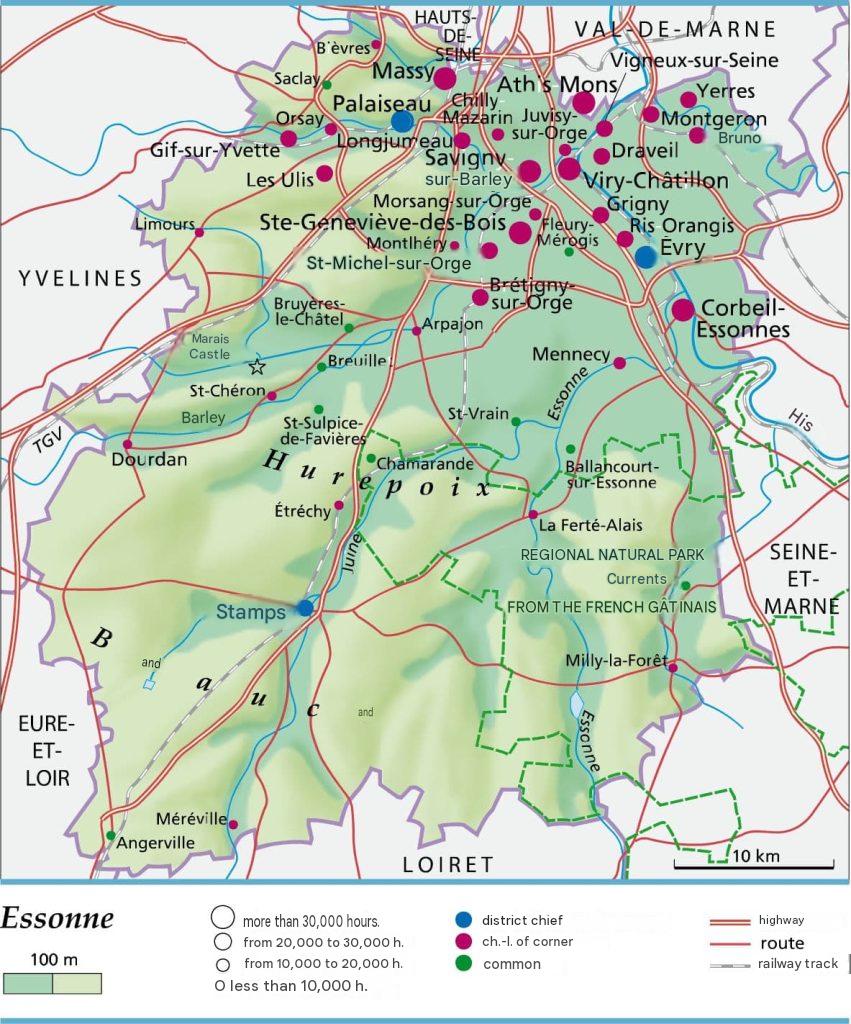
What you need to know about the Essonne department ?
Essonne is located in the Île-de-France region and 40% of its territory belongs to the Paris metropolitan area. Geologically, the area is situated in the Paris Basin. Essonne is a French department located in the Île-de-France region south of Paris. It is partially integrated into the Paris metropolis and is named after the Essonne river, whose course runs through the territory on a north-south axis to join the Seine.
In fact, it is a department that was created after the disappearance of the former Seine-et-Oise territory. According to the Insee and Postal coding, the Essonne department is also the 91st department. So when we talk about the capital of this department, it is also its prefecture and is called Evry-Courcouronnes, its sub-prefectures are called Etampes and Palaiseau.
In demographic terms, the inhabitants of Essonne currently number 1,324,546, and the population density is 734 inhabitants per square kilometre, since the department covers an area of 1,804 km². Administratively, the Essonne department is divided into 3 arrondissements, 10 legislative constituencies, 21 cantons, 9 intermunicipal authorities, and 194 municipalities.

What are the neighboring departments of the Essonne department?
Considering that the Essonne department was once established on the territory occupied by a region of Seine-et-Oise. This is why the departments close to it are: the Yvelines department which borders it to the west.
Next is the Hauts-de-Seine department which borders it to the west-north. To the northeast and north, the Val-de-Marne department. Then, there is a large part of the Seine-et-Marne department which borders the 91 to the east and south. To the south and southwest, there is the fact that the Eure-et-Loir and Loiret departments border it.
What is the climate like in the Essonne department?
When we talk about the 91 department, namely Essonne, it displays a degraded type of climate, in fact, an oceanic type climate. This is mainly the result of the fact that this department is strongly influenced by winds coming from the West and ending in the Southwest. This type of climate is mainly characterized by the fact that there is a lot of rain, which falls about 160 days a year. It is then that we can say that Essonne is one of the least rainy departments in France.
As it is a dry department, we obviously talk about the amount of precipitation which amounts to about 560 mm per year, especially in the part of the department of Brétigny-sur-Orge, but in Nice there is at least 870 mm of rain per year and in Marseille there is 630 mm of rain per year.
When we talk about precipitation, it is well distributed throughout the year. But on the other hand, there are times when precipitation turns into storms, which are brief but very strong. Regarding average precipitation, there are about 20 storm days, 16 days of snow, and 44 days of thick fog. When we talk about sunshine duration, there are about 1,790 hours of sunshine per year.
When we talk about temperature variations, temperatures are generally typical of the Paris basin, which shows temperatures in July from 12 to 24°C on average, from 0 to 6°C in January. But when we talk about temperatures, the minimums hover around 2°C in the northern part of the urban area.
What are the most important cities in the Essonne department?
We have compiled for you the 10 best cities in the Essonne department; these are the 10 most visited tourist cities
- Gif-sur-Yvette
- Palaiseau
- Dourdan
- Orsay
- Epinay-sur-Orge
- Yerres
- Verrières-le-Buisson
- Villebon-sur-Yvette
- Juvisy-sur-Orge
- Évry-Courcouronnes

What are the largest municipalities in the Essonne department?
To establish this ranking, we referred to the area of the municipalities in the Essonne department, so here are the 10 largest municipalities in the 91:
- Étampes
- Milly-la-Forêt
- Morigny-Champigny
- Dourdan
- Chalo-Saint-Mars
- Le Mérévillois
- Angerville
- Maisse
- Bouville
- Boissy-le-Sec
FAQ – Essonne map
A map of Essonne helps you locate the department’s main municipalities, road networks, and natural areas. It also provides a better understanding of its geographical organization.
A map helps you plan your route by identifying towns, roads, and major points of interest. It also makes traveling easier and helps you organize your trip more efficiently.
Yes, it is useful for finding your way, discovering new places, or planning your journeys. It is also an excellent resource for geographic research and educational activities.
