
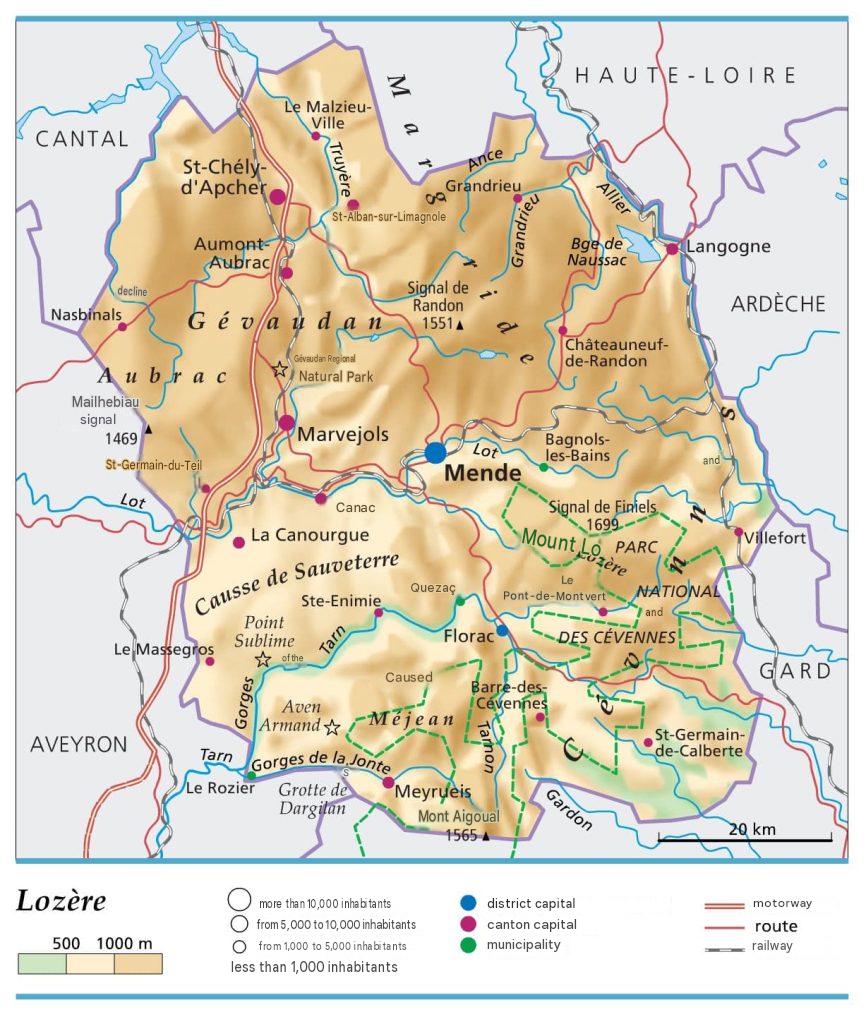
What you need to know about the Lozère department ?
Here is an overview of the Lozère department, which is part of the Occitanie region and is numbered 48. When it comes to population, Lozère remains the least populated department in France, with around 77,829 inhabitants, while its total area is 5,166 km², resulting in a population density of 15 inhabitants per km². The Lozère department takes its name from Mont Lozère and is located at the southern end of the Massif Central.
The capital of this said department is called Mende, and its sub-prefectures are on the other hand. In fact, this department was one of the oldest among the 83 departments created since 1790. Moreover, the territory occupied by the Lozère department was formerly occupied by the canton of Saugues, the canton of Meyrueis, or the canton of Villefort.
It was only recently, that is, at the beginning of 2016, that the Languedoc-Roussillon region merged with Midi-Pyrénées to create the Occitanie region. Indeed, the 48th department is currently divided into 2 arrondissements, 1 legislative constituency, 13 cantons, 10 intercommunalities, and 152 communes.

Which departments border the Lozère department?
Indeed, it is a rural department and its neighbors are the departments of Ardèche bordering it to the west, the department of Aveyron bordering it to the east, the department of Haute-Loire and the department of Cantal. There is also the department of Gard. These neighboring departments of Lozère belong to two specific regions: the Auvergne-Rhône-Alpes Region and the Occitanie region.
What is the climate like in the Lozère department?
Lozère is at 854.54 meters altitude, on the west coast of the ocean, and has a warm climate in summer. The area’s annual temperature of 9.61 degrees Celsius is 2.83% below the French average. Typical annual precipitation in Lozère is about 52.42 mm (2.06 inches), and there are 104.82 rainy days (28.72% of the time). Furthermore, its climate is cold and humid, influenced by the Atlantic Ocean. The northern and northeastern parts of the area contain the Margeride mountains, made of granite at altitudes from 1,000 to 1,550 m. The climate there is also cold but drier than Aubrac with less snowfall.
What are the main cities in the Lozère department?
Here we present the top 10 rankings of the largest and most populated cities in the 48th department.
- Mende
- Marvejols
- Saint-Chély-d’Apcher
- Langogne
- Peyre en Aubrac
- Bourgs sur Colagne
- La Canourgue
- Florac Trois Rivières
- Chanac
- Saint-Alban-sur-Limagnole
What are the largest communes in the Lozère department?
To make this ranking, we referred to the area of each commune in the Lozère department.
- Meyrueis
- Pont de Montvert – Sud Mont Lozère
- Gorges du Tarn Causses
- Vebron
- Grandrieu
- La Canourgue
- Hures-la-Parade
- Chanac
- Arzenc-de-Randon
- Nasbinals

During the current second ranking of the communes of Lozère, we grouped them according to the density of inhabitants per km2.
- Mende
- Saint-Chély-d’Apcher
- La Canourgue
- Saint-Alban-sur-Limagnole
- Montrodat
- Marvejols
- Langogne
- Florac Trois Rivières
- Chanac
- Peyre en Aubrac
FAQ – Lozère map
A Lozère map helps locate the department’s main cities, roads, and administrative boundaries. It also provides an overview of plateaus, mountains, rivers, and neighboring municipalities.
A map is useful for planning a trip, organizing a route, or finding a specific location. It also helps users better understand the department’s geography and natural features.
A detailed Lozère map is available in printed form from certain organizations or in digital format on various specialized platforms. It may include municipalities, road networks, landforms, and the department’s main points of interest.
