
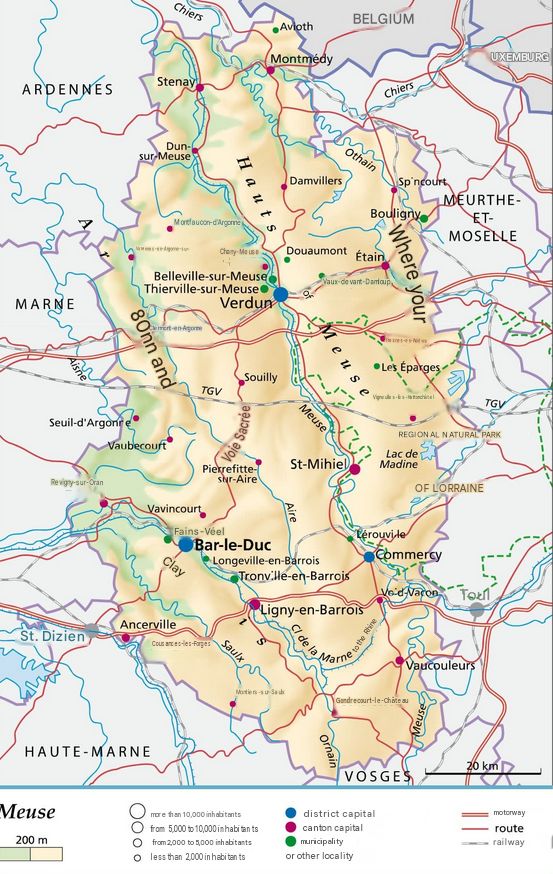
What you need to know about the Meuse department ?
We are here to introduce the Meuse, also known as the French department 55. Administratively, this department is part of the Grand Est region. Furthermore, the department is managed by a departmental council. The inhabitants of the Meuse currently number 180 745, covering a surface area of 6,211 square kilometers. This results in a density of 29 inhabitants per square kilometer. Furthermore, administratively, the Meuse department is divided into arrondissements, legislative constituencies, cantons, intercommunal entities, and communes, with 3, 2, 17, 15, and 499 respectively. Geographically, the Meuse is located in the eastern part of the Paris Basin.

What are the neighboring departments of the Meuse department ?
Since the Grand Est region is the region to which the Meuse department belongs, this said department has neighbors such as the Vosges department, the Meurthe-et-Moselle department, the Haute-Marne department, the Ardennes department, and the Marne department. But this said department also shares a border with Belgium.
What are the most important cities in the Meuse department ?
Here are the most important cities in the Meuse department, that is to say in terms of area and population density per km2 :
- Saint-Mihiel
- Commercy
- Ligny-en-Barrois
- Etain
- Revigny-sur-Ornain
- Verdun
- Bar-le-Duc
- Vaucouleurs
- Montmédy
- Stenay
On the other hand, here are the top cities in terms of tourist visits in the Meuse department :
- Bar-le-Duc
- Verdun
- Ornes
- Girauvoisin
- étain
- Verneuil-Petit
- Villers-Sous-Pareid
- Saint-Mihiel
- Commercy
- Vauquois
- Belleville-sur-Meuse
What is the climate like in the Meuse department ?
Instead, the climate of the Meuse is classified as a continental-oceanic climate. This is defined by the fact that there are winters and summers, with intermediate periods between the two. The latter is characterized by moderate rainfall and variable temperatures.
Also, regarding rainfall, it is variable, with an annual rainfall of about 900 mm. In contrast, the eastern region receives less precipitation, namely the Woëvre (850 mm per year) compared to the central region (that is to say the Barrois region). Moreover, the region receives 1000 mm of precipitation per year.
Furthermore, some classifications indicate that the Meuse has a temperate climate with intermittent warm seasons. Additionally, some parts of the Meuse receive on average 800 mm of precipitation per year. This is mainly seen in areas close to the Paris Basin and the Plain. This means that all these areas of the sector are different.
There are also climate consolidation events due to the fact that there is continentality in the middle of winter. This is due to the presence of a high-pressure system, which lowers the temperature and causes strong frosts, which are intensified especially by north-east to west winds. During this period, sunshine is still abundant, interrupted by short heat waves. Moreover, winters are short and summers often stormy.
What are the most important municipalities in the Meuse department?
To make this ranking, we referred to the size of each of the municipalities in the Meuse department.
- Municipalities
- Clermont-en-Argonne
- Vigneulles-lès-Hattonchâtel
- Les Hauts-de-Chée
- Dainville-Bertheléville
- Mouzay
- Vigneulles-lès-Hattonchâtel
- Gondrecourt-le-Château
- Montiers-sur-Saulx
- Vaucouleurs
Regarding this second ranking of the municipalities of the Meuse, we grouped them according to the density of inhabitants per km2.
- Verdun
- Commercy
- Ligny-en-Barrois
- Belleville-sur-Meuse
- Thierville-sur-Meuse
- Bar-le-Duc
- Saint-Mihiel
- Étain
- Revigny-sur-Ornain
- Ancerville

FAQ: Meuse map
The Verdun memorial site bears witness to the significant history of the Great War. The citadel of Montmédy also offers an impressive architectural discovery.
Spring is perfect for exploring the lush landscapes and mirabelle plum orchards. Summer allows you to enjoy the Madine lake with the family.
A car is essential for freely traveling through the countryside and historical sites. The departmental bus network connects the main towns to the TGV stations.
