
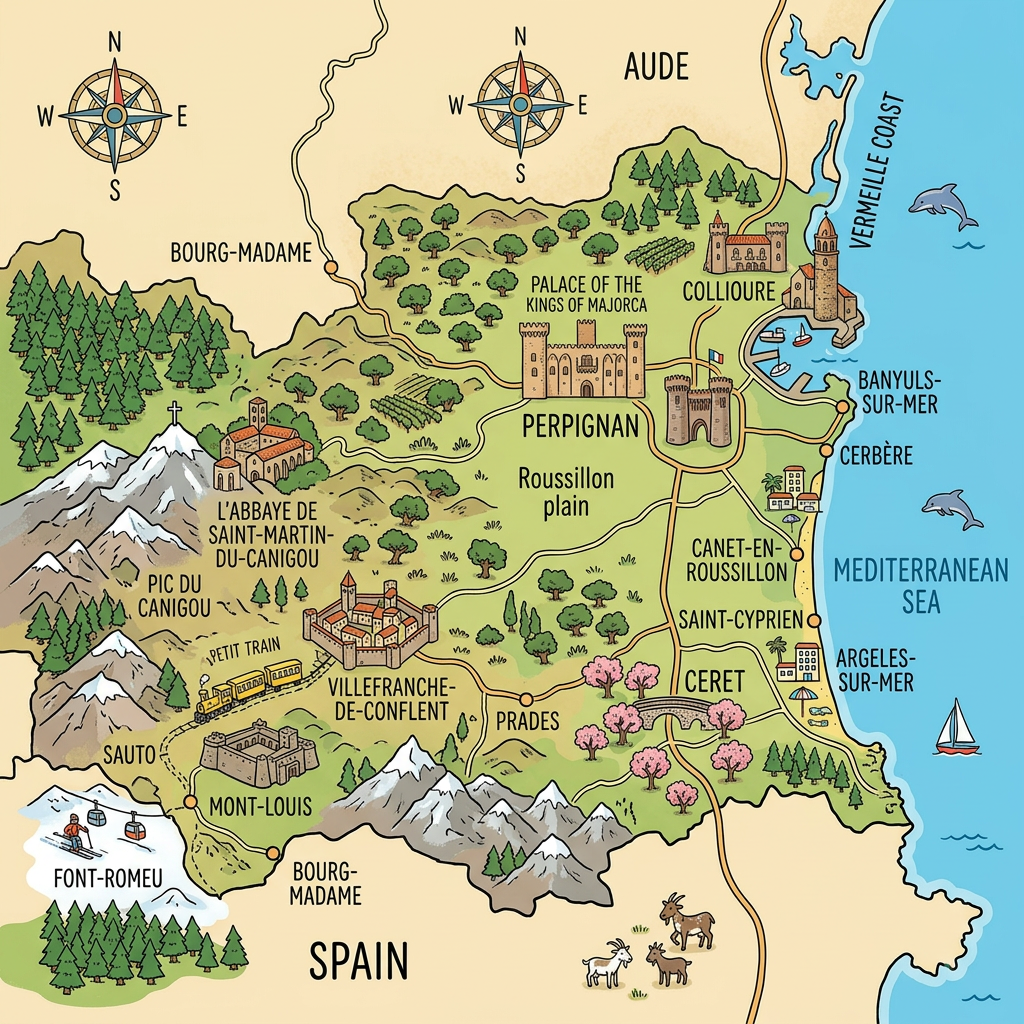
What you need to know about the Pyrénées-Orientales department ?
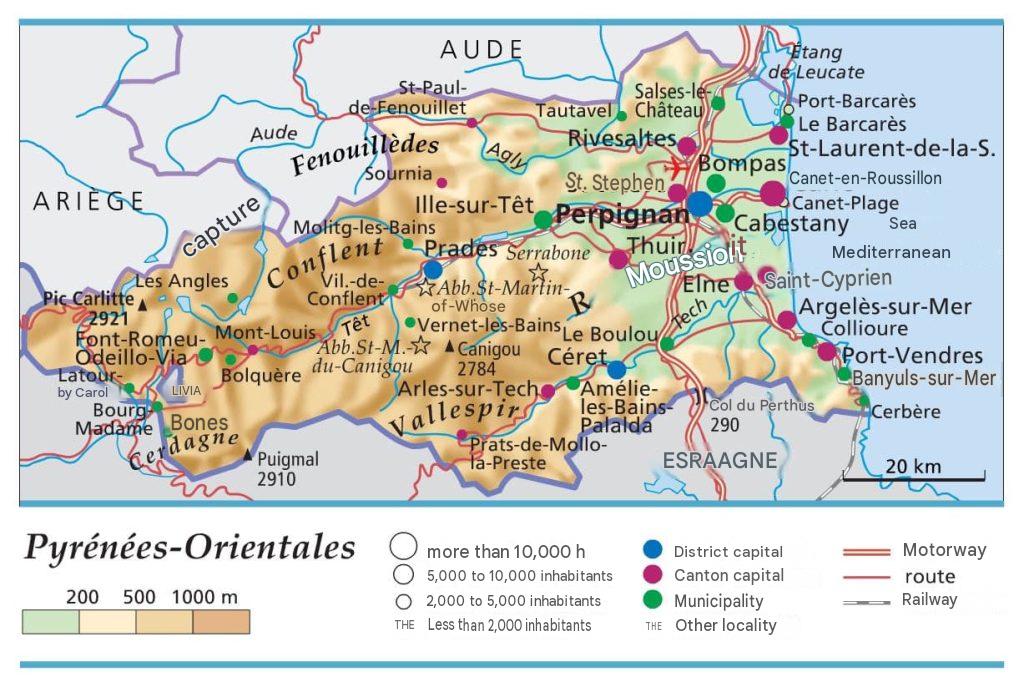
We will present to you here a French department located in the southern section of France. This department, numbered 66, is part of the Occitanie region. Moreover, it is one of the oldest departments dating back to before 1790. Furthermore, the prefecture of department 66, which is also the capital, is called Perpignan. However, its sub-prefectures are called Prades and Céret.
Demographically, the department has 490,896 inhabitants, also known as Nord-Catalans, Roussillonnais, or Catalans. The surface area of the department is 4,116 km², which indicates that the population density is 119 inhabitants per km². Finally, regarding administrative subdivisions, department 66 is divided into 3 arrondissements, 4 legislative constituencies, 17 cantons, 12 intercommunal entities, and 226 communes.

Which departments border the Pyrénées-Orientales department?
Geographically, the Pyrénées-Orientales department, located in the south of France, has several neighboring departments, notably the department of Aude which borders it to the northern section. Then, there is the department of Andorra and the department of Ariège which border it in its western section.
What is the climate like in the Pyrénées-Orientales department?
The Roussillon plain mainly displays a severe Mediterranean climate type, characterized by a cold but bearable period; a summer drought (in the Gaussen sense) that lasts somewhat, and very extreme autumnal precipitation. Along the constraints of the plain, and up to the tributaries of all the main rivers, a consistency of climate is observed: the late spring drought is of shorter duration and temperatures are a bit higher.
The topography and geology of said department 66 are the origin of a dual climatic impact:
- Mediterranean-type impact, mainly marked by mild temperatures and repetitive summer drought;
- Geological-type impact: due to the impressive mountains that hinder the circulation of air masses.
Annual precipitation is about 500 to 650 mm (exceeding 800 mm in the Albères) but only 15% falls throughout the period following the end of spring, which is characteristic of a dry period of 3 months.
The annual temperature generally ranges between 13 and 15°C, especially for the hot summer period (about thirty days per year when the temperature exceeds 30°C).
The recurrence of strong breezes is also characteristic (about 130 days a year with a breeze speed greater than 16 m/s) with a predominance of the tramontane, drying the climate.
What are the most important cities in the Pyrénées-Orientales department?
The cities we present to you are the most populated and largest cities in the Pyrénées-Orientales department:
- Perpignan
- Canet-en-Roussillon
- Saint-Estève
- Saint-Cyprien
- Argelès-sur-Mer
- Saint-Laurent-de-la-Salanque
- Cabestany
- Pia
- Rivesaltes
- Elne
What are the largest municipalities in the Pyrénées-Orientales department?
To make this ranking, we referred to the area of each municipality in the Pyrénées-Orientales department:
- Prats-de-Mollo-la-Preste
- Mosset
- Perpignan
- Fontpédrouse
- Tautavel
- Angoustrine-Villeneuve-des-Escaldes
- Salses-le-Château
- Porta
- Argelès-sur-Mer
- Py
Regarding this second ranking of the municipalities in the Pyrénées-Orientales department, we grouped them according to the population density per km²:
- Perpignan
- Saint-Estève
- Argelès-sur-Mer
- Saint-Laurent-de-la-Salanque
- Céret
- Canet-en-Roussillon
- Saint-Cyprien
- Cabestany
- Rivesaltes
- Elne

FAQ: Pyrénées-Orientales map
The Salses fortress is a unique historical monument that is an absolute must-see. Collioure charms every visitor with its colorful port and exceptional light.
Spring is ideal for enjoying the hiking trails in the Albères mountains. Summer allows you to enjoy beach activities and Mediterranean evenings.
A car is recommended for exploring mountain villages and the rocky coast. The tourist train on the Cerdagne line also offers a magnificent journey.
