
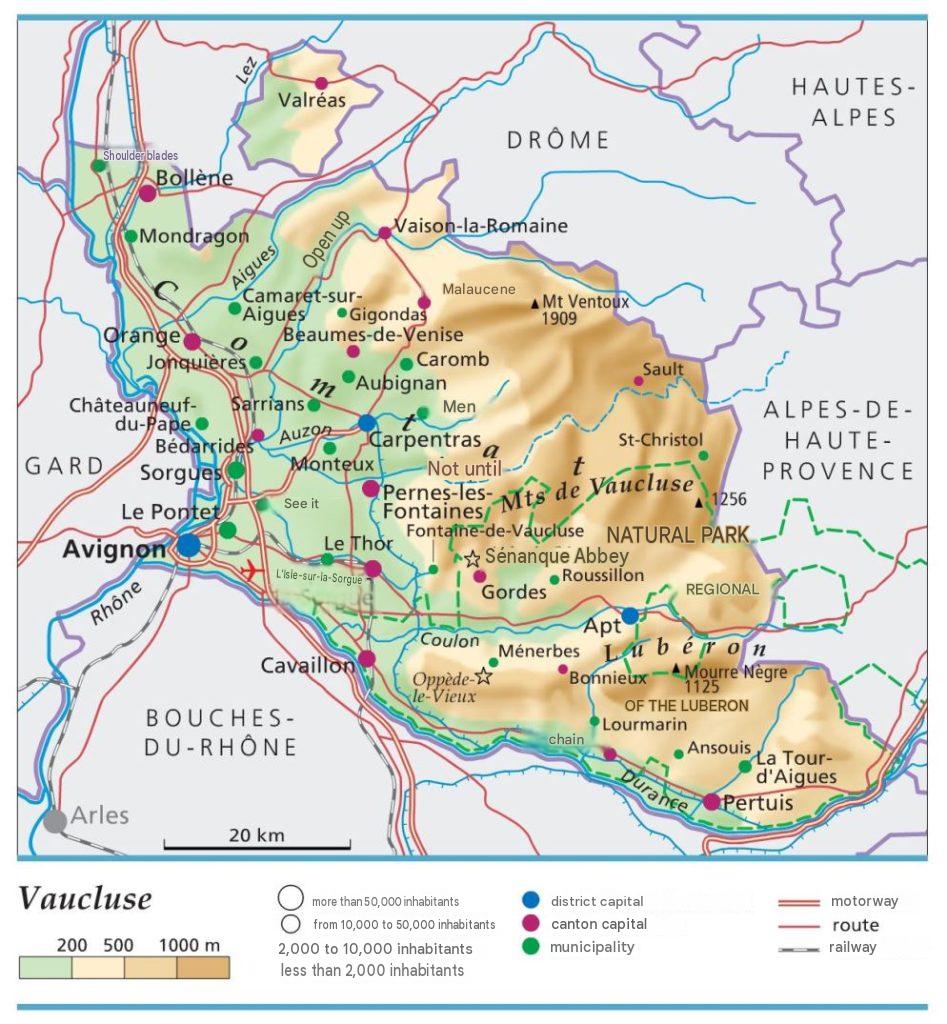
What you need to know about the Vaucluse department?
We are currently presenting a department that is part of the Provence-Alpes-Côte-d’Azur region. It is the department number 84 in France, also known as the Vaucluse department. This department’s name means “the enclosed valley” in Latin. Furthermore, the fact is that the Vaucluse department has a prefecture which is also its administrative center named Avignon. Its sub-prefectures number two and are Apt and Carpentras.
Demographically, the Vaucluse department has 566,569 inhabitants, known as Vauclusiens, with a density of 161 inhabitants per km²; the reason is that the department’s surface area is 3,567 km². Administratively, the Vaucluse department is divided into 3 arrondissements, 5 legislative constituencies, 17 cantons, 13 inter-municipal cooperation structures, and 151 communes.

What are the neighboring departments of the Vaucluse department?
Indeed, the region to which the Vaucluse department belongs is the Provence-Alpes-Côte-d’Azur region (located in the southeastern part of the country). Its neighboring departments are the Gard department to the west, the Ardèche department to the northwest, and the Drôme department to the north. The Vaucluse department is also bordered by Alpes-de-Haute-Provence and Var as well as the Bouches-du-Rhône department.
What is the climate like in the Vaucluse department?
When talking about the climate of the Vaucluse department, it is actually a Mediterranean-type climate. However, it is known that this climate is somewhat continental. The fact is that the department is located in the Provence relief, that is, the Vaucluse mountains and the Baronnie massif.
The climate is therefore strongly defined by:
- Temperature variability with drops of around 18°C per year.
- There is also variability in precipitation, meaning that for about 80 days, rain constantly falls in the form of showers during the spring and autumn periods.
- Comparing the climate of this department with the rest of the French territory, it is observed that summer periods are drier and hotter in Vaucluse. Conversely, the winter periods can be milder and softer, despite the Mistral wind blowing strong winds 100 days a year.
Avignon
In this part of the department, there are 45 days where rainfall occurs at a rate of 2.5 liters per m2. This is the quantification of precipitation (amount of rain and snow). In Avignon, temperatures can reach 40.5°C during heatwaves, that is, in the summer period. Temperatures are extremely low in winter, they can reach -12°C.
Carpentras
It is a commune located in the Mediterranean part of department 84. Its climate is marked by 4 types of climate, namely, a double dry season. The first occurs during the winter period and the second is much longer and takes place during the summer period.
Then, there is also a double rainy season, first there is the autumn season which shows a lot of rain. Then, there is the spring period which mainly features a hot and dry summer, which favors the occurrence of anticyclones and electrical storms that can be very strong. On the other hand, the winter periods are mild and there is a lot of precipitation in this area although it rarely snows.
What are the most important cities in the Vaucluse department?
Indeed, we have made this list of the 10 most visited cities by tourists in the 84 department or Vaucluse.
- Avignon
- Orange
- L’Isle-sur-la-Sorgue
- Monteux
- Vaison-la-Romaine
- Pertuis
- Bédarrides
- Cavaillon
- Carpentras
- Le Pontet
What are the largest municipalities in the Vaucluse department?
To establish this ranking, we referred to the area of the municipalities in the Vaucluse department, so here are the 10 largest municipalities in the 84.
- Sault
- Bédoin
- Saint-Saturnin-lès-Apt
- Orange
- Pertuis
- Avignon
- Cheval-Blanc
- Valréas
- Beaumont-de-Pertuis
- Bollène

FAQ: Vaucluse map
The Ventoux tourist office and the departmental website offer detailed maps suitable for hiking and cycling. These resources allow you to plan your routes while accounting for the significant elevation gain.
Yes, tourist maps showcase picturesque villages and must-see historical sites. You will also find route suggestions there to explore the landscapes of the Luberon.
Tourist offices publish specific plans for scenic routes to discover lavender fields during the season. These documents make it easy to navigate between the most iconic growing areas in the department.
